Tokyo is a city of endless discovery, and the Tokyo subway network is the heartbeat that connects it all. To truly experience the city's vibrant neighborhoods, mastering its underground arteries is essential. For first-time visitors, Tokyo’s rail network may look complex, but it’s actually designed for speed and convenience. With hundreds of stations and clear signage, travelers can reach major attractions, shopping areas, and business districts with ease once they know the basics. This guide walks you through ticket options, station navigation, route planning, and operating hours, helping you move through Tokyo like a local and spend less time lost and more time exploring.
Tokyo Subway Overview
Tokyo’s subway system is one of the most advanced and efficient urban rail networks in the world, serving millions of passengers every day. It is operated by two separate companies — Tokyo Metro and Toei Subway — which together form what travelers commonly call the Tokyo Subway. The network connects major business districts, shopping areas, and tourist attractions such as Shibuya, Shinjuku, Ginza, Asakusa, Ueno, Roppongi, and Ikebukuro, making it the fastest and most convenient way to get around central Tokyo.
Tokyo Metro focuses on the city center with 9 color-coded lines, while Toei Subway complements it with 4 lines that reach additional neighborhoods and transfer points. Each line uses clear colors, letters, and station numbers, allowing visitors to navigate easily even without Japanese language skills.
🔺 Key Features & Characteristics:
-
Extensive & Dense Network: Over 300 stations across 13 lines, covering nearly every major district in central Tokyo.
-
Flawless Integration: Subways seamlessly connect with:
-
JR East's Yamanote Line (the vital above-ground loop connecting major hubs like Shinjuku, Shibuya, Tokyo, Ueno, Ikebukuro).
-
Private Railways (Tobu, Keio, Odakyu, etc.) that extend to suburbs.
-
-
Precision Punctuality: Famous for being on time to the second. Delays are rare and announced with apologies.
-
Peak Hour Crowding: Morning rush hours (7:30-9:30 AM) on major lines can be extremely crowded. Station staff (oshiya or "pushers") are sometimes used.
-
Cleanliness & Safety: Immaculately clean, safe, and quiet. No eating or loud talking is the social norm.
-
Excellent Signage: Stations have clear signage in Japanese and English. Color-coded lines and alphanumeric station codes (e.g., Roppongi: H-04, E-23) make navigation foolproof.
🔺The Two Main Subway Operators:
1. Tokyo Metro (東京メトロ)

The primary operator. Its lines (like the Ginza, Marunouchi, and Shibuya lines) cover most of central Tokyo’s tourist and business hubs.
🚇 Lines include:
Tokyo Metro operates 9 color-coded subway lines (Ginza, Marunouchi, Hibiya, Tozai, Chiyoda, Yurakucho, Hanzomon, Namboku, Fukutoshin) that connect major districts such as Shibuya, Shinjuku, Ginza, Asakusa, Ueno, Akihabara, Ikebukuro, Roppongi, and Tokyo Station areas. These lines form the backbone of public transportation for both commuters and travelers.
Each Tokyo Metro line is marked with a color, letter, and station number, making navigation easy even for first-time visitors. For example, G-09 means Ginza Line, station number 9.
|
Line Name |
Letter |
Color |
Key Destinations |
|
Ginza |
 |
Orange |
Shibuya, Ginza, Ueno, Asakusa |
|
Marunouchi |
 |
Red |
Shinjuku, Tokyo Station, Ikebukuro |
|
Hibiya |
|
Silver |
Roppongi, Tsukiji, Akihabara |
|
Tozai |
|
Sky Blue |
Nakano, Nihonbashi, Chiba area |
|
Chiyoda |
|
Green |
Omotesando, Akasaka, Yushima |
|
Yurakucho |
|
Gold |
Ikebukuro, Ginza-itchome, Toyosu |
|
Hanzomon |
 |
Purple |
Shibuya, Omotesando, Oshiage (Skytree) |
|
Namboku |
|
Emerald |
Meguro, Iidabashi, Akabane-iwabuchi |
|
Fukutoshin |
|
Brown |
Ikebukuro, Shinjuku-sannchome, Shibuya |


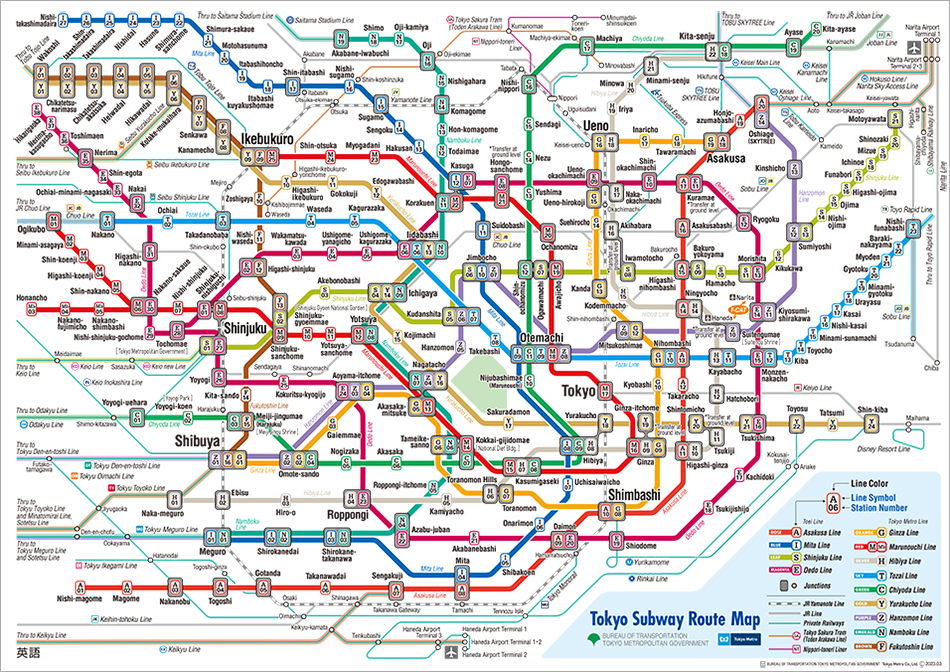
>>Click here for more station informations
2. Toei Subway (都営地下鉄)

While Tokyo Metro is a private corporation, Toei Subway (都営地下鉄) is the government-run counterpart. It is operated by the Tokyo Metropolitan Bureau of Transportation, an agency of the city government.Although it only has 4 lines compared to the Metro's 9, Toei's lines are often more spacious and provide critical connections to major airports and the city's perimeter.
🚇 Lines include:
Each line is identified by a Letter, a Color, and a Number.
|
Line Name |
Letter |
Color |
Key Destinations |
|
Asakusa |
|
Rose |
Asakusa, SkyTree (Oshiage), Ginza (Higashi-ginza), direct to Haneda/Narita |
|
Mita |
|
Blue |
Meguro, Hibiya, Otemachi (Tokyo Station area), Sugamo |
|
Shinjuku |
|
Leaf Green |
Shinjuku, Ichigaya, Jimbocho (Book district) |
|
Oedo |
|
Magenta |
Roppongi, Tsukiji Market, Shinjuku, Ryogoku (Sumo) |


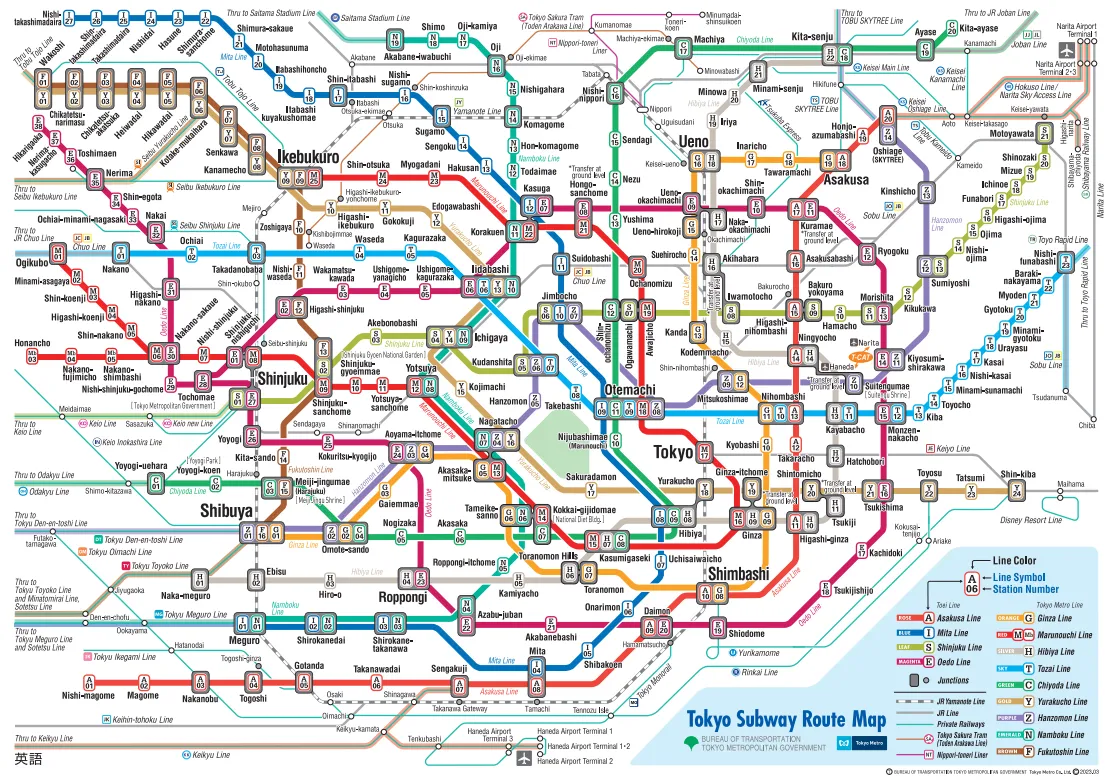
>>Click here for more station informations
‼️ Tokyo Metro vs. Toei Subway:
|
Feature |
Tokyo Metro |
Toei Subway |
|
Operator |
Private company (partially gov't-owned) |
Tokyo Metropolitan Government |
|
Number of Lines |
9 lines |
4 lines |
|
Fare System |
Separate, but integrated with IC cards |
Separate, but integrated with IC cards |
|
Primary Coverage |
Extensive network in central commercial & business cores |
Often serves as important connectors and loops (like the Oedo Line) |
|
Train Frequency |
Very frequent |
Frequent |
|
Day Passes |
Offers its own 24-hour ticket |
Offers its own 24-hour ticket |
|
Airport Links |
Limited |
Better via Asakusa Line |
|
Visual Identity |
Modern, sleek station designs |
Slightly more utilitarian feel |
Most locals don't think of them as "Toei" or "Metro"—they just look for the line color and letter on Google Maps. However, if you are staying in areas like Asakusa, Roppongi, or Shinjuku, you will likely find yourself using Toei lines more frequently.There are a few practical differences to keep in mind:
-
Separate Fares: If you buy a paper ticket for a Tokyo Metro line, it won't work on a Toei line unless you buy a "Transfer Ticket."Most locals and tourists use an IC Card (Suica or Pasmo) or the Tokyo Subway Ticket, which seamlessly covers both operators.
-
The Oedo Line (The Deep One): This is Tokyo’s newest and deepest subway line. It forms a massive "6-shaped" loop around the city. Because it is so deep underground, transfers can take 5–10 minutes just to reach the surface or the next platform.
-
The Asakusa Line (The Airport Link): This is arguably the most useful line for tourists. Many trains "seamlessly" turn into the Keikyu Line (to Haneda Airport) or the Keisei Line (to Narita Airport), meaning you can often get to the airport without changing trains.
-
Wider Trains: Some Toei lines (like the Shinjuku and Mita lines) use a different track gauge than the Metro, resulting in slightly wider and more spacious train cars.
Ticket Type & Pricing
1. Regular Paper Tickets (Distance-Based)
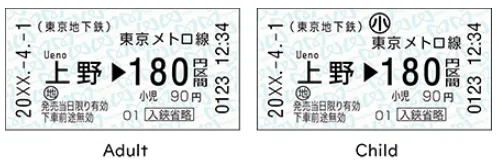
How to Buy: At ticket vending machines. Use the fare map above the machine to find the price to your destination station, press the button for that amount, then insert cash.
Price: The fare is calculated based on the distance you travel.If you underpay, you must use a "Fare Adjustment Machine" (精算機 / seisan-ki) near the exit gates to pay the difference before exiting.
-
1–6 km: ~¥180 (Adult) / ¥90 (Child)
-
7–11 km: ~¥210 / ¥110
-
12–19 km: ~¥260 / ¥130
-
20–27 km: ~¥300 / ¥150
-
28–40 km: ~¥330 / ¥170
How to Use: Insert the ticket into the gate slot to enter and exit (the machine keeps it).
Best For: One-off trips if you don't have an IC card.
If you use an IC card (Suica/PASMO), fares are slightly cheaper and charged to the balance.For most tourists, using a physical paper ticket for every ride is the least efficient method.
2. IC Cards (Suica, PASMO, Welcome Suica)
Suica and Pasmo are functionally identical in the Tokyo area. They work on ALL Tokyo Metro, Toei Subway, JR trains, buses, and even for small purchases at convenience stores and vending machines.These IC cards use a "1-yen unit" fare system, which is often a few yen cheaper than paper tickets.For example, a ¥180 paper ticket costs ¥178 when using an IC card.
How to Buy: Purchase from ticket vending machines at any major station.
Card Price:
-
Standard Suica/PASMO: ¥2,000 (includes a ¥500 refundable deposit and ¥1,500 usable credit).
-
Welcome Suica / PASMO Passport: ¥1,500 (This is a tourist-only card with no deposit; the full ¥1,500 is usable credit).
How to Use: Simply tap the card on the reader at the gate to enter and exit. The correct fare is deducted automatically.
Best For: Recommended if you're staying longer and want simple payment without buying tickets each time.
If you have an iPhone or Apple Watch, you can add a Suica or Pasmo directly to your Apple Wallet for free. You can top it up instantly with your credit card.
3. Special Passes & Discount Tickets
A. For Tourists: The Best Value
-
-
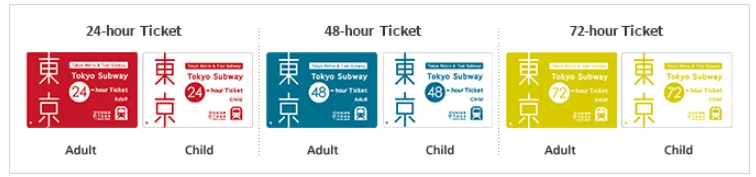
What it is: Unlimited rides on ALL Tokyo Metro and Toei Subway lines for a set period.
-
Prices:
-
24-hour ticket: ¥800
-
48-hour ticket: ¥1,200
-
72-hour ticket: ¥1,500
-
-
How to Buy: Exclusively for foreign passport holders (tourists) at airports (Haneda/Narita) and some tourist information centers. It is almost never sold at regular subway stations.You can also buy the Tokyo Subway Ticket online from KKday, Klook and Trip.com before travel.
-
Best For: Tourists planning intense subway use within a day. Calculate if it's worth it – you need to take about 3-4 trips per day to break even.
-
B. For Residents & Long-Term Visitors
-
-
Unlimited rides on Tokyo Metro lines only for 24 hours.
-
Price: ¥700 for adult. Sold at Tokyo Metro station machines.
-
-
-
Unlimited rides on Toei Subway lines, Toei Buses, Toei Streetcars (Toden), and the Nippori-Toneri Liner for one day.
-
Price: ¥700 for adult. Sold at Toei station machines.
-
-
1 Day Ticket for Toei Subway and Tokyo Metro:
-
Unlimited use of Toei Subway and Tokyo Metro for one day.
-
Price: ¥900 for adult. Available at automatic ticket vending machines at all Toei Subway and Tokyo Metro stations.
-
-
Commuter Passes (定期券 / Teikiken):
-
A monthly or quarterly pass for a fixed route between two stations. Offers significant discounts for regular commuters.
-
Requires registration at ticket offices. Can be loaded onto an IC Card.
-
🔔 Tips on Choosing Tickets:
✅ If you’re in Tokyo for sightseeing (many subway trips): Get a Tokyo Subway Ticket (24/48/72-hour pass) — simplest and often cheapest.
✅ If you’re staying a week or longer: Use an IC card (Suica/PASMO) — convenient for metro, other trains, buses, and even stores.
✅ If you only need a few rides:Just buy single tickets at the machine.
‼️ Important Price & Age Rules
-
Infants (Under 1): Always free.
-
Toddlers (1–5): Up to two toddlers can travel for free with one paying adult.
-
Children (6–11): Pay roughly 50% of the adult fare.
-
The "Transfer Discount": If you use an IC card to transfer between a Tokyo Metro line and a Toei line within 60 minutes, you receive a ¥70 discount automatically.
Operating Hours & Timetable
Tokyo's subway operates like a precision instrument. Unlike some cities with 24-hour service, Tokyo’s trains take a "breather" in the middle of the night for maintenance.Here's a clear guide to Tokyo Subway Operating Hours & Timetable for Tokyo Metro and Toei Subway — essential info for planning your rides in Tokyo.
1. General Operating Hours
-
First Trains: Generally depart between 5:00 AM and 5:30 AM from terminal stations.
-
Last Trains: Generally arrive at their final terminal between 12:00 AM (Midnight) and 1:00 AM. The last train to leave a central station (like Shinjuku or Tokyo) is typically shortly before midnight.
-
Rush Hour Peak: The most intense crowding is on weekdays from 7:30 AM to 9:30 AM (inbound toward central Tokyo) and 5:30 PM to 7:30 PM (outbound).
-
Variations:
-
Weekdays vs. Weekends: Last departure times can be slightly later on weekends/holidays than on weekdays.
-
Holiday/Seasonal Schedules: Schedules can change during holidays and special events — always check an app or official timetables.
-
⚠️ Crucial: The "last train" (shuden) varies by station. A train might leave Shinjuku at 12:10 AM, but it may only go halfway down the line.
2. Frequency (How long is the wait?)
You rarely need to look at a timetable in Tokyo because the frequency is so high.
-
Rush Hour (7:30–9:30 AM / 5:30–7:30 PM): Trains arrive every 2 to 3 minutes.
-
Mid-day / Off-peak: Trains arrive every 5 to 7 minutes.
-
Late Night (After 10:00 PM): Frequency drops to every 10 to 12 minutes.
3. How to Check Real-Time Data?
For the most accurate "right now" information, use these tools:
-
Google Maps (iOS / Andriod) or Apple Maps: The most practical tool for real-time planning. Enter your destination, select the transit icon, and it will give you:
-
Optimal route with line colors and numbers.
-
Exact departure and arrival times.
-
Platform numbers and specific exit advice.
-
"Last Train" warnings if relevant.
-
-
Japan Travel by Navitime App: Offers more detailed train-specific search filters and can account for your IC card balance.
-
Official Operator Apps: Tokyo Metro and Toei have their own apps (Tokyo Metro Subway, Toei Subway) with downloadable timetables and route maps.
Essential Tips for Visitors
-
Avoid Rush Hour: Peak times are 7:30–9:30 AM and 5:30–7:30 PM. Avoid these if you have large luggage or want to breathe.
-
The Alpha-Numeric Code: Every station has a letter and a number (e.g., G-16 for Ginza). Follow these on signs rather than trying to read the Kanji or long names.
-
The "Yellow Signs": Once you get off a train, look for the bright yellow signs on the pillars. They list every major landmark and exactly which exit number (e.g., Exit B2) will put you closest to it.
-
Google Maps is King: It tells you exactly which car to board for the fastest transfer and which exit number (e.g., "Exit A3") puts you closest to your destination.
-
Unspoken Etiquette:
-
Backpacks: In crowded cars, wear your backpack on your front or place it between your feet.
-
The Silent Rule: Talking on the phone is a major faux pas. Keep conversations at a whisper.
-
Escalators: In Tokyo, stand on the left, walk on the right. (Note: This is the opposite in Osaka!)
-
Tokyo Subway FAQ
Is Tokyo Metro the same as JR?
No. JR lines are separate (like Yamanote Line). Subway passes don’t cover JR.
Can tourists use Suica/PASMO?
Yes. Physical cards or mobile versions work perfectly for visitors.
Are there English signs and announcements?
Yes. All major stations provide English, Chinese, and Korean signage, ticket machines in English, and bilingual train announcements.
Is Tokyo subway hard to use?
Surprisingly easy thanks to color-coded lines, station numbers, and clear signs.
What is the best ticket for visitors?
If you're sightseeing a lot, the best option is the Tokyo Subway Ticket (24/48/72-hour pass) for unlimited rides on both Tokyo Metro and Toei Subway. For longer stays, an IC card is more flexible.
Can I bring luggage on the subway?
Yes, but avoid rush hours (7:30–9:30 AM, 5:30–7:30 PM). Use elevators where available and keep suitcases out of aisles. Large luggage is allowed but can be inconvenient during peak times.
Does the Tokyo Subway go to the airports?
Not directly to both.
-
Haneda Airport → Accessible via Toei Asakusa Line (through Keikyu).
-
Narita Airport → Mostly via JR or Keisei, not pure subway.
The subway connects with airport rail lines easily.
Can I eat or drink on the subway?
-
Eating: It is generally frowned upon to eat on local subway trains. Because the seats face each other and the cars can be crowded, eating is seen as a nuisance.
-
Drinking: Taking a quick sip of water or a soft drink from a resealable bottle is perfectly fine. However, avoid drinking from open cups (like takeout coffee) or drinking alcohol.
-
The Rule of Thumb: If the train has a pull-down tray (like the Shinkansen or Limited Express), eating is expected. If it's a bench-seat commuter train, wait until you reach the station.
Is there free Wi-Fi?
Yes, but it requires a quick registration.
-
Tokyo Metro: Look for the SSID "Metro_Free_Wi-Fi".
-
Toei Subway: Look for the SSID "Toei_Subway_Free_Wi-Fi".
You usually have to register your email address. For a seamless experience, many travelers use the "Japan Wi-Fi auto-connect" app, which logs you into these networks automatically as you enter the station.
What do I do if I lose something?
Tokyo has one of the best lost-and-found systems in the world.
-
Same Day: Go to the nearest station office (Station Control Room).
-
After 24 Hours: Items are moved to a centralized center.
-
Tokyo Metro: The main center is at Iidabashi Station (Namboku Line).
-
Toei Subway: Check the Toei Transportation Customer Center.
-
-
Pro Tip: Be prepared to describe your item in detail. If you lost a phone, they will often ask for the brand, color, and even the lock-screen wallpaper.