From the vibrant yatai food stalls of Hakata to the volcanic landscapes of Kagoshima, Kyushu offers an unforgettable blend of urban energy and natural beauty. But to truly explore like a local, you need more than just a map—you need the right travel pass. The JR Kyushu Sugoca card is the key to unlocking the region's vast transportation network without the hassle of calculating individual fares. Far more than just a train ticket, this versatile e-money tool simplifies your transit across subways, buses, and even private railways. In this guide, you’ll learn everything you need to know about using Sugoca in Kyushu — from where travelers can obtain one, how to reload balance, and where it works, to important tips for refunds before leaving Japan. Whether you’re exploring Hakata, hopping on JR trains, or visiting hot spring towns, this article helps you travel faster, cheaper, and with less hassle.
What Is SUGOCA?
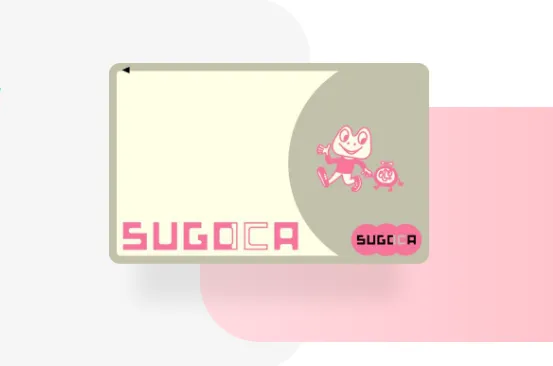
Launched by JR Kyushu in 2009,SUGOCA(スゴカ) is a rechargeable contactless smart card for public transport, primarily in Japan's Kyushu region (around Fukuoka), used on JR trains, buses, and subways, and for shopping/vending machines, featuring a frog mascot.Although SUGOCA is issued in Kyushu, it works in most major cities across Japan wherever IC cards like Suica, PASMO, or ICOCA are accepted. This makes it ideal not only for exploring Kyushu, but also for continuing your journey to Tokyo, Osaka, or other regions without switching cards.
🔺 Key Features:
-
Convenient Travel: Tap to pay for fares on trains, buses, and subways in Kyushu and other regions.
-
Shopping: Usable at many convenience stores, vending machines, and restaurants.
-
Interoperability: Works across most of Japan's major IC card networks (like Suica, Pasmo).
-
Reloadable: Can be topped up at stations or designated machines.
-
Mascot: Features a distinctive frog designed by American graphic artist Rodney Alan Greenblat.
Where Can You Use SUGOCA?
A. Transportation
1. In Kyushu:
SUGOCA is the "king" of Kyushu transport. It covers:
-
JR Kyushu Lines: Major areas around Fukuoka, Kitakyushu, Kumamoto, Kagoshima, Oita, Nagasaki, and Saga.
-
Fukuoka City Subway: Fully compatible.
-
Nishitetsu Trains & Buses: Though Nishitetsu issues "nimoca," SUGOCA works perfectly here.
-
Kitakyushu Monorail.
2. Nationwide Interoperability:
Because SUGOCA is part of the 10-card mutual network, you can use it in other cities:
-
Tokyo: JR East (Suica), Metro/Private lines (Pasmo).
-
Osaka/Kyoto: JR West (ICOCA), Private lines (PiTaPa).
-
Nagoya: JR Central (TOICA), Meitetsu (Manaca).
-
Sapporo: JR Hokkaido (Kitaca), Subway (Sapica).
🚫 Important Limitations:
-
❶ No Shinkansen: You cannot use the balance to enter Shinkansen gates. You must buy a separate physical ticket.
-
❷ No "Area Crossing": You cannot start a journey in one IC area (e.g., Fukuoka) and end it in another (e.g., Oita) if the train passes through stations that don't support IC cards.
-
❸ Limited Express Surcharges: For "Limited Express" trains (like the Sonic or Kamome), the SUGOCA covers the base fare, but you must buy a separate Limited Express Ticket (Tokkyu-ken) from a machine or conductor.
B. Shopping & Daily Use
You can also pay with SUGOCA at:
-
7-Eleven, Lawson, FamilyMart
-
Vending machines
-
Station shops
-
Coin lockers
-
Some restaurants and tourist facilities
Just tap your card at checkout like a credit card.>>Click for the shop list
How to Get a SUGOCA Card?
Getting a SUGOCA card is easy and fast — perfect for travelers arriving in Kyushu who want to start riding trains and buses right away. You can buy one at major JR stations, airports, and even some tourist counters.
1. Buy at JR Stations
The most common way to get a SUGOCA card is at JR Kyushu stations.
📍 Where:
-
JR ticket machines
-
JR ticket offices (Midori no Madoguchi)
-
Major stations like Hakata (Fukuoka), Kokura (Kitakyushu), Kumamoto, and Kagoshima-Chuo
🕐 When:
-
Typically available during station operating hours.
💴 Cost:
-
Approx. ¥2,000 total
-
¥500 deposit (refundable)
-
¥1,500 initial usable balance
-
📣 Process:
Option A: Ticket Machines (Self-Service)
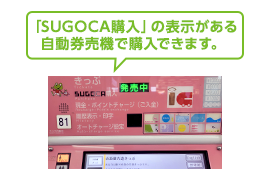
-
Look for the "Multifunctional Ticket Machines" (usually black or dark blue with the SUGOCA logo).
-
Select "English" on the touch screen.
-
Choose "Purchase SUGOCA" and select "Standard SUGOCA."
Option B: Ticket Office (Midori-no-madoguchi)
Go to the manned "Green Window" ticket office. This is the best option if you want to buy a Child SUGOCA (requires showing the child's passport) or a Registered SUGOCA (which can be reissued if lost).
You may find different designs or limited-edition cards at certain locations.
2. Buy at Airport Stations
If you're flying into Fukuoka Airport (FUK), you can pick up a SUGOCA card as soon as you land.
🛬 Where:
-
JR Kyushu ticket counters
-
Ticket/vending machines near the train lines connecting the airport to Fukuoka city
This is often the easiest option for first-time visitors.
3. Buy at Tourist Information Centers
Some major cities and airports offer SUGOCA at tourist service counters — perfect if you want help or English support when buying.
🗺️ Where to check:
-
City tourist info desks
-
Airport welcome centers
Availability may vary, so look for signage or ask staff.
‼️ Tips Before You Buy
✔ One card per person: Each traveler needs their own SUGOCA to tap in/out at train gates.
✔ Cash is usually easiest: Most machines accept cash only — have some yen ready.
✔ Ask for English help: JR staff usually assist with English instructions and top-up guidance.
Types of SUGOCA Cards
SUGOCA cards come in several types designed for different travel needs, from short-term visitors to daily commuters. While tourists usually choose the standard card, it’s helpful to understand the options available in Kyushu.
1. Standard SUGOCA (無記名 - Mukimei / Anonymous)
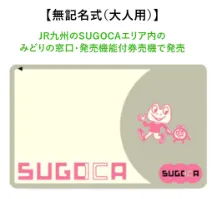
This is the most common card for short-term visitors.
-
Target User: Tourists, casual riders, and anyone wanting a card immediately.
-
Identification: Not linked to a name. Purchased and used anonymously.
-
Key Features:
-
No registration required. Buy and use.
-
Cannot have a commuter pass (定期券, teikiken) loaded onto it.
-
Cannot be reissued if lost. Treat it like cash.
-
Perfect for short-term visitors to Okinawa/Japan.
-
-
Price: ¥2,000 (¥500 deposit + ¥1,500 balance).
-
Purchase: Instant from ticket vending machines at Yui Rail or JR Kyushu stations.
2. Registered SUGOCA (記名式 - Kimeishiki / Personalized)
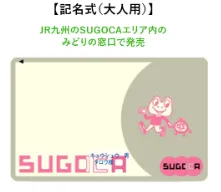
This card is linked to your identity.
-
Target User: Foreign residents, long-term students, or frequent commuters in the Kyushu/Okinawa region.
-
Identification: Registered with your name and can be linked to your My Number (Social Security) card for additional services.
-
Key Features:
-
Can have a commuter pass loaded onto it. This offers unlimited travel between specific stations for a set period (1 month, 3 months, etc.) at a discounted rate.
-
Can be reissued if lost or stolen (for a fee). The remaining balance and any commuter pass can be transferred to a new card.
-
Can be used for online shopping and other services that require a registered card.
-
Required if you want to link it to a Sugoca Mobile (see below).
-
-
Purchase: Must be applied for at a JR Kyushu Station's "Midori-no-Madoguchi" (Ticket Office). Not available from vending machines.
-
Price: Same as regular card (2,000 yen for card + initial charge).
3. Child SUGOCA
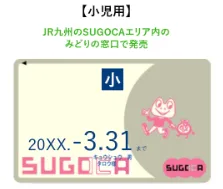
Essential for children to ensure they are only charged half-price fares.
-
Target User: Children aged 6-11 (Elementary school students).
-
Fare: Provides approximately 50% discount on train and bus fares, as per Japanese child fare rules.
-
Purchase: Must be applied for in person at a "Midori-no-Madoguchi" with proof of the child's age (e.g., passport, residence card).
‼️ Important: The card will automatically switch to adult fares the day after the child's 12th birthday.
4. Special Design & Commemorative Cards
JR Kyushu occasionally releases limited edition Sugoca cards featuring popular anime, local mascots, scenic spots, or trains.Examples: Cards featuring the Seven Stars in Kyushu luxury train, Kumamoto's bear mascot Kumamon, or the Kyushu Shinkansen.
These are usually Regular (Anonymous) Cards with a special design. They function identically but are collectibles. They may cost slightly more (e.g., 2,000-2,500 yen) with the same 1,500 yen initial value.
⁉️ Which Type Should Travelers Choose?
-
For 99% of visitors to Okinawa: The Regular (Anonymous) SUGOCA from the Yui Rail station machine is the perfect, no-fuss choice.
-
If you already have a Suica/Pasmo/ICOCA from Tokyo/Osaka: Use that. You do not need a SUGOCA for functionality. Get one only as a souvenir.
-
If moving to Okinawa/Kyushu for work/study: Visit the ticket office early on to get a Registered SUGOCA, especially if you will have a daily commute.
How to Use SUGOCA Card?
Using a SUGOCA card is designed to be a "tap-and-go" experience. Once you have credit on the card, you rarely need to visit a ticket machine unless you are running low on funds.
🚆 1. Using it for Trains & Subways
This is the most common use. You do not need to buy individual paper tickets.
-
Entry: Locate the automatic ticket gate. Look for the blue glowing pad with the "IC" logo. Tap your card (or your wallet if the card is inside) against the pad. A "beep" will sound, and the gate will open.
-
Exit: At your destination, tap again on the exit gate's blue pad. The screen will display the fare deducted and your remaining balance.
-
If the gate turns red: This usually means you have insufficient funds or you didn't tap properly at the start. Look for a Fare Adjustment Machine (marked "Settlement" or "Yellow") near the gates to add the necessary cash.
🚌 2. Using it on Buses
In Kyushu (and most of Japan), the process for buses is slightly different from trains:
-
Boarding: Enter through the middle/rear door. Tap your card on the reader located next to the door.
-
Exiting: When you get off at the front door, tap your card on the reader next to the driver. The fare is automatically calculated based on the distance you traveled.
⚠️ Note: If the bus has a flat fare (common in some city centers), you may only need to tap once upon boarding or exiting. Follow the lead of the locals!
🛒 3. Using it for Shopping & Vending
SUGOCA is a "digital wallet" accepted at millions of locations.
-
Convenience Stores: Tell the clerk "IC Card" or "SUGOCA" and tap your card on the reader at the register.
-
Vending Machines: Press the button for your drink first, then tap your card on the reader.
-
Coin Lockers: Many modern lockers allow you to use your SUGOCA as the "key." You tap to pay and lock, then tap the same card later to unlock it.
💰 4. How to Top Up (Recharge)
Since SUGOCA is a prepaid card, you must add cash to it.
-
Ticket Machines: Insert your card into any machine with the "IC" logo, select "Charge" on the screen, and insert cash (¥1,000, ¥2,000, etc.).
-
7-Bank ATMs: Found in every 7-Eleven. Choose "Recharge" on the screen, place your card in the reader, and insert cash.
-
Convenience Store Counters: You can ask the cashier to "Charge" (Cha-ji) your card. Give them the cash, and tap your card when prompted.
🚫 Important Rules:
-
❶ Cash Only: You cannot top up a physical SUGOCA card with a credit card at a machine; it must be cash.
-
❷ The "Area" Rule: You cannot use SUGOCA for a single trip that starts in one region and ends in another (e.g., Hakata to Osaka). For long-distance travel, use the Shinkansen and buy a paper ticket.
-
❸ One Card per Person: Each traveler must have their own card; you cannot "double tap" for a friend.
SUGOCA Refund Policy
If you decide you no longer need your SUGOCA card at the end of your trip, you can return it to get back your ¥500 deposit and any remaining balance. However, there are specific rules about where and how this is done.
1. Where to Get a Refund
-
JR Kyushu Only: You can only refund a SUGOCA card at JR Kyushu ticket offices (Midori-no-madoguchi).
-
Key Locations: Major stations like Hakata, Kokura, Kumamoto, Kagoshima-Chuo, and Nagasaki.
You cannot refund a SUGOCA card in Tokyo, Osaka, or at Fukuoka Airport's subway station (which handles Hayakaken cards). You must go to the JR portion of the station.
2. The Refund Calculation
The refund amount depends on how much money is left on the card. JR Kyushu charges a ¥220 handling fee, but only from the remaining balance—never from your deposit.
|
If your balance is... |
Refund you receive |
|
Over ¥220 (e.g., ¥1,000) |
Balance - ¥220 Fee + ¥500 Deposit = ¥1,280 |
|
Exactly ¥220 |
¥0 (Fee eats balance) + ¥500 Deposit = ¥500 |
|
Less than ¥220 (e.g., ¥10) |
¥0 (Fee eats balance) + ¥500 Deposit = ¥500 |
|
Zero (¥0) |
No fee can be charged + ¥500 Deposit = ¥500 |
💡 Pro-Tip: To maximize your refund, try to use up your balance entirely at a convenience store or vending machine before returning the card. If your balance is ¥0, you get your full ¥500 back without paying a fee!
3. How to Do It
-
Locate a Ticket Office: Look for the green sign that says "JR Ticket Office" or "Midori-no-madoguchi."
-
Hand over the card: You can simply say, "Haraimodoshi onegaishimasu" (Refund, please).
-
Identification: For a Standard (Unregistered) card, no ID is usually needed. For a Registered or Child SUGOCA, you may be asked to show your passport to verify you are the card owner.
-
Receive Cash: The clerk will take the card and give you your refund in Japanese Yen.
⚠️ Special Notes:
-
Damaged Cards: If the card is severely damaged and the machine cannot read it, you may not be able to get a refund immediately (it may require a "reissue" process first).
-
Souvenir Option: If you don't return the card, it remains valid for 10 years from your last use. Many travelers keep it as a souvenir or for their next trip to Japan.
Frequently Asked Questions (Q&A)
Can tourists buy SUGOCA?
Yes, anyone can buy it at JR Kyushu stations.
Can I use SUGOCA in Tokyo or Osaka?
Yes, it works anywhere IC cards are accepted.
Does SUGOCA expire?
No expiration as long as it’s used periodically.
Can two people share one SUGOCA?
No, each person needs their own card at the gates.
Can I use SUGOCA for Shinkansen?
You can use it for base fares, but seat reservations and limited express tickets must be purchased separately.
Can I get a refund for my SUGOCA in Tokyo?
No. You can only refund a SUGOCA card at JR Kyushu ticket offices (Midori-no-madoguchi) in the Kyushu region. If you are flying out of Tokyo or Osaka, you won't be able to get your ¥500 deposit back there.
What's the maximum amount I can put on the card?
The maximum stored value is ¥20,000.
Can I pay with credit card to charge my SUGOCA?
At vending machines, cash only (¥1,000/¥5,000/¥10,000 bills and coins). At convenience stores, you can pay the cashier with a credit card for the charge amount, but they will still process the card charge via cash transaction.
What if I lose my SUGOCA?
If it's a Regular (Anonymous) card, it's treated like lost cash—you cannot get a refund. If it's a Registered card, you can report it lost at a JR ticket office and get a replacement (for a fee) with your balance transferred.