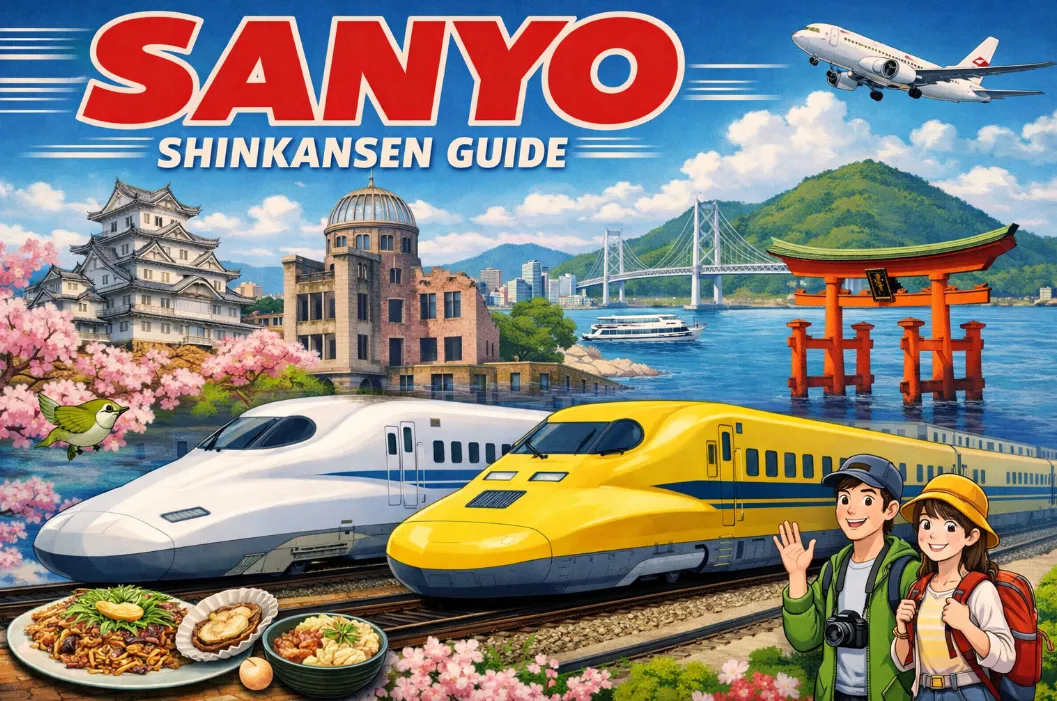
Traveling through Western Japan is an experience defined by speed and seamless connectivity, largely thanks to the Sanyo Shinkansen. Linking the neon-lit streets of Osaka to the coastal charm of Fukuoka, this high-speed rail line is a lifeline for tourists exploring Hiroshima, Okayama, and beyond. Whether you're a first-time visitor or a seasoned rail enthusiast, understanding the nuances of JR West’s flagship line is key to a perfect trip. From securing the best window seat for scenic views to making online reservations during peak seasons, this guide covers the essential logistics so you can focus on the destinations that matter.
What is the Sanyo Shinkansen?
➤ Opened: It was constructed in stages between 1972 and 1975, making it Japan's second Shinkansen line after the Tokaido line.
➤ Operator: Operated by JR West, except for a short section in Kyushu which is operated by JR Kyushu.
➤ Route: Shin-Osaka → Hakata
➤ Max speed: Up to 300 km/h (186 mph)
➤ Travel time: As fast as 2h 30m end-to-end
Operated by the West Japan Railway Company (commonly known as JR West),the Sanyo Shinkansen (山陽新幹線, Sanyō Shinkansen) is a shinkansen line that connects Osaka (Shin-Osaka Station) with Fukuoka (Hakata Station) on Kyushu. It was completed in 1975 as the second shinkansen line and serves as the primary artery for travel through western Japan.Today trains reach speeds of up to 300 km/h.Some trains along the Sanyo Shinkansen provide through service to the Tokaido Shinkansen to/from Tokyo and to the Kyushu Shinkansen to/from Kagoshima.It is an indispensable part of Japan's transportation network and a prime example of the transformative power of high-speed rail.
Whether you’re heading to Kobe, Himeji, Okayama, Hiroshima, or Fukuoka, the Sanyo Shinkansen offers frequent departures, smooth rides, and excellent connectivity with other Shinkansen lines.
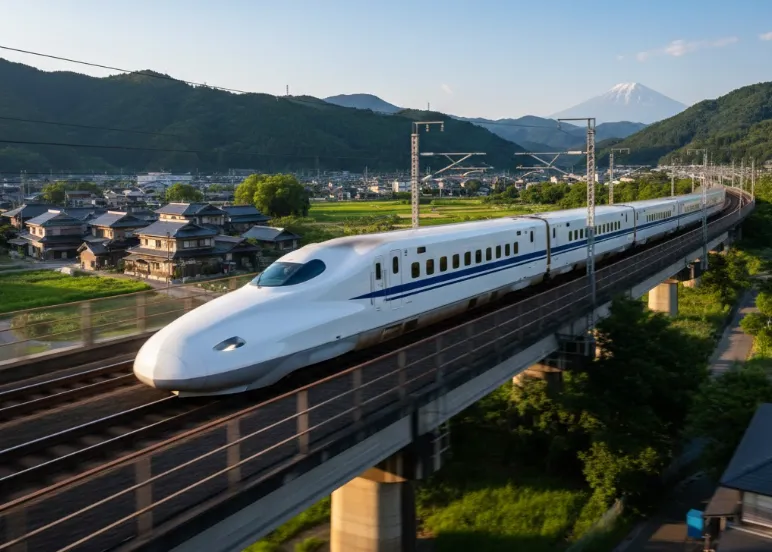
🔺 Key Facts and Role:
-
Connector: It directly links the Kansai region (Osaka, Kyoto, Kobe) with the Chugoku region (Hiroshima, etc.) and northern Kyushu (Fukuoka).
-
Part of a Greater Network: It is the western extension of the Tokaido Shinkansen (which runs from Tokyo to Shin-Osaka). Together, they form the primary "Tokyo-Hakata" corridor, a vital economic and transportation backbone for Japan.
-
Connection to Kyushu: At Hakata Station, the line seamlessly connects with the Kyushu Shinkansen, which continues south to Kagoshima (the Kagoshima Route) and west to Nagasaki (the Nagasaki Route, part of which uses a unique "Dual Mode Vehicle" on conventional track).
-
High Speed: Trains reach up to 300 km/h, making it slightly faster than the Tokaido Shinkansen’s 285 km/h.
-
High Tunnel Density: About 50% of the route is in tunnels, which means fewer scenic views of the countryside compared to other lines, but it allows for straighter tracks and higher speeds.
-
Major Stops & Tourism: The line provides easy access to some of Japan's most iconic UNESCO sites:
-
Himeji: Famous for the "White Heron" Himeji Castle.
-
Okayama: Gateway to the Korakuen Garden and the art islands of Naoshima.
-
Hiroshima: Access to the Peace Memorial Park and the "floating" gate at Miyajima.
-
-
JR Pass Usage: The Japan Rail Pass covers the Sanyo Shinkansen, but you must pay a supplement to use the Nozomi or Mizuho trains. However, several JR West Regional Passes (like the Sanyo-San'in Area Pass) include these faster trains at no extra cost.
- Unique Themed Trains: The Sanyo Shinkansen is famous for its "novelty" trainsets that you won't find on the Tokyo-bound lines,such as the Hello Kitty Shinkansen.
1. Train Types & Services
Unlike the Tokaido line, the Sanyo Shinkansen runs several types of trains.There are five main train categories. While they all use the same tracks, their speeds and stop patterns vary significantly:
|
Service |
Speed |
Stops |
Best For |
JR Pass Info |
|
Nozomi (のぞみ) |
300 km/h |
Major hubs only. Fastest (Osaka to Hakata in ~2h 25m). |
Business travelers |
Requires a supplement fee. |
|
Mizuho (みずほ) |
300 km/h |
Very few stops. Often continues to Kagoshima. |
Osaka ↔ Kyushu |
Requires a supplement fee. |
|
Sakura (さくら) |
300 km/h |
Semi-fast. Highly recommended for comfort. |
Tourists, great value |
Fully Covered |
|
Hikari (ひかり) |
285 km/h |
Medium-fast. Includes the "Rail Star" sets. |
Pass users |
Fully Covered |
|
Kodama (こだま) |
285 km/h |
Stops at every station. |
Short trips |
Fully Covered |
⚠️ Note: Mizuho and Sakura trains often have more comfortable 2-2 seating in reserved ordinary cars, compared to the 3-2 layout on others.
2. Route & Major Stations
The Sanyo Shinkansen runs along Japan’s southwest coast, linking Shin-Osaka in Kansai with Hakata (Fukuoka) in Kyushu. It is the main high-speed rail corridor across western Honshu and the gateway between Osaka, Hiroshima, and Fukuoka.
At Shin-Osaka, the line connects seamlessly with the Tokaido Shinkansen from Tokyo and Nagoya. At Hakata, trains continue onto the Kyushu Shinkansen toward Kumamoto and Kagoshima, allowing long-distance through service across Japan.
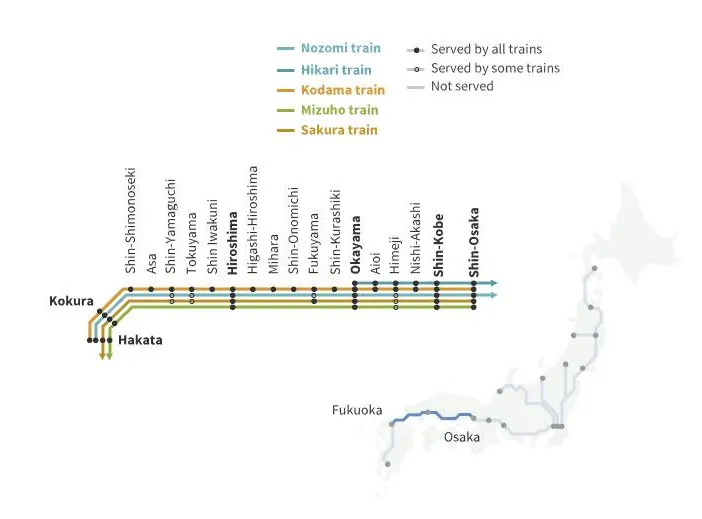
📍 Route: Shin-Osaka → Hakata (553 km)
📍 Full Station List (East → West):
|
Station |
Location (Prefecture) |
Major Sights & Access |
|
Shin-Osaka |
Osaka |
Dotonbori, Osaka Castle; transfer to Tokaido Shinkansen. |
|
Shin-Kobe |
Hyogo |
Arima Onsen, Mt. Rokko Ropeway, Kobe Beef restaurants. |
|
Nishi-Akashi |
Hyogo |
Akashi Kaikyo Bridge (world’s longest suspension bridge). |
|
Himeji |
Hyogo |
Himeji Castle (UNESCO site), Koko-en Garden. |
|
Aioi |
Hyogo |
Access to the scenic Ako coastline. |
|
Okayama |
Okayama |
Korakuen Garden, Okayama Castle; gateway to Shikoku island. |
|
Shin-Kurashiki |
Okayama |
Kurashiki Bikan Historical Quarter (traditional canal district). |
|
Fukuyama |
Hiroshima |
Fukuyama Castle (visible from the station platform). |
|
Shin-Onomichi |
Hiroshima |
Shimanami Kaido (famous cycling route), Temple Walk. |
|
Mihara |
Hiroshima |
Coastal town; ferry access to "Rabbit Island" (Okunoshima). |
|
Higashi-Hiroshima |
Hiroshima |
Sake breweries in the Saijo district. |
|
Hiroshima |
Hiroshima |
Peace Memorial Park, ferry to Miyajima (Itsukushima). |
|
Shin-Iwakuni |
Yamaguchi |
Kintai-kyo Bridge (iconic five-arched wooden bridge). |
|
Tokuyama |
Yamaguchi |
Shunan "Industrial Night View" (popular for photography). |
|
Shin-Yamaguchi |
Yamaguchi |
Akiyoshido Cave, Yamaguchi city’s Five-Storied Pagoda. |
|
Asa |
Yamaguchi |
Quiet transit hub for local San'yo lines. |
|
Shin-Shimonoseki |
Yamaguchi |
Karato Fish Market (famous for Fugu/Pufferfish). |
|
Kokura |
Fukuoka |
Kokura Castle, Tanga Market; northern gateway to Kyushu. |
|
Hakata |
Fukuoka |
Canal City, Nakasu food stalls (Yatai), Kushida Shrine. |
Not every train stops at every station—service patterns depend on whether you take Kodama, Hikari, Sakura, Nozomi, or Mizuho.
⁉️ Which Train Should You Pick?
-
If you have a JR Pass (National): Look for Sakura or Hikari trains. They are almost as fast as the Nozomi but are included in your pass without an extra surcharge.
-
If you are in a rush: The Nozomi and Mizuho have the fewest stops.
-
If you want the best seat: Try to book the Sakura or Mizuho. As mentioned in the Seat Classes section, their Reserved Ordinary cars have much wider 2+2 seating compared to the 3+2 seating on the Nozomi.
-
If you are sightseeing: The Kodama is slow, but it's the only way to reach smaller "hidden gem" stations like Shin-Onomichi or Mihara.
🔔 Navigation Highlights:
-
The "Big Six": Every single train type (Nozomi, Mizuho, Sakura, Hikari, Kodama) stops at: Shin-Osaka, Shin-Kobe, Okayama, Hiroshima, Kokura, and Hakata.
-
The Tunnel Factor: A significant portion of this line runs through tunnels (over 50%). If you want the best views of the Seto Inland Sea, try to get a window seat on the South side of the train (Seat E in Ordinary/Seat D in Green Car) between Okayama and Hiroshima.
-
Platform Sights: At Fukuyama Station, you can actually photograph the castle towers directly from the Shinkansen platform—it is one of the closest castles to a train station in Japan.
3. Seat Classes
The Sanyo Shinkansen offers comfortable, airline-style seating designed for both short hops and long-distance travel. Depending on the train type, you can choose between Ordinary Car (Standard) and Green Car (First Class).
|
Feature |
Ordinary (Non-Reserved) |
Ordinary (Reserved) |
Green Class |
|
Seating |
3+2 (Cramped) |
2+2 or 3+2 |
2+2 (Spacious) |
|
Legroom |
Excellent |
Excellent |
Extra-Large |
|
Power Outlets |
Window seats only |
Every seat (usually) |
Every seat |
|
Price |
Base + Express Fee |
+ 530–900 Yen |
+ 3,000–5,000 Yen |
|
Best For |
Short trips or travelers outside peak hours. |
Great for most travelers who want comfort at a reasonable price. |
Ideal for long rides like Osaka → Hiroshima → Fukuoka, business travelers, or anyone wanting extra comfort. |
A. Ordinary Class (Standard)
This is the most common class. However, the experience varies significantly depending on whether you reserve a seat or not.
-
Non-Reserved (3+2 seating): Found in Cars 1–3 of most trains. Seats are arranged with three on one side and two on the other. It is first-come, first-served.
-
Reserved (2+2 seating) — The Insider Tip: On the Sakura and Mizuho trains (the 8-car sets), the reserved ordinary cars use a 2+2 layout. These seats are wider, more plush, and nearly as comfortable as Green Class for a much lower price.
-
Reserved (3+2 seating): On the Nozomi and Hikari trains, reserved seats are usually the same 3+2 width as non-reserved, just with a guaranteed spot.
B. Green Class (First Class)
Marked by a green four-leaf clover symbol, this is the premium option.
-
Layout: Always 2+2 seating, providing much more elbow room and a wider aisle.
-
Amenities: Deeply reclining "cradle" seats, footrests, personal reading lights, and often a more tranquil, carpeted atmosphere.
-
Service: While there is no "free" meal like on an airplane, you can often order food and drinks via a QR code on the seat (on Nozomi trains).
⚠️ Note: All Green Class seats require a reservation; there is no such thing as a "non-reserved" Green seat.
4. Travel Times & Timetable
Travel times on the Sanyo Shinkansen are highly efficient, with trains reaching speeds of 300 km/h (186 mph). Your travel time depends on the train type—Nozomi, Mizuho, Sakura, Hikari, or Kodama—with faster services skipping smaller stations.
A. Major Travel Times (Approx.)
|
Route |
Nozomi / Mizuho |
Sakura / Hikari |
Kodama |
|
Shin-Osaka → Shin-Kobe |
~13 min |
~13 min |
~15 min |
|
Shin-Osaka → Himeji |
~30 min |
~32 min |
~45 min |
|
Shin-Osaka → Okayama |
~45 min |
~50 min |
~70 min |
|
Shin-Osaka → Hiroshima |
~1h 25m |
~1h 30m |
~2h 20m |
|
Shin-Osaka → Kokura |
~2h 05m |
~2h 15m |
~3h 10m |
|
Shin-Osaka → Hakata |
~2h 30m |
~2h 40m |
~4h 00m |
|
Hiroshima → Hakata |
~1h 00m |
~1h 05m |
~1h 45m |
|
Okayama → Hiroshima |
~35 min |
~40 min |
~60 min |
B. General Timetable Patterns
The Sanyo Shinkansen operates from roughly 6:00 AM to midnight.
-
Frequency: During peak hours, a train departs Shin-Osaka heading West every 10–15 minutes.
-
First/Last Trains:
-
The first trains (usually Mizuho or Nozomi) depart around 6:00 AM.
-
The last direct train from Shin-Osaka to Hakata typically leaves around 9:30 PM.
-
The last train to Hiroshima usually leaves around 10:30 PM.
-
⁉️ How to Check Real-Time Schedules?
Since 2026 schedules can vary by day (especially with "Seasonal" extra trains), it is best to use one of these tools for your exact date:
-
Navitime for Japan Travel: The gold standard for English-speaking travelers. It allows you to filter by "JR Pass" to see only covered trains.
-
Smart-EX App: Official booking app where you can see live seat availability and exact departure times.
-
Google Maps (iOS; Android): Very reliable for Shinkansen times; it will even tell you which platform number to head to.
How to Buy Sanyo Shinkansen Tickets?
1. Ticket Types & Components
To ride the Sanyo Shinkansen, your ticket is technically composed of two or three distinct parts. While you may sometimes receive a single piece of paper, the price and the rules are always a combination of these specific components.
A. The Two Required Components
To even step onto a Shinkansen platform, you need both of the following:
-
Base Fare (Joshaken): This is the cost of simply moving your body from Point A to Point B. It is the same price whether you take a slow local train or the high-speed Shinkansen.
-
Limited Express Surcharge (Tokkyu-ken): This is the "speed tax." You pay this for the privilege of using the high-speed Shinkansen tracks and saving time.
⚠️ Note: When buying at a machine, you will often be asked: "Do you already have a base fare ticket?" If you are just starting your journey, always select "Set Ticket" or "Base Fare + Express Ticket" to get everything you need.
B. Seat-Specific Ticket Types
Your Limited Express Surcharge changes depending on where you sit:
-
Non-Reserved (Jiyu-seki): The cheapest option. You can sit in any open seat in the designated non-reserved cars (usually Cars 1–3). If the train is full, you may have to stand.
-
Reserved (Shitei-seki): Guarantees you a specific seat in a specific car. The price varies slightly by season (usually 200 to 400 Yen more than the standard rate).
-
Green Car (Green-ken): This is a third component added on top. It is the first-class surcharge for larger seats and more legroom. All Green Car seats are reserved.
⚠️ Peak Season "Reserved Only" Rule: It is important to remember that during Golden Week (May), Obon (August), and New Year’s, the Nozomi trains (the fastest ones) operate as Reserved Only.During these times, "Non-Reserved" tickets are not sold for Nozomi trains.You must have a Reserved Seat Ticket to board, or you may be forced to wait for a slower Kodama or Hikari train that still has non-reserved cars.
C. Physical vs. Digital Formats
How you hold these components depends on how you bought them:
|
Format |
Appearance |
How to Use |
|
Traditional Paper |
Two small tickets (or one combined) |
Insert both tickets into the gate slot at the same time. Remember to grab them as they pop out the other side. |
|
Smart-EX (QR) |
A QR code on your phone |
Scan the QR code at the yellow scanner on the gate. A small "Seat Information" slip will print out—keep it for the conductor. |
|
IC Card Link |
Your Suica/Pasmo/Icoca card |
If you link your Smart-EX ticket to your IC card, you just tap the card. The gate will recognize your "Base Fare + Express" purchase automatically. |
2. Purchase Methods
Buying tickets for the Sanyo Shinkansen is straightforward, but the "best" way depends on whether you want the lowest price, the most convenience, or are using a rail pass.
A. Online (Recommended for 2026)
-
Smart-EX (App/Website): The official service for the Tokaido, Sanyo, and Kyushu lines.You can link your ticket to an IC card (Suica/Pasmo/Icoca) so you can just tap your phone or card at the gate.
-
Pros: Official English app; allows you to change your reservation for free; provides a QR code for entry (no paper ticket needed).
-
Process:
-
Register account (foreign passports accepted)
-
Search route and schedule
-
Select seats on virtual map
-
Pay with credit card
-
Options:
-
Pick up at station machine (using reservation number)
-
Use mobile ticket QR code
-
Load onto IC card (Suica/PASMO compatible devices)
-
-
-
-
JR West Online Reservation: Ideal if you are also buying a regional pass (like the Kansai-Hiroshima Pass).
-
Steps:
-
Choose route and date
-
Select train & seat type
-
Pay by card
-
Receive QR code or pickup code
-
-
⚠️Note: You must pick up physical tickets from a "Midori-no-kenbaiki" (Green Vending Machine) at the station before boarding.
-
-
Klook/KKday: Ideal for foreign tourists.You must pick up physical tickets from a "Midori-no-kenbaiki" (Green Vending Machine) at the station before boarding.
B. At the Station (Best for Flexibility)
If you prefer to decide on the fly, you can buy tickets at any major JR station.
-
Ticket Machines: Look for the Blue or Green "Reserved Seat" machines. They have a prominent "English" button. You can pay with cash or most major international credit cards.
-
Ticket Offices (Midori-no-Madoguchi): Look for the green sign with a person reclining in a seat. These are staffed offices. They are helpful if you have complex requirements (like oversized luggage), but lines can be long at major hubs like Shin-Osaka.
C. Using a Rail Pass
If you have a Japan Rail Pass or a JR West Regional Pass:
-
National JR Pass: You can use the Sakura, Hikari, or Kodama for free. To ride the Nozomi or Mizuho, you must purchase a special supplemental ticket.
-
Regional Passes: Most JR West passes (like the Sanyo-San'in Area Pass) already include the fast Nozomi and Mizuho trains at no extra cost.
-
Reserving Seats: You can reserve seats for free at the ticket machines by scanning your pass and your passport.
3. Ticket Prices (One-Way)
Prices vary by seat type — Unreserved, Reserved Seat, and Green Car (First Class) — and by whether you take faster services like Nozomi/Mizuho or slightly slower Sakura/Hikari/Kodama.
🚆 Shin-Osaka ↔ Hakata (Full Line)
|
Seat Type |
Typical Fare (One-Way) |
|
Unreserved Seat |
~¥16,060 |
|
Reserved Seat (Nozomi) |
~¥17,050 |
|
Reserved Seat (Sakura) |
~¥16,850 |
|
Green Car (Nozomi / Mizuho) |
~¥22,210 |
💡 Prices include both the basic fare + limited express (Shinkansen) surcharge.
📍 Other Common Routes & Fares
Here's how prices look for some other popular Sanyo Shinkansen segments (adult, one-way):
|
Route |
Typical Price (Ordinary Reserved) |
Green Car (Reserved) |
|
Shin-Osaka → Hiroshima |
~¥10,950 – ¥11,000 |
~¥14,000+ |
|
Shin-Osaka → Okayama |
~¥6,460 |
~¥8,250+ |
|
Hiroshima → Hakata |
~¥6,300 |
+Green surcharge |
💡 Exact amounts vary slightly by train type and season.
🧒 Child Fares
-
Children (6–11 years): About half the adult fare.
-
Under 6: Free without a seat (fare required if reserving a seat).
The Luggage Rules
When traveling on the Sanyo Shinkansen, the luggage rules are strictly enforced to ensure passenger comfort and safety. The most important thing to know is that oversized luggage requires a mandatory reservation.
1. The 160 cm Rule
The need for a reservation is determined by the "total dimensions" of your bag ($Length + Width + Height$).
-
Under 160 cm (Standard): No reservation needed. You can store these in the overhead racks (which are quite deep and sturdy) or at your feet (the legroom is much larger than on an airplane).
-
160 cm to 250 cm (Oversized): Mandatory reservation required. This size is typical for large checked suitcases.
-
Over 250 cm: Not allowed on the train at all. You must use a luggage delivery service (Takkyubin).
2. How to Reserve Luggage Space?
There is no extra charge for reserving luggage space if you do it in advance. When you book your seat, you must specifically select a seat that comes with luggage access.
-
Seat with Oversized Baggage Area: This is a seat in the last row of the car. You are entitled to store your bag in the space directly behind your seat.
-
Seat with Oversized Baggage Compartment: This grants you access to a locked shelf in the deck area (near the doors). You use an IC card (like Suica) or a dial code to lock/unlock it.
-
Where to book: You can select these options on the Smart-EX app, at ticket machines (look for the "Oversized Baggage" button), or at a ticket office.
3. Penalties & Restrictions
-
The 1,000 Yen Fine: If you bring an oversized bag into a car without a reservation, the conductor will charge you a 1,000 yen penalty fee and move your bag to a designated area (which may be far from your seat).
-
No Non-Reserved Cars: You cannot bring oversized luggage into Non-Reserved cars (Cars 1–3). You must book a Reserved Seat or Green Car seat to get luggage space.
-
Exceptions: Baby strollers, musical instruments, and sports equipment (like bicycles in bags) are generally exempt from the reservation rule, though it is still "good manners" to book a back-row seat if you want to use the floor space behind it.
4. Pro-Tip: Use "Takkyubin"
If you are traveling with multiple large suitcases, consider using a luggage forwarding service (Yamato "Black Cat" is the most famous).
-
Cost: Roughly 2,000–3,000 yen per bag.
-
Convenience: You drop your bags at your hotel lobby in Osaka, and they appear at your hotel in Hiroshima or Fukuoka the next day. This allows you to travel "hands-free" on the Shinkansen.
The Practical Tips
To make your Sanyo Shinkansen journey as smooth as possible in 2026, here are several "insider" practical tips that go beyond the basic timetable.
1. Master the Seat Selection
-
The "Views" Side: On the Sanyo Shinkansen (Osaka to Hakata), the south side (Seat A) is generally superior because it offers occasional glimpses of the Seto Inland Sea. However, be aware that about 50% of this line is in tunnels.
-
Charging Your Devices: If you are on an N700S (the newest model), every seat has a power outlet in the armrest. On older N700A models, outlets are only at the window seats (A and E) and the very front/back rows.
-
The 2-2 Layout Secret: Avoid the 3-2 seating of the Nozomi if you can. The Sakura and Mizuho trains have 2-2 seating in Reserved Ordinary cars that feels almost like a First Class "Green Car" for a fraction of the price.
2. Dining Like a Local (Ekiben)
-
The Station Meal: Eating on the Shinkansen is a Japanese tradition. Buy an Ekiben (station bento) before boarding.
-
Must-Try Bento: At Nishi-Akashi Station, look for the Hipparidako Meshi—it's a famous octopus rice dish served in a reusable ceramic pot.
-
Onboard Carts: In 2026, many Sanyo trains still have trolley service (snacks/drinks), but they are becoming rarer. It is always safer to buy your food and a "can of Highball" or green tea at the station concourse first.
3. Station Strategy
-
Shin-Osaka is Huge: If you are transferring from a local train to the Shinkansen, allow at least 15–20 minutes. The Shinkansen platforms are on the 4th floor, while local JR lines are on the 1st/2nd.
-
Platform Food: If you forgot to buy food, many platforms have small kiosks (Kiosk or Bellmart) and even standing noodle shops (Tachigui Udon) where you can grab a hot bowl in 5 minutes.
-
The "Castle View": If you are passing through Fukuyama Station but not stopping, look out the North window (Seat E) to see Fukuyama Castle sitting right next to the tracks.
4. Etiquette & Comfort
-
Trash: There are no trash cans at your seat. You must take your trash to the bins located in the vestibules between cars.
-
The "Recline" Rule: It is polite to give a quick nod or a "sumimasen" (excuse me) to the person behind you before reclining your seat.
-
Smoking: As of 2024–2025, smoking rooms on all Shinkansen have been removed. The trains are now 100% smoke-free.
5. Tech & Wi-Fi
-
Free Wi-Fi: "Shinkansen_Free_Wi-Fi" is available on all trains. It requires a simple email or social media login but can be spotty in the many tunnels of the Sanyo line.
-
Smart-EX App: Use this to change your seat even 5 minutes before departure. If you see a better seat open up on the app, you can switch your reservation digitally for free.
Common Q & A for the Sanyo Shinkansen
Q: Can I use my Suica/PASMO on the Shinkansen?
A: Yes, but only for base fare on SOME trains. You'll still need to purchase a Shinkansen ticket or use a ticket gate that accepts IC cards for combined payment.
Q: Is there WiFi on board?
A: Most trains have free WiFi (connect to "JR-WEST_FREE_Wi-Fi").
Q: What if I miss my reserved train?
A: You can usually take a later train in the non-reserved section, but may need to stand.
Q: Best time to travel?
A: Weekday mid-mornings are least crowded. Avoid Friday evenings and holiday beginnings/endings.
Q: How early should I arrive?
A: 15-20 minutes if you need to buy tickets; 10 minutes if you already have them.
Q: Do I need to buy tickets in advance?
A: For most of the year, you can buy tickets 15–30 minutes before departure. However, for Golden Week (May), Obon (August), and New Year’s, you should book as early as possible (up to one month in advance) as trains sell out completely.
Q: Is there food served on board?
A: There is no "airline-style" meal service in Ordinary or Green Class. Some trains have a trolley that sells snacks and drinks, but this service is being phased out. Most travelers buy an Ekiben (lunch box) at the station before boarding.
Q: Why is the station called "Shin-Osaka" and not just "Osaka"?
A: "Shin" means "New." The original Osaka Station was too crowded and located in an area where it was physically impossible to build the straight, wide tracks required for high-speed trains. Shin-Osaka was built specifically to accommodate the Shinkansen.
Q: Do I need to reserve a seat?
A: Not always, but it’s recommended.
-
Reserved seat: Guaranteed, best during busy seasons.
-
Non-reserved seat: Cheaper, first-come first-served.
-
During weekends, holidays, and peak travel, always reserve.
Q: Which side has the best views?
A: When traveling Shin-Osaka → Hiroshima → Hakata, sit on the right side for coastal scenery. Window seats are best for photography and relaxing.