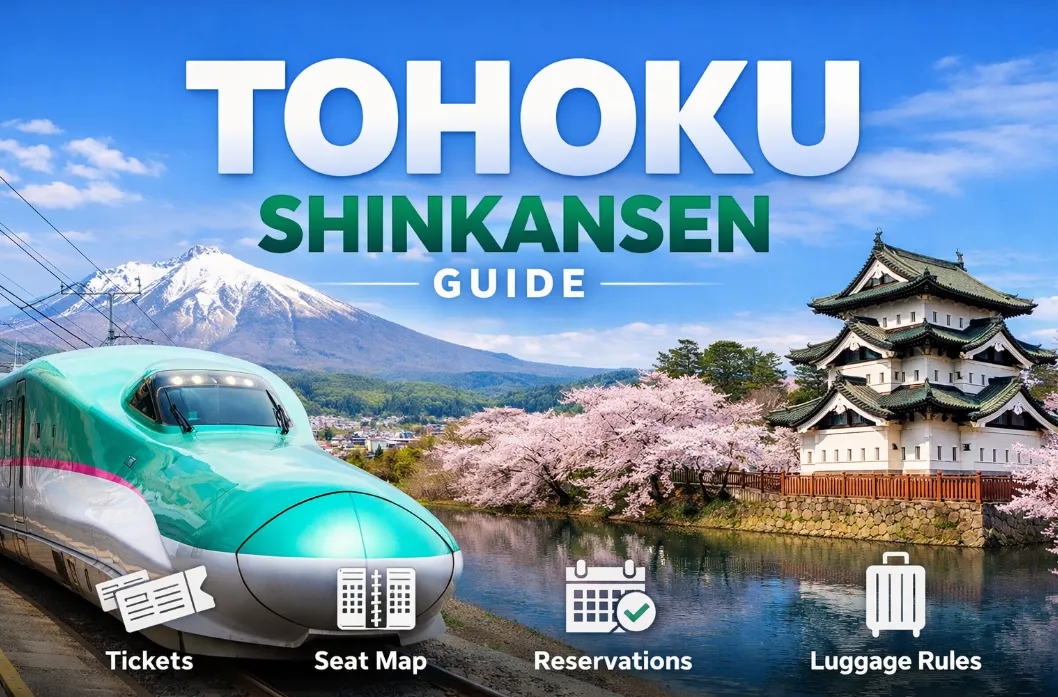
Venturing north from the neon glow of Tokyo to the serene landscapes of northern Honshu has never been easier. The Tohoku Shinkansen, Japan’s longest bullet train line, serves as your high-speed gateway to a world of ancient samurai towns, steaming hot springs, and breathtaking seasonal beauty. From coastal landscapes to mountain towns, many travelers rely on this bullet train route to reach the Tohoku area efficiently. Knowing how pricing works, where to sit, how to reserve in advance, and what to do with large suitcases can greatly improve your trip.This guide breaks down the essentials in a simple, traveler-friendly way, so you can prepare properly, avoid common mistakes, and focus on enjoying your journey through the Tohoku region with ease and confidence.
What's the Tohoku Shinkansen?
➤ Opened: Opened in 1982 between Ōmiya and Morioka, later reaching Tokyo in 1991.
➤ Operator: JR East
➤ Route: Connects Tokyo Station to Shin-Aomori Station, serving major cities like Sendai and Morioka.
➤ Max speed: Up to 320 km/h (200 mph)
➤ Extensions: At its northern terminus, it connects directly to the Hokkaido Shinkansen, which travels through an undersea tunnel to reach the island of Hokkaido.
The Tohoku Shinkansen is Japan's longest high-speed bullet train line, operated by JR East, connecting Tokyo with Aomori in the northern Tohoku region. Stretching 674.9 km, it serves as a vital artery for the region with speeds reaching 320 km/h (200 mph). It’s famous for being fast, reliable, and scenic, especially for travelers heading to mountains, hot springs, and snow destinations.
1. Train Types & Services
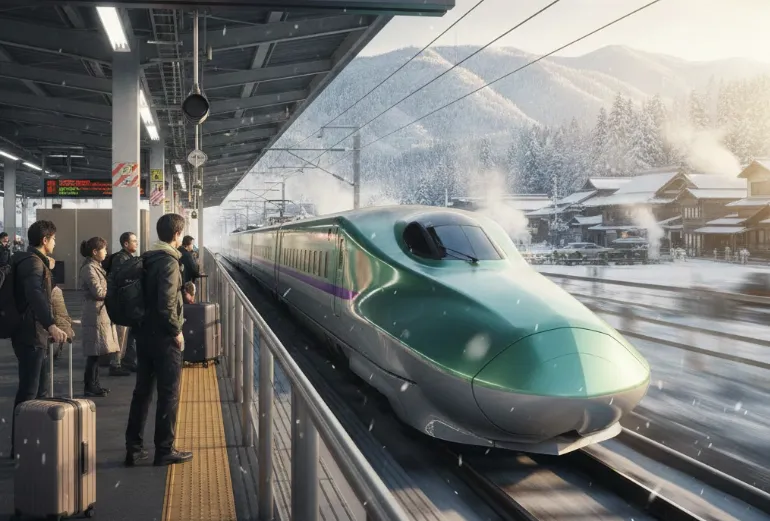
The Tōhoku Shinkansen operates several service types, each designed for different travel distances and stop patterns. There are four main types of service, ranging from "all-stops" to "super-express":
-
Hayabusa (はやぶさ): The fastest and premier service. It runs from Tokyo to Shin-Hakodate-Hokuto non-stop between Tokyo and Shin-Aomori. Uses E5/H5 Series trains with a top speed of 320 km/h (199 mph). Features Gran Class (luxury sleeper-like seating).
-
Hayate (はやて): Runs between Tokyo/Shin-Aomori and Shin-Hakodate-Hokuto. Makes limited stops.
-
Yamabiko (やまびこ): The primary rapid service between Tokyo and Sendai/Morioka.
-
Nasuno (なすの): Local service between Tokyo and Kōriyama/Fukushima.
|
Service |
Speed (Max) |
Stops |
Route |
Seating Type |
Best For |
|
Hayabusa (はやぶさ) |
320 km/h |
Major cities only |
Tokyo ⇄ Shin-Aomori (some continue to Hokkaido) |
All Reserved |
Long-distance travel (Sendai, Morioka, Aomori) |
|
Hayate (はやて) |
320 km/h |
Few stops |
Tokyo ⇄ Morioka / Shin-Aomori |
All Reserved |
Fast regional connections |
|
Yamabiko (やまびこ) |
275-300 km/h |
Medium number |
Tokyo ⇄ Sendai / Morioka |
Mix of Reserved & Non-Reserved |
Mid-distance travel |
|
Nasuno (なすの) |
275 km/h |
Commuter shuttle; stops at all stations |
Tokyo ⇄ Nasushiobara / Koriyama |
Reserved & Non-Reserved |
Short trips from Tokyo |
Unlike some other Shinkansen lines, Hayabusa has no non-reserved seats, so booking in advance is smart during weekends and holidays.
🔔Key Takeaway for Travelers:
-
For speed to Hokkaido or Morioka, choose Hayabusa.
-
For travel to Sendai, Yamabiko is perfect.
-
For Akita, you'll be on a Komachi.
-
For Yamagata, you'll be on a Tsubasa.
Always check the electronic departure boards at stations, which clearly show the service name, final destination, departure time, and stopping pattern for each train.
2. Route & Major Stations
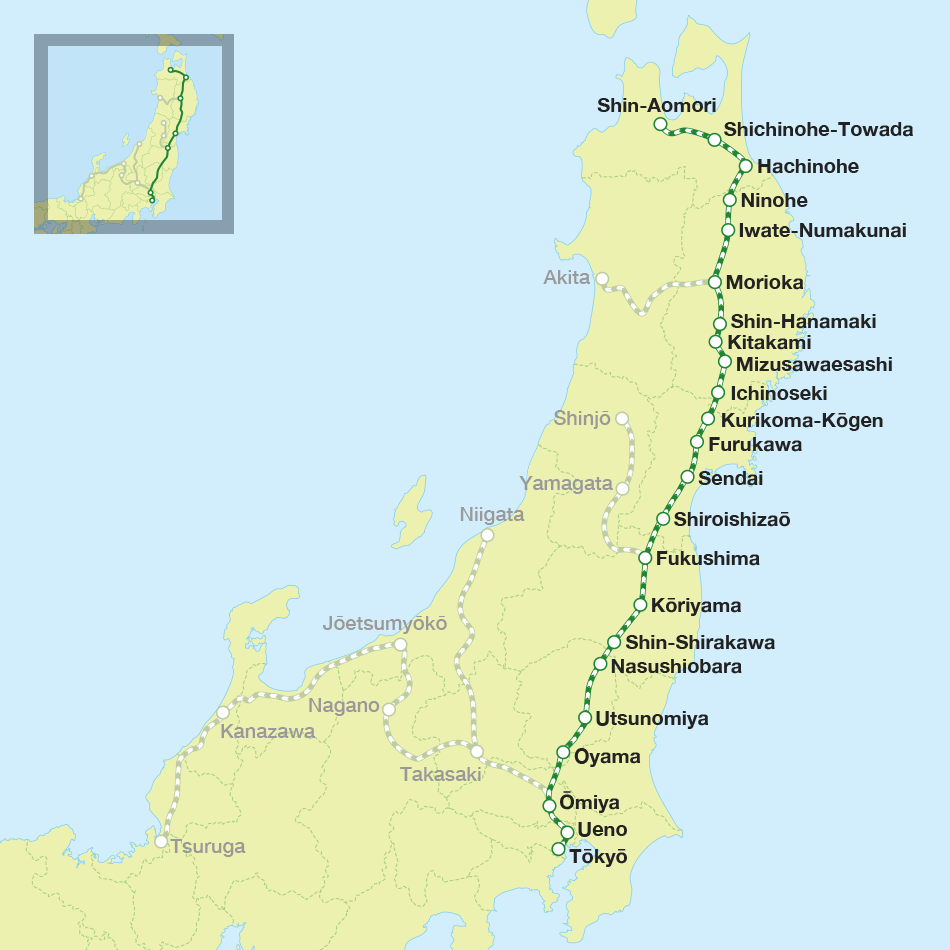
The Tōhoku Shinkansen is the lifeline of Northeast Japan. To navigate it effectively, it helps to visualize it as one massive main trunk with two smaller branches that split off into the mountains.
A. The Main Line (Tokyo to Aomori)
The primary route runs north-south, connecting the capital to the northernmost point of the main island.
|
Station |
Significance |
Major Connection |
|
Tokyo |
The southern terminus. |
Tokaido Shinkansen (to Osaka/Kyoto) |
|
Ueno |
Second stop in Tokyo; closer to the city's north side. |
Local lines to Nippori/Asakusa |
|
Ōmiya |
The gateway hub for Saitama. |
Joetsu & Hokuriku Shinkansen |
|
Utsunomiya |
Famous for gyoza dumplings. |
JR Nikko Line (for Nikko shrines) |
|
Fukushima |
Junction for the Yamagata Shinkansen. |
Yamagata "Mini-Shinkansen" |
|
Sendai |
Largest city in Tohoku; the cultural heart. |
Sendai Airport & local sightseeing lines |
|
Morioka |
Junction for the Akita Shinkansen. |
Akita "Mini-Shinkansen" |
|
Hachinohe |
Gateway to the rugged Sanriku Coast. |
Aoimori Railway |
|
Shin-Aomori |
The northern terminus. |
Hokkaido Shinkansen (to Hakodate) |
The line was extended through the Seikan Tunnel under the Tsugaru Strait to Shin-Hakodate-Hokuto in 2016.The Shinkansen does not stop at Aomori; it flows directly into the Hokkaido Shinkansen. If you board a Hayabusa train in Tokyo, you can often stay in your seat all the way through the undersea Seikan Tunnel to reach Shin-Hakodate-Hokuto on the island of Hokkaido in about 4 hours total. Future plans (around 2030) aim to extend it to Sapporo.
⚠️Note: Not all trains stop at every station — express services like Hayabusa skip smaller stops.
B. The Branch Lines (Mini-Shinkansen)
Unlike other lines, these "Mini-Shinkansen" trains share the main Tōhoku tracks from Tokyo before switching to specialized, narrower tracks to reach deeper into the prefectures.
-
Yamagata Shinkansen (Tsubasa): Branches off at Fukushima Station.
-
Major Stops: Yamagata, Shinjō.
-
Tip: Known for its purple-and-white E3 or E8 series trains.
-
-
Akita Shinkansen (Komachi): Branches off at Morioka Station.
-
Major Stops: Tazawako (for Lake Tazawa), Kakunodate (Samurai district), Akita.
-
Tip: These sleek red trains are "coupled" to the green Hayabusa trains until Morioka, where they physically detach.
-
3. Seat Classes
The Tōhoku Shinkansen offers several seating options, letting travelers choose between comfort, luxury, and budget. Depending on the train type, you'll find Ordinary Class, Green Car, and the premium GranClass.
|
Feature |
Ordinary |
Green Car |
GranClass |
|
Configuration |
3x2 |
2x2 |
1x2 |
|
Seat Width |
~44 cm |
~48 cm |
~53 cm |
|
Recline |
Manual |
Manual/Power |
Full Power Shell |
|
Power Outlets |
All/Window |
Every seat |
Every seat |
|
Food/Drink |
Buy from cart |
Buy from cart |
Included (Hayabusa) |
|
Comfort Level |
⭐⭐⭐ |
⭐⭐⭐⭐ |
⭐⭐⭐⭐⭐ |
A. Ordinary Class (Standard)
The most common and affordable way to travel. Even "basic" seats on a Shinkansen are significantly more spacious than Economy on an airplane.
-
Layout: 3x2 configuration (Rows A-B-C and D-E).
-
Legroom: Roughly 104 cm (41 inches). You can easily fit a backpack in front of your knees.
-
Amenities: Tray table, cup holder, seat-back pocket, and deep recline.
-
Power: On newer E5 and E6 trains (used for Hayabusa and Komachi), every seat has a power outlet. On older trains, outlets may only be at the window seats.
B. Green Car (Business Class)
The Green Car offers a quieter, more exclusive environment for travelers willing to pay a premium (usually about ¥4,000–¥6,000 more than Ordinary).
-
Layout: 2x2 configuration. No middle seats, meaning wider armrests and more personal space.
-
Legroom: Roughly 116 cm (46 inches).
-
Amenities: Thickly padded "cradle" reclining seats.
-
Integrated footrests.
-
Reading lights and a dedicated attendant button.
-
A wet towel (oshibori) is often handed out upon boarding.
-
C. GranClass (First Class)
Introduced first on the Tōhoku line, this is the pinnacle of Japanese rail travel. There is only one GranClass car per train (Car 10), containing only 18 seats.
-
Layout: 1x2 configuration.
-
The Seat: Massive, shell-shaped power-reclining seats that tilt back 45 degrees without bothering the person behind you.
-
Service (on Hayabusa):
-
Gourmet Food: A complimentary seasonal bento (Light Meal) featuring local Tohoku ingredients.
-
Free-Flow Drinks: Unlimited beer, wine, sake, and soft drinks.
-
Amenities: Slippers, eye masks, and blankets are provided.
-
⚠️Note: Some Yamabiko or Nasuno services offer "GranClass (No Service)," where you get the seat but no food or attendant for a lower price.
4. Travel Times and Timetable
The Tōhoku Shinkansen is famous for its "clockwork" precision. In 2026, the schedule remains dense, with the fastest Hayabusa services running roughly every hour, and supplemental Yamabiko and Nasuno services filling the gaps.
Major Travel Times (Approx.):
|
Route |
Hayabusa |
Yamabiko |
Notes |
|
Tokyo → Ueno |
6 min |
6 min |
Short city hop |
|
Tokyo → Omiya |
25 min |
25 min |
Main junction |
|
Tokyo → Utsunomiya |
~50 min |
~55 min |
Gateway to Nikko |
|
Tokyo → Fukushima |
~1h 25m |
~1h 40m |
Hot spring area |
|
Tokyo → Sendai |
~1h 30m |
~1h 50m |
Most popular stop |
|
Tokyo → Ichinoseki |
~1h 55m |
~2h 25m |
Access to Hiraizumi |
|
Tokyo → Morioka |
~2h 15m |
~2h 45m |
Nature & ski base |
|
Tokyo → Hachinohe |
~2h 45m |
— |
Coastal city |
|
Tokyo → Shin-Aomori |
~3h 00m |
— |
Northern terminal |
👉Times vary slightly by stop pattern and season, but Hayabusa is always the fastest choice.
Timetable Characteristics & Frequency:
-
High Frequency Core Route (Tokyo ↔ Sendai):
-
Peak Hours: Trains depart every 10-15 minutes.
-
Off-Peak: Every 20-30 minutes.
-
The first Yamabiko to Sendai departs Tokyo around 6:00 AM, and the last around 9:30 PM.
-
-
Hokkaido Services (Hayabusa/Hayate):
-
Less frequent, about 1-2 trains per hour.
-
The first Hayabusa to Shin-Hakodate-Hokuto departs Tokyo around 6:35 AM, the last around 3:40 PM.
-
Last Trains from Tokyo end early for northern destinations. Always check if heading out late.
-
-
Branch Line Services (Komachi/Tsubasa):
-
Frequency varies. Komachi to Akita runs about once per hour.
-
Tsubasa to Yamagata runs roughly every 30-60 minutes.
-
How to Check Real-Time Schedules?
For actual travel planning, static tables are less useful than real-time tools. Here’s how to check:
✅Best Official App/Website: Jorudan or Japan Travel by Navitime
-
These route planners are indispensable.
-
Enter: Departure (e.g., "Tokyo"), Arrival (e.g., "Sendai"), Date & Time.
-
Result: Shows exact departure/arrival times, transfers, service names, and travel duration.
-
They integrate real-time schedule data.
✅At the Station: Electronic Departure Boards
-
Found on every platform and concourse.
-
Shows in order: Departure Time → Service Name & Destination → Car Numbers & Seat Class Info → Track Number.
-
Color-coded by service type (e.g., Gold for Hayabusa).
✅Official JR East Timetable Website
-
The official site provides downloadable PDF timetables for specific routes, but the apps are more user-friendly for on-the-go planning.
Tickets & Pricing
1. The Fare Structure
When you ride the Tōhoku Shinkansen, the total ticket cost is made up of:
-
Base Fare (乗車券 Jōshaken): Covers the distance traveled from A to B. This is the fundamental ticket.
-
Limited Express Ticket (特急券 Tokkyūken): The surcharge for riding the Shinkansen itself. You must pay this on top of the base fare.
-
Seat Reservation Fee (指定席券 Shiteisekiken): Optional, but if you want a reserved seat, this fee is added. If you ride Non-Reserved, you only pay Parts 1 & 2.
-
Gran Class / Green Car: Require an additional Premium Surcharge on top of all the above.
👉Total Fare = Base Fare + Limited Express Ticket + (Optional Seat Reservation Fee)
2. Typical One-Way Prices (Regular Fares)
Here's concrete comparison for the popular route. Prices are in JPY and approximate.
|
Destination |
Ordinary Car |
Green Car |
GranClass |
|
Sendai |
~¥11,210 |
~¥14,870 |
~¥21,870 |
|
Morioka |
~¥14,810 |
~¥19,680 |
~¥26,680 |
|
Shin-Aomori |
~¥17,470 |
~¥23,540 |
~¥30,540 |
⚠️Note: Prices can fluctuate slightly by a few hundred yen depending on whether it is a peak (holiday) or off-peak season.
3. How to Buy Tickets?
There are several convenient ways, from high-tech to traditional.
A. At the Station (Most Common)
-
Ticket Machines (Midori-no-madoguchi): Multi-language, intuitive touch screens. You can select "Shinkansen," then choose date, time, train, seat class, and seat preference (window/aisle). Pay with cash or card.
-
Ticket Counters: Staffed counters (also called Midori-no-madoguchi). Helpful for complex itineraries, group travel, or if you need assistance. English is often spoken at major stations.
B. Online & In-App (Highly Recommended)
01. JR East Train Reservation (Ekinet): The official site (requires account, English available).You can reserve seats from 10:00 AM (JST) one month before your travel date.
-
The Process:
-
Create an account and register a credit card.
-
Search your route (e.g., Tokyo to Sendai) and select your seat class.Unlike some third-party sites, the official site lets you pick your specific car and seat (Window/Aisle).
-
-
Pick-up: After booking, you receive a QR code. You can use this code at any JR East station to print your physical tickets at a "Reserved Seat Ticket Vending Machine."
02. SmartEX App: The best official app for foreign tourists. You can book, pay with international credit cards (Amex, Visa, Mastercard), and get e-tickets (QR codes). Often offers online discounts
03. Third-Party Sites: Such as Klook etc., sell vouchers you exchange at counters (usually no discount).
C. Using a Rail Pass (JR Pass or JR East Pass)
If you already have a digital or physical rail pass, you don't "buy" a ticket.The pass covers the Base Fare + Limited Express Ticket.However,you must get a seat reservation for the Hayabusa or Komachi.
-
At the Machine: Insert your rail pass into the machine (if it has a slot) or scan the QR code. Select "Seat Reservation with Pass."
-
Online: If you bought your pass via the official JR East website, you can book your $0$ seat reservations online before you even arrive in Japan.
4. Discounts & Special Tickets
|
Ticket Name |
Description |
Best For |
Key Restrictions |
|
Unlimited travel on JR lines for 7, 14, 21 days. |
Tourists doing multi-city trips. |
Must purchase BEFORE arriving in Japan. |
|
|
5 flexible days within 14 days for JR East region. |
Focused travel in Tohoku. |
Can buy after arrival. |
|
|
SmartEX Advance Purchase |
10-30% discount on online bookings. |
Anyone with fixed plans. |
Book 1-28 days in advance. Non-refundable basic fare. |
|
Hayatoku / Tokuwari Fares |
Small discount for round-trip or off-peak travel. |
Flexible domestic travelers. |
Limited availability, specific trains. |
|
Earlbird (Early Bird) Discount |
Special advance sale with deep discounts (up to 50%). |
Very flexible planners. |
Sold in limited batches, non-refundable. |
🔔Key Tips for Saving Money & Hassle:
-
Book Early Online: The SmartEX App advance purchase is the single best way for non-pass holders to save money (10-30%).
-
Reserve, Don't Risk: The small fee for a Reserved Seat (¥530) is worth the peace of mind, especially with luggage or during peak times.
-
Validate Your Pass: If using a JR Pass, you must get it activated/validated at a JR office before your first Shinkansen trip. You cannot just board.
-
Children's Fares: Ages 6-11 pay half the adult fare for all components. Under 6 ride free if they sit on a guardian's lap (one free child per adult).
The Luggage Rules
Traveling on the Tōhoku Shinkansen is luggage-friendly, but Japan has specific size rules to keep trains comfortable and safe. Knowing what you can bring — and where to store it — will make your trip smoother.
1. The "160 cm" Rule
Whether a bag is "oversized" is determined by adding its length, width, and height (L + W + H).
-
Under 160 cm: No reservation needed. You can put these in the overhead racks (which are much deeper than those on planes) or by your feet.
-
160 cm to 250 cm: This is Oversized. You technically need a "Seat with Oversized Luggage Area."
-
Over 250 cm: Not allowed on the train. You must use a delivery service (like Yamato Transport or Sagawa) to send it ahead.
2. Reservation Policy (The Tohoku Exception)
This is where it gets a bit nuanced compared to the Tokyo-Kyoto lines:
-
Tokaido/Sanyo/Kyushu Lines: Reservations are mandatory. If you don't book, you pay a ¥1,000 fine.
-
Tōhoku/Joetsu/Hokuriku Lines: As of 2026, the strict mandatory reservation system with the ¥1,000 fine is not universally enforced the same way. However, JR East has been phasing in "Seats with Oversized Luggage Area" on many Hayabusa and Yamabiko trains.
-
Recommendation: If you have a large bag, always select the "Oversized Luggage" seat option anyway. It costs the same as a regular reserved seat and guarantees you the space behind the last row.
3. Storage Options
|
Location |
Best For |
Note |
|
Overhead Rack |
Carry-ons & Mid-size |
Can hold up to a standard "Large" (approx. 70L–80L) suitcase if it's not too heavy to lift. |
|
Behind Last Row |
Extra Large / 160cm+ |
Only available to those sitting in the very last row of the car. |
|
Deck Compartments |
Skis, Snowboards, Large bags |
Some newer E5/E6 trains have dedicated racks in the area between cars. These are often first-come, first-served unless they have a lock system. |
4. Pro-Tips for Heavy Packers
-
The "Hitchhiker" Trick: If you are taking the Akita (Komachi) or Yamagata (Tsubasa) Shinkansen, the cars are narrower. Large bags are much harder to manage here, so definitely reserve the last row.
-
Hands-Free Travel: Japan’s luggage forwarding service (Takkyubin) is incredible. For about ¥2,500–¥3,500, they will take your suitcase from your hotel in Tokyo and have it waiting at your hotel in Aomori the next day. This is highly recommended to avoid the Shinkansen luggage struggle entirely.
-
The "E5" Advantage: If you are on the Hayabusa (E5 series), the overhead racks are surprisingly spacious and can fit many "checked-size" bags that would never fit on a plane's overhead bin.
Tohoku Shinkansen Q & A
Which side should you sit on?
When traveling North (Tokyo → Aomori):
-
Left Side (Seats A/B): Best views of Mount Iwate near Morioka.
-
Right Side (Seats D/E): Better views of the Pacific coastline (though the tracks stay inland, you get glimpses) and the Hakkoda Mountains as you approach Aomori.
Can I use my Suica/PASMO card to board?
Yes and no. You cannot simply "tap" a standard IC card at the Shinkansen gate like you do for local subways. However:
-
Touch-and-Go: You can use the "Shinkansen e-Ticket Service" by linking your Suica/PASMO to a reservation made on the JR-East Train Reservation website.
-
Standard Tickets: Most people still use physical paper tickets (Base Fare + Express Ticket) or a Rail Pass.
Can I smoke on the train?
No. As of 2024, all smoking rooms have been removed from all Shinkansen trains in Japan. The entire Tōhoku Shinkansen is 100% smoke-free. You must use designated smoking areas inside the station buildings before you board.
Can I eat and drink on board?
Absolutely. Eating on the Shinkansen is a highlight of the trip.
-
Ekiben: It is highly encouraged to buy a station lunch box (Ekiben) and drinks at the station before boarding.
-
On-board Sales: While many lines have cut back on "trolley service," you can still find it on some Hayabusa runs. However, it’s safer to buy your food at the station to ensure you have what you want.
-
Alcohol: Drinking beer, sake, or canned highballs is perfectly legal and common.
What if I miss my reserved train?
-
If you have a regular ticket: You can board the Non-Reserved (unreserved) car of any later train on the same day.
-
If you have a Rail Pass: You simply go to a machine or ticket office and get a new reservation for a later train for free.
-
The Hayabusa Exception: Since the Hayabusa is "All-Reserved," if you miss it, you can stand in the deck area (between cars) of a later Hayabusa or sit in any open seat with a "Standing Ticket," but it's much better to just re-book.
What's the fastest way to get from Tokyo to Sendai?
Take the Hayabusa service, which takes 1 hour and 30 minutes. If Hayabusa isn't available at your time, the Yamabiko service is the next fastest, taking about 1 hour and 45 minutes to 2 hours.
Is it worth paying extra for Green Car or Gran Class?
It depends on your budget and trip length.
-
Gran Class is a luxury experience with meal service—worth it as a special treat for the long 4-hour trip to Hokkaido.
-
Green Car offers significantly more space and quiet. It's excellent value for any journey over 2 hours (e.g., Tokyo to Sendai or further). For shorter trips, Ordinary Class is perfectly comfortable.
For most tourists, Ordinary Class with a Reserved Seat is the standard and recommended choice.
I'm going to Nikko/Hakone/Mt. Fuji. Is this the right Shinkansen?
No. The Tohoku Shinkansen goes north.
-
For Nikko, you take the Tōhoku Shinkansen to Utsunomiya Station and transfer to a local JR line.
-
For Hakone/Mt. Fuji, you need the Tōkaidō Shinkansen (the famous blue "Hikari" or "Kodama" trains) from Tokyo or Shinagawa Station towards Odawara/Atami. The even faster "Nozomi" is not covered by the JR Pass.