Traveling to the captivating gateway of Kyushu just got faster and smoother. Whether you're heading to Nagasaki for the night views or Hakata for the ramen, the West Kyushu Shinkansen line offers an unforgettable ride. Operating the stylish N700S "Kamome" (Seagull) trains, this route offers a swift and scenic connection between Takeo-Onsen and Nagasaki. However, since the line is currently a "shinkansen island" disconnected from the main network, navigating the integrated transfer system, understanding seat maps, and managing oversized luggage can be tricky for first-timers. In this guide, you’ll learn everything you need to know before boarding—from purchasing rail passes and choosing the right seat class to navigating luggage rules and making smooth transfers to other lines. If you're unsure about reserved seating, oversized baggage policies, or how connections work at Takeo Onsen Station, this comprehensive overview will help you plan your journey with confidence.
What's the Nishi Kyushu Shinkansen?
➤ Name: Nishi Kyushu Shinkansen (西九州新幹線)
➤ Operator: JR Kyushu
➤ Opened: 23 September 2022
➤ Route: Takeo-Onsen (Saga) ↔ Nagasaki
➤ Length: ≈ 66 km — one of the shortest Shinkansen lines in Japan
➤ Service Name: Kamome (かもめ) Shinkansen trains
➤ Rolling Stock: N700S series (6-car sets)
The Nishi-Kyushu Shinkansen is JR Kyushu's high-speed rail line connecting the city of Nagasaki to the town of Takeo-Onsen. Since its opening in September 2022, it has significantly cut travel times to this historic port city.It is Japan’s newest and shortest Shinkansen line.Using N700S "Kamome" trains, it links Nagasaki to the main Kyushu network via a 23-minute, 5-station route, usually requiring a transfer at Takeo-Onsen.
1. The Route & Stations
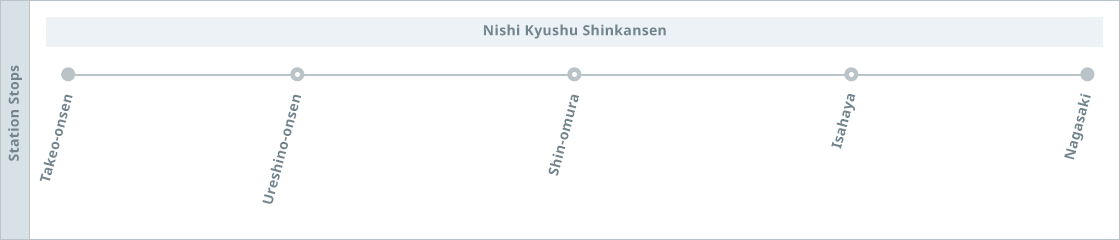
The currently operating line is 66 km long and runs between Takeo-Onsen Station (Saga Prefecture) and Nagasaki Station.The line makes the following stops:
-
Takeo-Onsen: The transfer hub and a famous hot spring town.
-
Ureshino-Onsen: A new station serving a famous tea and onsen district.
-
Shin-Omura: Convenient for access to Nagasaki Airport.
-
Isahaya: A major transit point for the Shimabara Peninsula.
-
Nagasaki: The final stop, located in a newly redeveloped station building.
|
Station |
Prefecture |
Transfers / Highlights |
|
Takeo-Onsen |
Saga |
Transfer to "Relay Kamome" (to Hakata), Famous Hot Springs |
|
Ureshino-Onsen |
Saga |
Famous for "Bihada-no-yu" (skin-beautifying) hot springs |
|
Shin-Omura |
Nagasaki |
Near Nagasaki Airport (accessible by bus/local train) |
|
Isahaya |
Nagasaki |
Transfer to Shimabara Railway and Omura Line |
|
Nagasaki |
Nagasaki |
Terminal station; Peace Park, Glover Garden, Mount Inasa |
How to Travel from Fukuoka (Hakata) to Nagasaki:
This line is not yet fully connected to the main Sanyo/Kyushu Shinkansen network . If you are traveling from Hakata Station (Fukuoka) , you will need to do a cross-platform transfer at Takeo-Onsen Station . You'll take a "Relay Kamome" limited express train from Hakata to Takeo-Onsen, step off, and walk just a few steps to the waiting Shinkansen "Kamome" on the other side of the same platform. The entire journey from Hakata to Nagasaki takes about 1 hour and 20 minutes.
1️⃣Step 1: Relay Kamome
Board the Relay Kamome Limited Express train at Hakata Station. The ride takes approximately 60 minutes to reach Takeo-Onsen.
2️⃣Step 2: The "Shinkansen Cross-Platform Transfer"
At Takeo-Onsen Station, the Relay Kamome arrives at one side of the platform (Platform 10), and the Shinkansen Kamome waits on the opposite side (Platform 11). You simply walk across the platform—no stairs or gates required.
3️⃣Step 3: Kamome Shinkansen
The Shinkansen ride from Takeo-Onsen to Nagasaki takes only 23–28 minutes.
Total Travel Time: ~90 minutes (30 minutes faster than the old express-only route).
2. Train Cars & Seat Types
The Nishi Kyushu Shinkansen uses a 6-car version of the state-of-the-art N700S (Supreme) trainset. Unlike the 16-car trains you see on the Tokyo-Osaka route, these are specifically customized for Kyushu with unique interiors and a focus on high-end design.Here is the breakdown of the car types and seat configurations:
A. Seat Layout and Configuration
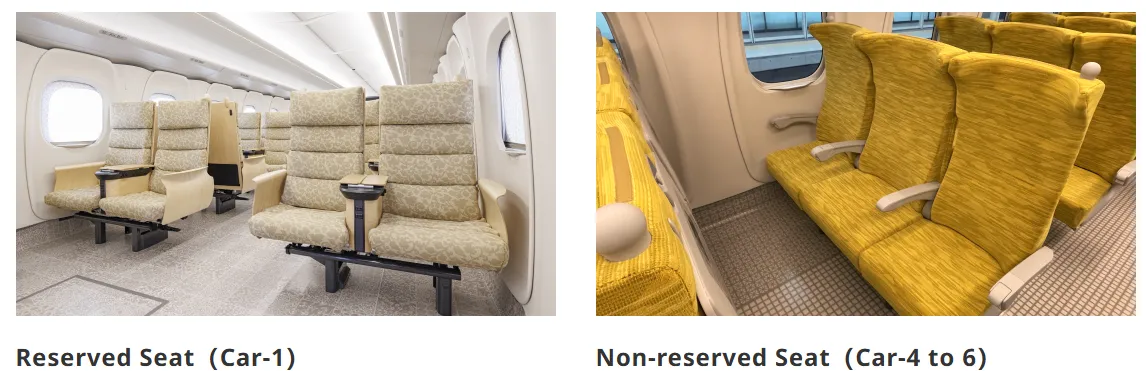
The train is divided into two distinct seating styles: Reserved (指定席) and Non-reserved (自由席) cars. Interestingly, there is no Green Car (First Class) on this line, but the reserved seats are designed to feel like a premium experience.
Reserved (Cars 1–3):
✔️Best choice if you want guaranteed seating.
✔️More legroom and a relaxed 2+2 layout.
✔️Ideal if traveling with companions who want seats together.
Non-Reserved (Cars 4–6):
✔️Cheaper and flexible — just show up and find an open seat.
✔️Great if your schedule is flexible or during non-peak times.
❗Can be crowded at busy hours — may require standing until seats free up.
|
Car Number |
Seat Type |
Layout |
Capacity |
Interior Features |
|
Cars 1–3 |
Reserved |
2+2 |
163 total |
Wide seats, wooden finishes, and Japanese motifs (chrysanthemums/lions). |
|
Cars 4–6 |
Non-Reserved |
3+2 |
233 total |
Cheerful yellow seats with a "checkerboard" or modern fabric design. |
B. Seat Features and Design
-
All Seats: Regardless of class, every seat on the Kamome is equipped with a power outlet, allowing you to charge your devices throughout the journey.
-
Reserved Seats (指定席): These seats feature flame-resistant wood on the armrests and unique traditional Japanese patterns on the upholstery, with a different design in each of the first three cars . The armrests are fixed, meaning they do not flip up.
-
Non-reserved Seats (自由席): These seats have a simple and bright design. The armrests can be flipped up, which can be more convenient if you are traveling with a small child or have larger bags you'd like to place on the seat next to you.
C. Luggage Storage
-
Overhead Racks: Standard Shinkansen racks are available for small/medium bags.
-
Oversized Luggage: If your bag’s total dimensions (Length + Width + Height) exceed 160 cm, you must book a "Seat with Oversized Luggage Area." These are located in the last row of the reserved cars (Cars 1–3).
-
Behind the Seat: Space behind the final row is reserved specifically for those who have booked those specific seats.
3. Service Frequency & Timetable
The Nishi Kyushu Shinkansen operates as a high-frequency shuttle service. Because it currently requires a transfer at Takeo-Onsen, you must look at both the "Relay" and "Shinkansen" schedules to get the full picture.
-
Hakata ↔ Nagasaki: Trains run roughly 1–2 times per hour.
-
Total Journey Time: Approximately 1 hour 20 minutes (at top speed).
-
Operating Hours: First Train: Departs Hakata around 06:00; departs Nagasaki around 06:17.
-
Last Train: Departs Hakata around 22:00; departs Nagasaki around 22:10.
Timetables (major trains, 2026.3.14-2027.2.28)
How to Buy the Tickets?
Buying tickets for the Nishi Kyushu Shinkansen is straightforward, but the method changes slightly depending on whether you are using a rail pass or paying as you go.
Since the line requires a transfer (Hakata → Takeo-Onsen → Nagasaki), your ticket will usually cover the entire journey (both the "Relay" train and the Shinkansen) in one booking.
1. Buying Online (Best for Discounts)
This is the most convenient method and often gives you "Early Bird" (Hayatoku) discounts.
-
JR Kyushu Train Reservation (Official): This is the best site for the Nagasaki route. You can book seats, pay by credit card, and pick up your physical tickets at a machine using the QR code they email you.
-
SmartEX: Since 2024, the SmartEX app/website (which covers Tokyo to Osaka) also covers the Kyushu and Nishi Kyushu lines. You can link it to your IC Card (like Suica or Pasmo) and just tap through the gates without a paper ticket.
-
JR-West Online: Also supports Kyushu bookings if you are traveling from cities like Osaka or Hiroshima.
2. Buying at the Station (Traditional)
If you prefer a physical ticket or have questions for a human:
-
Ticket Machines (Green/Blue): Look for the "Reserved Seat" machines. They have an English menu. Select "Nagasaki" as your destination. The machine will automatically bundle the Relay Kamome and the Shinkansen into one transaction.
-
Ticket Office (Midori-no-Madoguchi): Head to the staffed window (marked with a green reclining seat logo). Simply tell the agent your destination and preferred time. They accept cash and most international credit cards.
3. Using a Rail Pass
If you have a JR Pass (All Japan) or a JR Kyushu Pass (All or Northern), you don't need to "buy" a ticket, but you should still book a seat:
-
Reserved Seats: Take your pass to any ticket machine or office to get a "Reserved Seat Ticket." This ensures you get the better 2x2 seating.
-
Non-Reserved: You can simply walk onto the train (Cars 4–6) and show your pass to the staff if asked.
💡The "Two-Ticket" Rule:
When you buy a paper ticket for this route, the machine might spit out three items:
-
Base Fare Ticket: Covers the distance of the trip.
-
Limited Express/Shinkansen Ticket: Covers the speed/seat reservation.
-
A Receipt: (Do not try to put this in the gate!)
How to use them: Put both the Fare and Limited Express tickets into the gate slot at the same time. The machine will stack them and pop them back out at the other end.
Typical Ticket Prices for the Nishi Kyushu Shinkansen
A. Standard Fares (Hakata ↔ Nagasaki)
If you buy your ticket at a machine or window on the day of travel, these are the typical 2026 prices:
-
Reserved Seat: ~¥6,050
-
Non-Reserved Seat: ~¥5,520
-
Green Car: ~¥8,400 (This puts you in the Green Car for the first 60 minutes, then a standard reserved seat for the 25-minute Shinkansen leg).
B. Online Discount Fares (Best Value)
If you book through the JR Kyushu Train Reservation website or the SmartEX app, you can save significantly.
|
Ticket Type |
Price (approx.) |
Booking Requirement |
|
Kamome Net Kippu |
¥4,500 |
Can be bought on the same day. |
|
Kamome Net Hayatoku 3 |
¥3,850 |
Must book at least 3 days in advance. |
|
EX Hayatoku 21 |
¥3,500 - ¥3,700 |
Must book at least 21 days in advance (SmartEX). |
If you are a tourist, the most cost-effective way to ride is often with a rail pass. The Nishi Kyushu Shinkansen is 100% covered by:
-
JR Pass (All Japan): Full coverage.
-
JR Kyushu Rail Pass (All Kyushu): Full coverage.
-
JR Kyushu Rail Pass (Northern Kyushu): Full coverage.
If you are making a round trip from Fukuoka to Nagasaki in one day, the Northern Kyushu Area Pass (3-day) at ¥12,000 almost pays for itself just with that one trip (a standard round trip is ~¥12,100). You'd then have two extra days of free travel to places like Kumamoto or Beppu.
The Luggage Rules
The Nishi Kyushu Shinkansen follows the standard "oversized luggage" rules used on major Japanese bullet train lines. Since the N700S "Kamome" is a high-speed train with limited floor space, these rules are strictly enforced to keep aisles clear.
A. The "160 cm Rule"
Whether you need a reservation depends on the total dimensions of your bag (Length + Width + Height):
-
Under 160 cm (Small/Medium): No reservation needed. You can store these on the overhead racks or at your feet.
-
160 cm – 250 cm (Large/Oversized): Reservation is REQUIRED. This size is typical for large check-in suitcases.
-
Over 250 cm: Not allowed on the train. You must use a luggage delivery service (like Yamato "Ta-Q-Bin").
B. Storage Locations on the Kamome
-
Overhead Racks: These are surprisingly deep and can fit most bags that fall under the 160 cm limit.
-
Oversized Luggage Area: This is the space behind the last row of seats in the reserved cars (Cars 1–3).
-
Luggage Shelves: Unlike the longer Shinkansen lines, the N700S Kamome has dedicated luggage racks near the doorways in some cars for mid-sized bags.
C. How to Book Luggage Space
If your bag is oversized (160 cm+), you must select a specific seat type when buying your ticket:
-
The Cost: It is free if you book it in advance.
-
The Penalty: If you board with an oversized bag without a reservation, you will be charged a ¥1,000 fine, and the conductor will move your bag to a designated (often inconvenient) spot.
-
Rail Pass Holders: You can reserve these seats for free at any ticket machine or window by selecting the "Seat with Oversized Baggage Area" option.
💡Pro Tips:
-
The "Relay" Transfer: Remember that you have to move your bags from the Relay Kamome to the Shinkansen at Takeo-Onsen. The platforms are level and right next to each other, but if you have multiple heavy bags, you only have about 3 minutes to make the switch.
-
Strollers & Sports Gear: Strollers, bicycles (in a bike bag), and musical instruments are generally exempt from the reservation rule, but it's still polite (and easier) to book the last-row seats if you need the extra floor space.
-
Hands-Free Travel: If you have massive suitcases, consider Hands-Free Travel services at Hakata Station. They can ship your bags directly to your hotel in Nagasaki for about ¥2,000–¥3,000, allowing you to enjoy the ride with just a small daypack.
Frequently Asked Auestions (Q & A)
Is there a direct train from Hakata to Nagasaki?
No. Because a section of the track in Saga Prefecture is still under construction (and currently involves some local political debate), you cannot yet ride a single train the whole way. You must take the Relay Kamome to Takeo-Onsen and transfer to the Shinkansen there.
Is the transfer at Takeo-Onsen difficult?
Not at all, it's designed to be very easy. The "Relay Kamome" and the Shinkansen "Kamome" stop on opposite sides of the same platform. You simply step off one train and walk a few steps to the other .
How long is the transfer at Takeo-Onsen?
Usually 3 minutes. This sounds tight, but it is a cross-platform transfer. The Shinkansen literally waits on the other side of the platform from your arriving train. You walk about 10–15 steps. It is designed to be the easiest transfer in the world.
Can I eat and drink on board?
Yes. Unlike local subways, eating is encouraged on the Shinkansen. There is no trolley service (food cart) on the Nishi Kyushu Shinkansen. You should buy your ekiben (station bento) or drinks at Hakata or Nagasaki Station before you board.
Which side has the best views?
-
Heading to Nagasaki: Sit on the left side (Seat A/B) for occasional glimpses of the Ariake Sea.
-
Heading to Hakata: Sit on the right side (Seat D/E).
Is the JR Pass "Nozomi" restriction relevant here?
No. The Nishi Kyushu Shinkansen only has one type of train: the Kamome. This is not a "Nozomi" or "Mizuho" class train, so it is fully covered by the standard JR Pass without any extra surcharges.
What happens if I miss my connection?
If your Relay Kamome is delayed, the Shinkansen will almost always wait for it. If you personally miss the connection (e.g., you stayed to use the restroom), your reserved ticket is still valid for a non-reserved seat on the next Shinkansen, which usually departs 30–60 minutes later.
I have a Rail Pass. Can I reserve a seat online?
No, not for this line. The "Relay Kamome" limited express and the Nishi-Kyushu Shinkansen "Kamome" are not covered by the JR Kyushu Rail Pass online booking service . To reserve a seat with a Rail Pass, you must visit a ticket counter ("Midori no Madoguchi") at a JR station in person after you arrive in Japan .