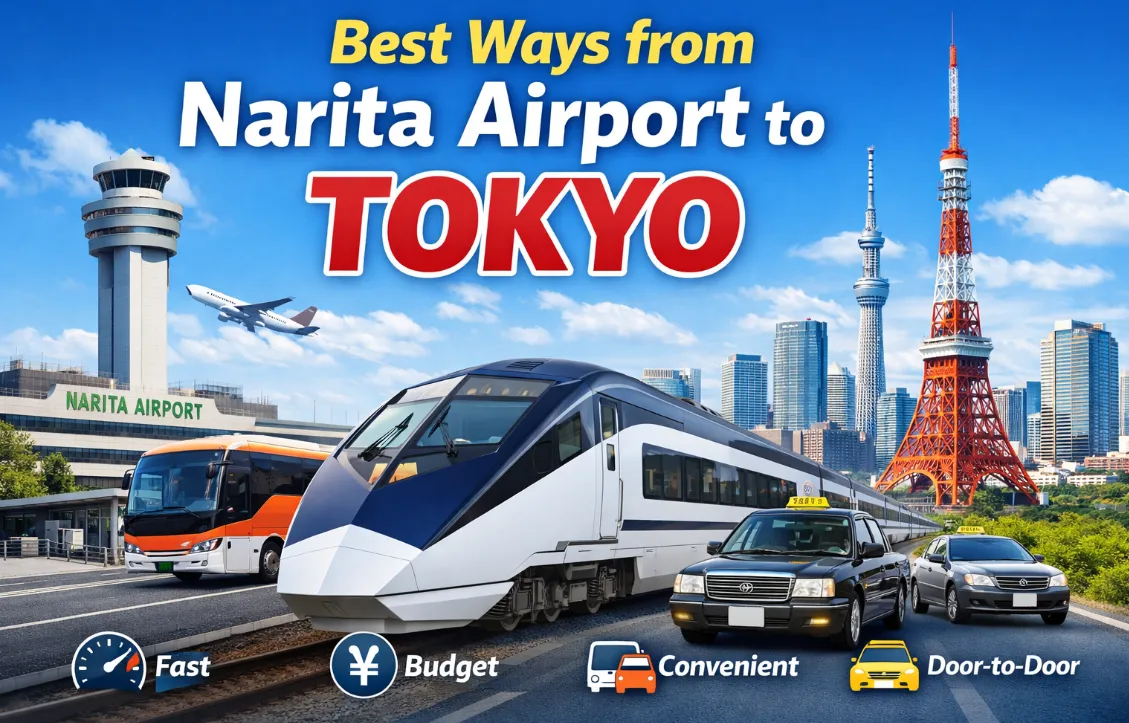
For many international travelers, Narita Airport is the gateway to Japan’s capital. However, the airport is located about 60 km from central Tokyo, which means choosing the right transportation option is an important part of planning your arrival. From express trains and limousine buses to taxis and shared transfers, there are several ways to travel between the airport and the city.The next question quickly follows: what’s the most convenient way to reach central Tokyo?This guide compares the most popular routes from Narita to the city center, covering travel duration, ticket prices, advantages, and potential drawbacks for each option. Whether you're heading to Shinjuku, Tokyo Station, or other major districts, you’ll find practical tips to help you pick the transportation method that fits your schedule, budget, and travel style.
Best Ways from Narita Airport to Tokyo: Quick Comparison Table
Planning your transfer from Narita Airport (NRT) to Tokyo is a key part of a smooth start to your trip. The best option for you will depend on your budget, final destination in Tokyo, luggage situation, and arrival time.Here is a quick overview of the main transportation methods from Narita Airport to central Tokyo.
|
Method |
Destination |
Travel Time |
Cost (One-Way) |
Best For |
|
Keisei Skyliner |
Ueno / Nippori |
36-41 min |
¥2,570 - ¥2,640 |
Travelers prioritizing speed and comfort, with destinations in Northern Tokyo (Ueno, Asakusa). |
|
Narita Express (N'EX) |
Major stations (Tokyo / Shinjuku / Shibuya) |
53-80 min |
¥3,000 - ¥3,070 |
First-time visitors and those heading directly to major hubs like Tokyo, Shinjuku, or Shibuya. |
|
Keisei Access Express |
Asakusa / Oshiage / Shinagawa |
60-70 min |
¥1,240 - ¥1,300 |
Budget-conscious travelers with light luggage, especially those heading to Asakusa or Oshiage. |
|
Airport Limousine Bus |
Major stations, door-to-door service to many hotels |
55-120 min (depending on traffic/destination) |
¥1,300 - ¥3,600 |
Travelers with heavy luggage, families, or those staying at major hotels. |
|
Private Transfer / Taxi |
Door-to-door |
60-90 min |
¥8,000 - ¥27,000+ |
Groups, families, those with mobility concerns, or late-night/early-morning arrivals. |
1. Keisei Skyliner
The Keisei Skyliner is the fastest train connecting Narita Airport with Tokyo, reaching speeds of up to 160 km/h. It takes about 36 minutes to Nippori Station and around 41 minutes to Ueno, where you can transfer to the JR Yamanote Line for other districts like Shinjuku or Shibuya.
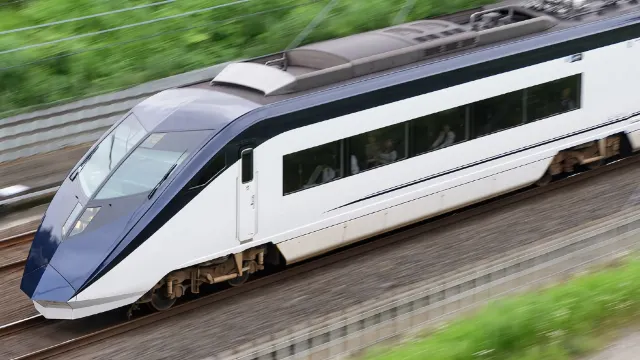
📍 Route: Narita → Nippori → Keisei Ueno.It primarily serves the northeastern part of Tokyo. From Nippori, you can easily transfer to the JR Yamanote Line to reach other popular areas like Tokyo Station, Shinjuku, and Shibuya.
✔️ Pros:
-
The fastest way into the city.
-
All seats are reserved, guaranteeing you a comfortable spot after your flight.
-
The trains also have large luggage storage areas and free Wi-Fi.
❌ Cons:
-
Only stops at Nippori and Ueno, not direct to Tokyo Station.
-
Requiring a transfer to the JR Yamanote line for other major hubs.
Travel Time:
It whisks you from the airport to Nippori in just 36 minutes and Ueno in 41 minutes.
Cost:
The fare is approximately ¥2,570 - ¥2,640.
How to Book:
1️⃣ The "Fastest" Way: Face Check-in Go
As of 2025/2026, this is the most advanced option. It allows you to skip the ticket vending machines entirely.
-
Visit the Official Keisei Skyliner e-ticket website.
-
Select "Skyliner e-ticket Face Check-in Go" (Available for one-way trips only).
-
Register your face: After payment, use your phone/PC camera to upload a photo of your face.
-
At the Airport: Walk directly to the "Face Check-in Go" gate. The system scans your face, and a machine dispenses your physical ticket automatically for the next available train.
⚠️ Note: If traveling in a group (up to 4 people), only the representative needs to register their face; the others simply follow them through.
2️⃣ The "Standard" Online Way (QR Code)
Best if you want the online discount but aren't comfortable with facial recognition or want to choose a specific later train.Purchase a "Skyliner Discount Ticket" on the official site or third-party apps like Klook/Trip.com.
3️⃣ The "Manual" Way (On Arrival)
If you didn’t book online, you can buy tickets after arriving:
➤ Where to Go: Head to the B1 level of Terminal 1 or Terminal 2/3.
➤ Ticket Office: Look for the orange/blue counters. Staff speak English and can help you with transfers.
➤ Vending Machines: Use the blue machines labeled "Skyliner." They have full English menus and accept credit cards or IC cards (Suica/Pasmo).
💡 Crucial Booking Tips:
-
❶ Round-Trip vs. One-Way: The "Face Check-in Go" service currently only works for one-way tickets. If you buy a round-trip e-ticket, you must exchange it for a voucher at the airport first.
-
❷ Seat Selection: If you use Face Check-in, the system assigns you the best available seat on the next train. If you want a specific seat (like a window or near the luggage rack), use the QR Code method at a machine instead.
-
❸ Passport: Always keep your passport handy when picking up "Discount Tickets," as staff may occasionally ask for proof of tourist status.
2. JR Narita Express (N’EX)
Operated by JR East, the Narita Express (N'EX) is another excellent choice, especially for first-time visitors. It connects the airport directly to many of Tokyo's most important train stations without any transfers.All seats are reserved, and the train provides large luggage racks, power outlets, and onboard restrooms.Furthermore,the N'EX is fully covered by the Japan Rail Pass, making it an exceptional value if you plan to do a lot of train travel around Japan.
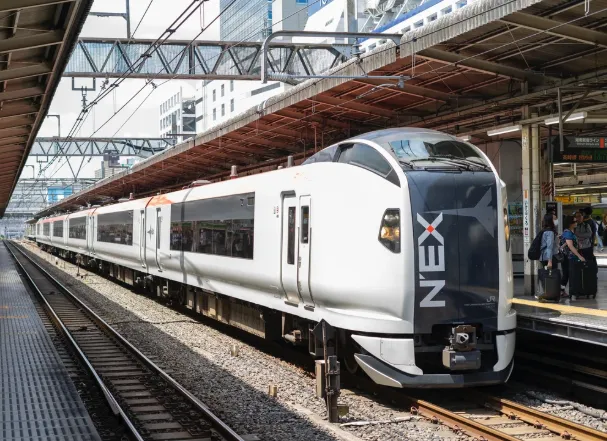
📍 Route: Narita → Tokyo Station → Shinagawa → Shibuya → Shinjuku.
✔️ Pros:
-
Direct access to major hubs (Tokyo, Shinagawa, Shibuya, Shinjuku, Yokohama).
-
Fully covered by the JR Pass.
-
Comfortable with reserved seating.
-
Spacious, large luggage racks.
❌ Cons:
-
More expensive than the Skyliner if buying a one-way ticket.
-
Slightly slower than the Skyliner.
-
Runs less frequently (every 30–60 mins).
Travel Time:
~53 mins to Tokyo Station; ~80 mins to Shinjuku/Shibuya.
Cost:
~¥3,070 (One-way) or ¥5,000 (N’EX Tokyo Round Trip Ticket).
How to Book:
1️⃣ Book Online in Advance
Booking online before you travel guarantees you a seat, especially during peak travel seasons. You can use the official JR East system or a trusted travel platform.
➤ Official JR East Website: You can reserve and purchase tickets directly through the JR-EAST Train Reservation system from abroad . This is the official channel, and it allows you to secure your specific train and seat.
➤ Via the "Welcome Suica Mobile" App (New for 2026!): As of October 1, 2025, JR East has made booking even easier. The "Welcome Suica Mobile" app (for visitors from overseas) is now linked with the JR-EAST Train Reservation system . This means you can book reserved seats on the Narita Express directly within the app and pass through the gates ticketless using your phone.
➤ Travel Booking Sites: User-friendly platforms like Klook and Trip.com also sell N'EX tickets . These are often a great choice because they allow you to pay in your own currency and provide a QR code to exchange for your ticket at the airport. Klook, for example, offers a simple three-step booking process for N'EX tickets.
2️⃣ Buy a Ticket at the Airport
If you prefer to handle things in person, purchasing a ticket when you land is very easy.
➤ Locate a Ticket Office: After clearing customs, head to the JR EAST Travel Service Center (located in the arrival lobbies of both Terminal 1 and Terminal 2·3). The staff here speak English and can help you book your seats.
➤ Use a Ticket Machine: You can also use the Reserved Seat Ticket Vending Machines ("Midori-no-Madoguchi") found near the train station entrances. These machines have an English language option, making it simple to select your destination, time, and seat.
3️⃣ Use a JR Pass
If you plan to do a lot of train travel in Japan, a Japan Rail Pass (JR Pass) can offer incredible value.The JR Pass covers the entire fare for the Narita Express. However, you still need to make a seat reservation . You can do this at any JR Ticket Office (like the one at the airport) by showing your pass. There is no additional cost for this.
💡 Important Tips:
-
❶ All Seats are Reserved: You cannot board the N’EX and just "find a seat" like a local train. You must have a designated seat number.
-
❷ Green Car (First Class): If you want extra legroom and a quieter cabin, look for the "Green Car" option during booking (usually ~¥1,500 extra).
-
❸ Wait for the Right Car: The N’EX often splits into two different directions at Tokyo Station. Ensure you are sitting in the correct car for your final destination (e.g., Cars 1-6 might go to Shinjuku, while 7-12 go to Yokohama).
3. Keisei Access Express
For travelers watching their wallet, the Keisei Access Express is a fantastic option. It's a commuter train that offers a slower but significantly cheaper ride into the city.Some services run directly to areas like Asakusa without transfers, making it a good choice if you’re traveling light.
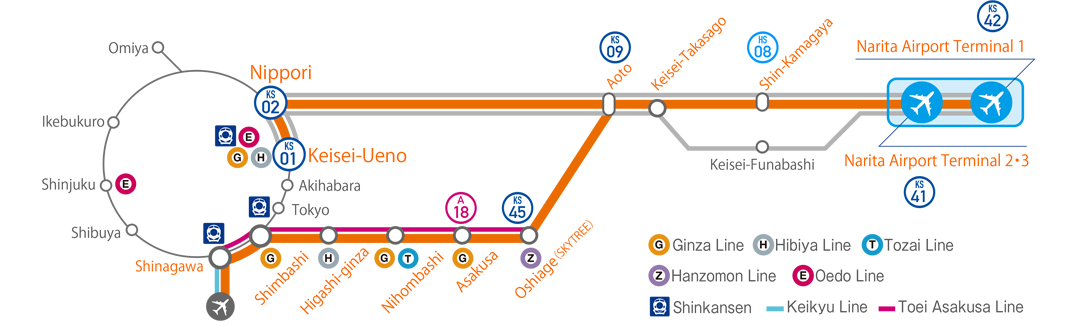
📍 Route: Narita Airport → Asakusa / Oshiage / Shinagawa.Operates between Narita Airport Terminal 1/2-3 and various Tokyo locations, often continuing to Haneda Airport.
✔️ Pros:
-
Very affordable.
-
Direct trains to eastern Tokyo.
-
No reservation needed.
❌ Cons:
-
The train has no reserved seating and can get very crowded, especially during rush hours (7:30-9:30 AM and 5:00-7:00 PM).
-
Limited luggage space.It's not recommended if you have large suitcases.
Travel Time:
Around 60–70 minutes depending on your destination.
Cost:
The cost from Narita Airport to central Tokyo is approximately ¥1,300 (about 1,240 - 1,300 yen) .
How to Book:
➤ Buy/Use an IC Card (Recommended): The easiest method is to use a rechargeable IC card like Suica or PASMO . You can buy and charge these cards at vending machines in the train station area. Simply tap your card on the reader at the ticket gates to enter and exit . This also works for almost all other trains, subways, and even convenience stores in Tokyo.
➤ Buy a Single Ticket: If you don't have an IC card, use the ticket vending machines. They have an English language option. Look for the fare to your destination.
4. Airport Limousine Bus
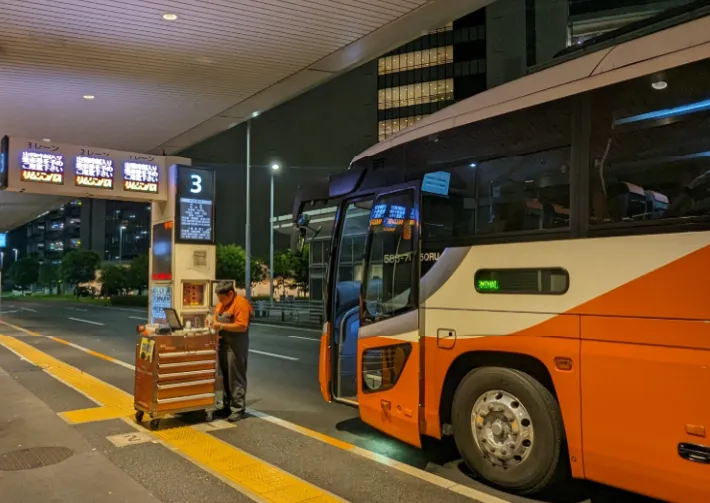
The Airport Limousine Bus is arguably the most relaxing way to get to your hotel, especially if you have heavy luggage or are traveling with family. These buses operate frequent services to major hotel areas and transportation hubs across Tokyo.
If you have multiple heavy suitcases, this is the least stressful option as it drops you directly at the lobby of major hotels.
✔️ Pros:
-
Door-to-door service to many major hotels.
-
Staff handles your luggage.
-
No navigating train stations.
❌ Cons:
-
Susceptible to highway traffic.
-
One of the most expensive public transit options.
Travel Time:
Unlike trains, buses are subject to Tokyo's traffic. While the trip can take as little as 55 minutes, it can easily stretch to 90 minutes or more during peak traffic times.
Cost:
Fares vary by destination, but you can expect to pay around ¥1,300 to ¥3,600.
How to Book:
1️⃣ Book Online
Booking online before you travel guarantees your seat, which is especially useful during peak travel seasons. You can use the official reservation system or trusted travel platforms.
|
Booking Platform |
How It Works |
Best For |
|
Official "Limousine Web" |
Visit the official website, select your route, date, and number of passengers, then make payment online. You'll receive a confirmation email with a QR code . |
Travelers who want to use the official system and secure their seat directly. |
|
Book through these platforms, often with discounted fares and payment in your own currency. You'll receive a QR code or voucher via email . |
Travelers looking for discounted tickets and a familiar booking interface in their language. |
After booking online, you will need to redeem your QR code for a physical boarding pass at the airport. Simply scan your QR code at the Limousine Bus Ticket Counter or a designated ticket vending machine to get your boarding pass before boarding .
⚠️Important Note: Some online bookings (like those through certain travel platforms) require you to click a link in your confirmation email to select your specific bus departure time and reserve your seat . Be sure to follow the instructions in your voucher carefully.
2️⃣ Buy a Ticket at the Airport
If you prefer to handle things in person or your plans are flexible, purchasing a ticket when you land is very easy. Ticket counters and machines are clearly signposted in the arrival lobbies .
-
Locate a Ticket Counter: After clearing customs, head to the Airport Limousine Bus Ticket Counter in the arrival lobby. The counters are located at:
-
Terminal 1: Arrival Lobby 1F, South Exit 1 (Open approximately 06:40 - 23:10)
-
Terminal 2: Arrival Lobby 1F, South Exit (Open approximately 06:30 - 23:00)
-
Terminal 3: Main Building 1F, South Gate (Open approximately 06:30 - 22:50)
-
The friendly, English-speaking staff can help you choose the right bus for your destination and sell you a ticket .
-
-
Use a Ticket Vending Machine: You can also purchase tickets from automated ticket machines located near the bus stops. These machines usually have an English language option and accept cash, credit cards, and IC cards
💡 Important Tips:
-
❶ Book Early for Peak Times: If you're traveling during Japanese holidays or peak tourist seasons, it's highly recommended to book your ticket online in advance to secure your preferred departure time.
-
❷ Luggage Allowance: Be mindful of the baggage allowance. You can typically bring up to two suitcases per person, with maximum dimensions of (h)120cm x (w)60cm x (d)50cm and weight of 30kg each .
-
❸ Child Fares: Children aged 6 to 11 pay a child fare. Infants and children under 6 ride for free if they sit on a parent's lap. If they need their own seat, a child ticket is required .
-
❹ Know Your Destination: Have your hotel name and address ready, especially in Japanese, to show the ticket agent or driver if needed.
5. Private Transfer / Taxi
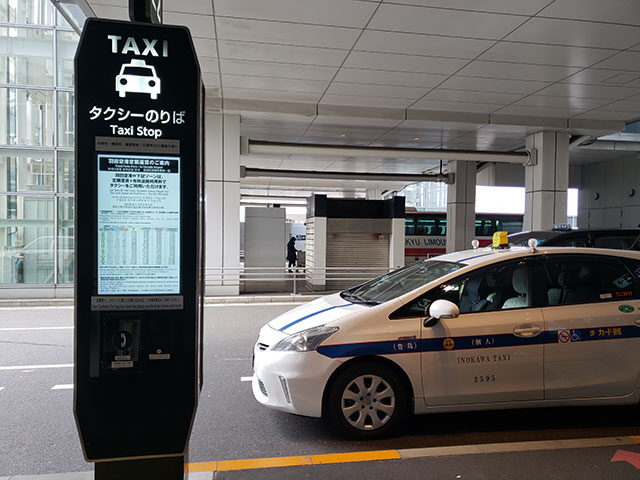
Taxis and private transfers provide door-to-door service from Narita Airport to your hotel. While they’re the most convenient option, they’re also the most expensive.
✔️ Pros:
-
Door-to-door service.
-
No transfers.
-
Ideal for groups or lots of luggage.
-
Available 24/7.
❌ Cons:
- Very expensive compared with trains or buses.
Travel Time:
60–90 minutes.
Cost:
➤ Shared Transfer: This option offers door-to-door service at a fixed price, which is cheaper than a private car. For example, a shared ride from Narita to any of Tokyo's 23 wards costs around ¥15,000 per person and includes luggage fees and tolls.
➤ Private Transfer: Perfect for groups or those who want the vehicle to themselves. Prices for a private transfer can start from around ¥8,000 for a standard car to a specific zone, going up significantly for larger vehicles.
➤ Taxi: A taxi fare to central Tokyo is steep, typically ranging from ¥25,000 to ¥35,000 , plus potential late-night surcharges (10 PM - 5 AM) and highway tolls.
How to Book:
➤ Private Transfer: It's essential to book these online in advance through services like Veltra or Welcome Pickups. You will receive a confirmation with pick-up details.
➤ Taxis: Simply follow the "Taxi" signs to the official taxi ranks outside each terminal. Pre-booking is generally not required but possible through apps like JapanTaxi.
Key Tips for a Smooth Arrival
-
Consider your luggage: Be honest about how much you can comfortably manage. If you have large or multiple suitcases, the Limousine Bus or a Private Transfer will save you a lot of stress.
-
Watch the clock: If you are arriving after 10:00 PM - 11:00 PM, train and bus services become very limited or stop altogether. In this case, booking a private transfer or preparing for a taxi is your only option for getting to Tokyo that night. Staying at an airport hotel is another great alternative.
-
Avoid rush hour: If possible, try to avoid arriving during the busy morning (7:30-9:30 AM) or evening (5:00-7:00 PM) commutes, especially if you plan to take local trains.
-
Have your destination handy: When taking a taxi or private transfer, have your hotel name and address written down in Japanese to show the drive.
-
Luggage Delivery: If you have multiple large bags, consider Hands-Free Travel counters (like Yamato Transport) at the arrivals hall. They will ship your luggage to your hotel for ~¥2,500, letting you take the train unencumbered.
-
Terminal 3: If you fly a budget airline (Jetstar, Peach), you will land at Terminal 3. You must walk about 10–15 minutes or take the free shuttle to Terminal 2 to access the Express Trains.