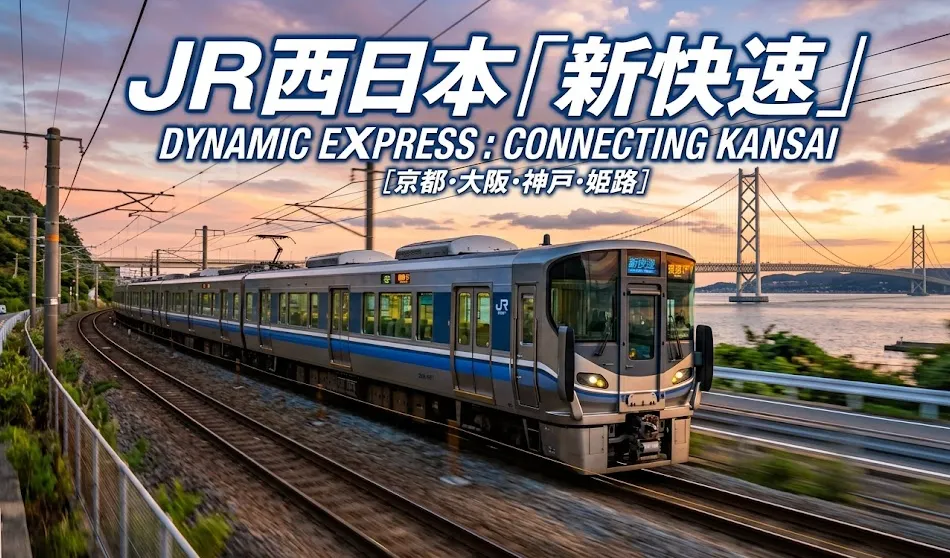
Traveling between Kyoto, Osaka, and Kobe doesn’t have to mean expensive express tickets or slow local trains. The JR Special Rapid service remains the smart commuter’s choice—offering top speeds without reserved-seat surcharges.Known for its speed and simplicity, this service is a favorite among commuters but often overlooked by visitors. As we head into 2026, staying updated on the latest route maps, ticketing rules, and A-SEAT reservation fees is crucial for a smooth journey. How to buy JR Special Rapid train seats in Japan?This guide breaks down everything you need to know, from station stops and travel times to unlocking the comfort of the A-SEAT car. Whether you’re a budget-conscious traveler or a daily rider, here’s how to move efficiently across the Kansai region.
What is the JR Special Rapid Service?
The JR Special Rapid (新快速 / Shinkaisoku) is a high-speed, limited-stop service operated by JR West in the Kansai region, connecting major cities like Kyoto, Osaka, Kobe, and Himeji. It is legendary among travelers and locals alike because it is the fastest way to get around the region without paying the expensive "Limited Express" or Shinkansen surcharges.
1. Speed and Efficiency
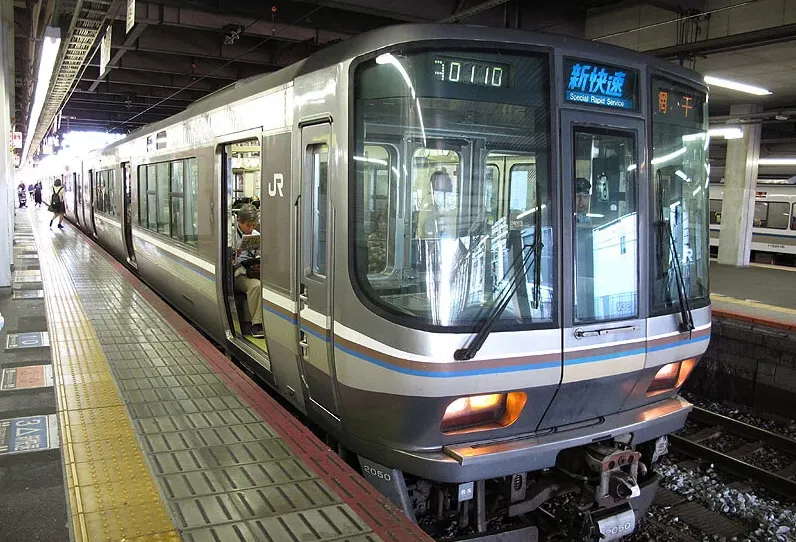
The Special Rapid is one of the fastest narrow-gauge trains in the world, reaching top speeds of 130 km/h (81 mph).It uses the same tracks as local trains but skips most minor stations.While a "Local" train from Kyoto to Osaka stops at every station (taking about 45 minutes), the Special Rapid does it in roughly 28 minutes.
2. No Extra Cost
Unlike the Bullet Train (Shinkansen) or the Haruka Express, the Special Rapid is considered a General Service train.
-
If you have a standard ticket, an IC card (like ICOCA or Suica), or a JR Pass, you just walk onto the platform and board.
-
There is no "Limited Express" fee. You pay the same price as you would for the slow train.
3. Key Features
-
Frequency: During the day, they run every 15 minutes like clockwork.
-
The Look: In 2026, you will mostly see the 223 and 225 series trains. They are silver with blue and beige stripes.
-
Seating: Most cars have "transverse seating" (forward-facing seats that can be flipped to face the direction of travel), which is much more comfortable than the long side-benches found on subways.
The 2026 Upgrade: The "New Rapid" Gets Faster & Smarter
As of March 14, 2026, JR West implemented a significant timetable revision that directly benefits travelers on the Kyoto, Kobe, and Sanyo lines .
While the Special Rapid (Shin-Kaisoku) has always been the king of commuter trains, the 2026 changes introduce two major improvements:
-
Expanded "Ureshi-to" Seating: The paid reserved seating service ("Ureshi-to") has been expanded. While this is a paid upgrade, its presence reduces crowding in the standard "free" cars.
-
New A-SEAT Competition: The introduction of paid premium seating on the Special Rapid (A-Seat) means the standard cars are less congested, making the "free" ride much more pleasant.
The A-SEAT Guide (Reserved Comfort)
The "A-SEAT" is a reserved, premium commuter seat found on the Special Rapid Service. Think of it as "Green Car Lite." It offers wider seats, power outlets, and a guaranteed place to sit.In 2026, JR West has expanded this service to more time slots to cater to tourists and remote workers.
Since the A-SEAT and "Ureshi-to" cars require a separate ticket (approx. ¥300-¥500), avoid them if you want "free" travel. However, their existence is excellent news for you because:
-
Less crowding: Passengers willing to pay migrate to these reserved cars.
-
Guaranteed Seating: No standing in the crowded commuter rush.
-
Amenities: Free Wi-Fi, power outlets at every seat, and reclining chairs with tables.
-
Predictable boarding: Stand on the platform where the non-reserved cars (Cars 1, 2, 3 usually) stop. The platform markings in 2026 clearly indicate which car is which.
How to Book A-SEAT?
-
Online (Smart EX or JR-West Online Train Reservation): Book up to a month in advance. You’ll get a QR code or can link it to your ICOCA.
-
Ticket Machine: Look for the "Reserved Seat" machines at the station.
-
On-Board: If there are empty seats, you can sometimes board and pay the conductor (or via a QR code on the seat back), though it's riskier during peak hours.
Routes & Travel Times
The Special Rapid runs seamlessly across three major urban lines:
-
Kyoto → Osaka → Kobe → Himeji
-
Core sections:
-
Kyoto → Osaka (JR Kyoto Line)
-
Osaka → Kobe (JR Kobe Line)
-
These trains skip many smaller stations, stopping only at major hubs—this is why they’re so fast.
It only stops at: Kyoto → Takatsuki → Shin-Osaka → Osaka → Amagasaki → Ashiya → Sannomiya (Kobe) → Kobe → Akashi → Nishi-Akashi → Kakogawa → Himeji.
|
Route |
Distance |
JR Special Rapid (Shin-Kaisoku) |
JR Shinkansen (Nozomi/Sakura) |
|
Kyoto → Osaka |
42.8 km |
28–30 minutes |
13–15 minutes |
|
Osaka → Kobe (Sannomiya) |
33.6 km |
20–25 minutes |
15–18 minutes |
|
Kyoto → Kobe (Sannomiya) |
75.5 km |
48–55 minutes |
30–35 minutes |
|
Osaka → Himeji |
93.6 km |
65–70 minutes |
30–40 minutes |
💡Important: Shinkansen stations (like Shin-Osaka or Shin-Kobe) are often not in city centers, while Special Rapid stops right in downtown areas.
JR Special Rapid Timetable
In 2026, the JR Special Rapid follows a patterned timetable, meaning trains depart at roughly the same minutes every hour. This makes it incredibly easy to use without constantly checking an app.Here is the official schedule for the JR Special Rapid service connecting Kyoto, Osaka, and Kobe, based on the October 14, 2026 timetable revision.
|
Route |
First Train (Weekday) |
Morning Peak (7:00–9:00) |
Midday Frequency |
Evening Peak (17:00–19:00) |
Last Train |
|
Kyoto → Osaka |
5:00 AM |
Every 10–15 min |
Every 15 min |
Every 10–15 min |
23:45 PM |
|
Osaka → Kobe (Sannomiya) |
5:15 AM |
Every 10–15 min |
Every 15 min |
Every 10–15 min |
0:15 AM |
|
Kyoto → Kobe (Sannomiya) |
5:00 AM |
~2–3 per hour |
~4 per hour |
~2–3 per hour |
23:30 PM |
The timetable is consistent in both directions. If you're traveling from Osaka to Kyoto, just reverse the "Kyoto → Osaka" times.While the timetable above gives you the big picture, apps like Google Maps or Japan Travel by Navitime will give you exact train times for your specific travel date.
Ticketing & Passes
For your trip on the Special Rapid between Kyoto, Osaka, and Kobe, you have two excellent "free" ticketing strategies. You can either pay per ride with an IC card for maximum flexibility or choose a JR pass for the best value if you plan to travel extensively.
-
➤ IC Cards: Simply tap your phone (Apple Pay/Google Pay) or physical card (ICOCA, Suica, Pasmo) at the gates.
-
➤ JR Pass: Fully covered. For A-SEAT, you must pay the additional A-SEAT fee as it is considered a "paid seating service."
Option 1: Pay-Per-Ride (IC Card)
This is the most straightforward and flexible method. You don't need to buy a separate ticket; just tap your IC card at the ticket gates.
-
What you need: An ICOCA, Suica, or Pasmo card. ICOCA is the local card for the Kansai region and can be purchased and charged at ticket vending machines in any JR-West station.
-
How to Ride: Simply tap your card on the reader at the ticket gate when you enter and tap again when you exit. The system automatically calculates and deducts the exact fare.
-
Cost: You only pay the basic fare for each trip.
|
Route |
Approx. Fare (IC Card) |
|
Kyoto Station → Osaka Station |
¥580 |
|
Osaka Station → Sannomiya (Kobe) |
¥420 |
|
Kyoto Station → Sannomiya (Kobe) |
¥990 |
⚠️Note: As of March 2026, JR West has implemented a minor fare adjustment (approx. 4-5% increase). Using an IC card usually yields a slightly lower fare than buying a physical paper ticket at the machine.
Option 2: Unlimited Ride Passes (Best for Day Trips)
If you plan to explore beyond the main three cities, these passes offer excellent value and can make your travel "free" after just a few rides. They are valid on the Special Rapid trains in the ordinary (non-reserved) cars
|
Pass Name |
2026 Price (Adult) |
Best For |
|
¥2,800 (1-Day) |
Day trips between Kyoto, Osaka, Nara, and Kobe. Includes the Haruka Express from KIX. |
|
|
¥12,000 (5-Day) |
If you're heading further out to Himeji, Okayama, or Kinosaki Onsen. |
|
|
¥35,000 (7-Day) |
Travel between Tokyo and Osaka via the "New Golden Route" (Kanazawa/Toyama). |
⚠️Note: The National JR Pass also covers the Special Rapid, but since the massive price hike, it is rarely worth it for just the Kansai region.
How to Find Your Train at the Station?
Finding your train in massive hubs like Osaka or Kyoto station can feel like a maze, but the JR Special Rapid is intentionally designed to be easy to spot.Here is the step-by-step breakdown to finding your platform and the correct boarding spot.
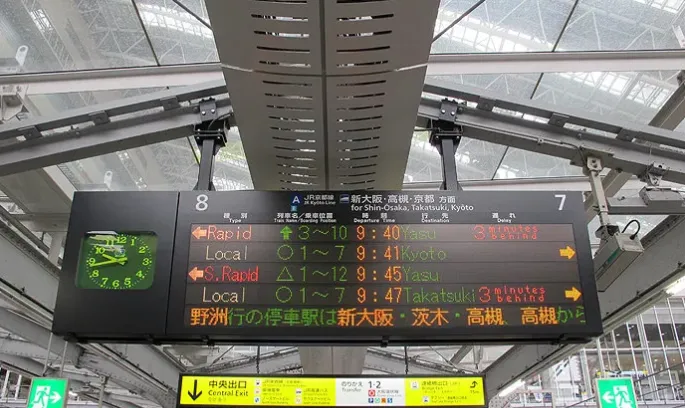
1. Follow the Color: "Blue is Your Friend"
JR West color-codes its services. To find the Special Rapid, ignore the red (Limited Express) and the orange (Rapid) signs.
-
Look for BLUE: All Special Rapid signs, overhead displays, and LED train fronts use a distinct Blue color theme.
-
Kanji to spot: [新快速] (Shin-Kaisoku).
2. Check the Platform (2026 Common Tracks)
While platforms can occasionally change due to maintenance, these are the "home" tracks for the Special Rapid:
-
Kyoto Station:
-
Westbound (to Osaka/Kobe/Himeji): Usually Platforms 4 or 5.
-
Eastbound (to Otsu/Maibara/Tsuruga): Usually Platforms 2 or 3.
-
-
Osaka Station:
-
Westbound (to Kobe/Himeji): Platforms 3, 4, 5, or 6.
-
Eastbound (to Kyoto/Maibara): Platforms 7, 8, 9, or 10.
-
-
Sannomiya (Kobe) Station:
-
Eastbound (to Osaka/Kyoto): Platform 2.
-
Westbound (to Himeji): Platform 3.
-
3. Deciphering the Floor Markings (Circles vs. Triangles)
This is where most travelers get confused. On the platform floor, you will see rows of symbols. The overhead electronic board will tell you which one to follow:
-
Circles (○): Usually indicate the boarding positions for 3-door trains (the standard for Special Rapids).
-
Triangles (△): Usually indicate 4-door trains (often Local or Rapid trains).
-
The Numbers: If the sign says "Special Rapid: ○ 1–12," find the circle with the number 1 through 12 on the floor and line up there.
4. Finding the A-SEAT (Reserved Car)
If you have a reservation for the A-SEAT, you need to be at Car No. 9.
-
Look for the Gold and Black "A-SEAT" branding on the platform floor or the hanging signs.
-
In 2026, Car 9 is always located toward the "Kyoto/Maibara" end of the train when heading West, and the "Himeji" end when heading East.
5. Final Visual Check
Before you step onto the train, look at the LED display on the side of the train car. It should show:
-
❶ Blue Background
-
❷ [新快速] Special Rapid
-
❸ The Destination (e.g., "for Himeji" or "for Tsuruga")
🔔Quick Tip: At Osaka Station, the Special Rapid departs from the "Old" platforms. If you find yourself at the ultra-modern underground "Umekita" platforms (Platforms 21–24), you are in the wrong place for the Special Rapid! Those are for the Haruka and Kuroshio express trains only.
Pro-Tips for a Smooth Ride
-
Peak hours are crowded: Weekdays 7:30–9:00 AM and 5:30–7:00 PM are the busiest. If you can, travel mid-morning or early afternoon for a more comfortable ride.
-
No reservation needed for free cars: Just tap your IC card (ICOCA, Suica, Pasmo) and board any non-reserved car.
-
Platforms at Osaka Station: Special Rapids for Kobe/Himeji usually depart from Platforms 3–6. For Kyoto, head to Platforms 7–10.
-
Don't get confused: Do not board the "Local" (Blue line) or "Rapid" (Orange line) unless you have plenty of time. They stop at many more stations and can take twice as long.
FAQ: JR Special Rapid
Is there an extra fee for the Special Rapid?
No. Unlike the Shinkansen or Limited Express trains (like the Haruka), the Special Rapid is a standard commuter service. You only pay the base fare. If you have a JR Pass or an IC card (ICOCA/Suica), you just tap and board.The only exception is the A-SEAT (Car No. 9), which requires a ¥840 reservation fee.
How do I know I’m not on the "Slow" train?
Check the color and the display.
-
Special Rapid: Blue signs, skips most stations. (Kyoto to Osaka in ~28 mins).
-
Rapid: Orange signs, stops at about half the stations. (Kyoto to Osaka in ~45 mins).
-
Local: Light Blue/Grey signs, stops at every station. (Kyoto to Osaka in ~60+ mins).
Can I bring large luggage on board?
Yes, but there is a catch. Unlike the Shinkansen, there are no mandatory "oversized luggage" reservations for the standard cars. However:
-
Space is limited: There are no dedicated luggage racks in standard cars; you must keep your bags with you.
-
Rush Hour Warning: Avoid bringing large suitcases between 7:30–9:00 AM and 5:00–7:00 PM. The trains are packed with commuters, and a large bag will be very difficult to manage.
-
The A-SEAT Advantage: If you have luggage, booking an A-SEAT is highly recommended as there is more legroom and space to keep a bag near you.
Is it better than the Shinkansen between Kyoto and Osaka?
Usually, yes. The Shinkansen only takes 14 minutes, but it arrives at Shin-Osaka station. You then have to transfer to a local train or subway to get to the actual city center (Umeda/Osaka Station).
The Special Rapid takes you directly into the heart of both cities (Kyoto Station to Osaka Station) in about 28–30 minutes, saving you the hassle and cost of an extra transfer.
What if I miss the last Special Rapid?
Don't panic. After the last Special Rapid (usually around 11:30 PM – Midnight), Local trains continue to run for another 30–45 minutes. They are slower, but they will still get you home.
Are there toilets on the train?
Yes — usually near the front or rear of the train.
Do I need A-SEAT?
No — only if you want a guaranteed seat during rush hour.
Do children pay half?
Yes — child fare is ~50% for tickets and passes.