Planning a journey through Western Japan often feels like a puzzle, but the JR West Sanyo-San’in Area Pass is the missing piece that brings it all together. Whether you're aiming to zip between Osaka and Fukuoka on the Sanyo Shinkansen or explore the rugged beauty of the northern coasts, this 7-day rail pass offers unparalleled freedom. So how to buy the Sanyo-San'in Area Pass?How to use it?This article covers how to secure your rail voucher ahead of time, which trains allow unlimited seating without reservations, and a realistic loop itinerary designed for first-time visitors to the San’in region. By the end, you’ll know exactly how to navigate the area without wasting a single hour on logistics.
What's the Sanyo-San'in Area Pass?
The Sanyo-San'in Area Pass is a 7-day, consecutive-use rail pass for foreign tourists providing unlimited travel on JR lines between Kansai Airport/Osaka, Hiroshima, and Fukuoka (Hakata). It includes the Sanyo Shinkansen (including Hello Kitty Shinkansen), Limited Express trains, local JR buses, and the Miyajima ferry. While the nationwide Japan Rail Pass is famous, this regional version is often considered the "better deal" if you are focusing on the area between Osaka and Fukuoka. It is one of the few passes that allows you to ride the Nozomi and Mizuho Shinkansen (the fastest bullet trains) without any extra surcharges.
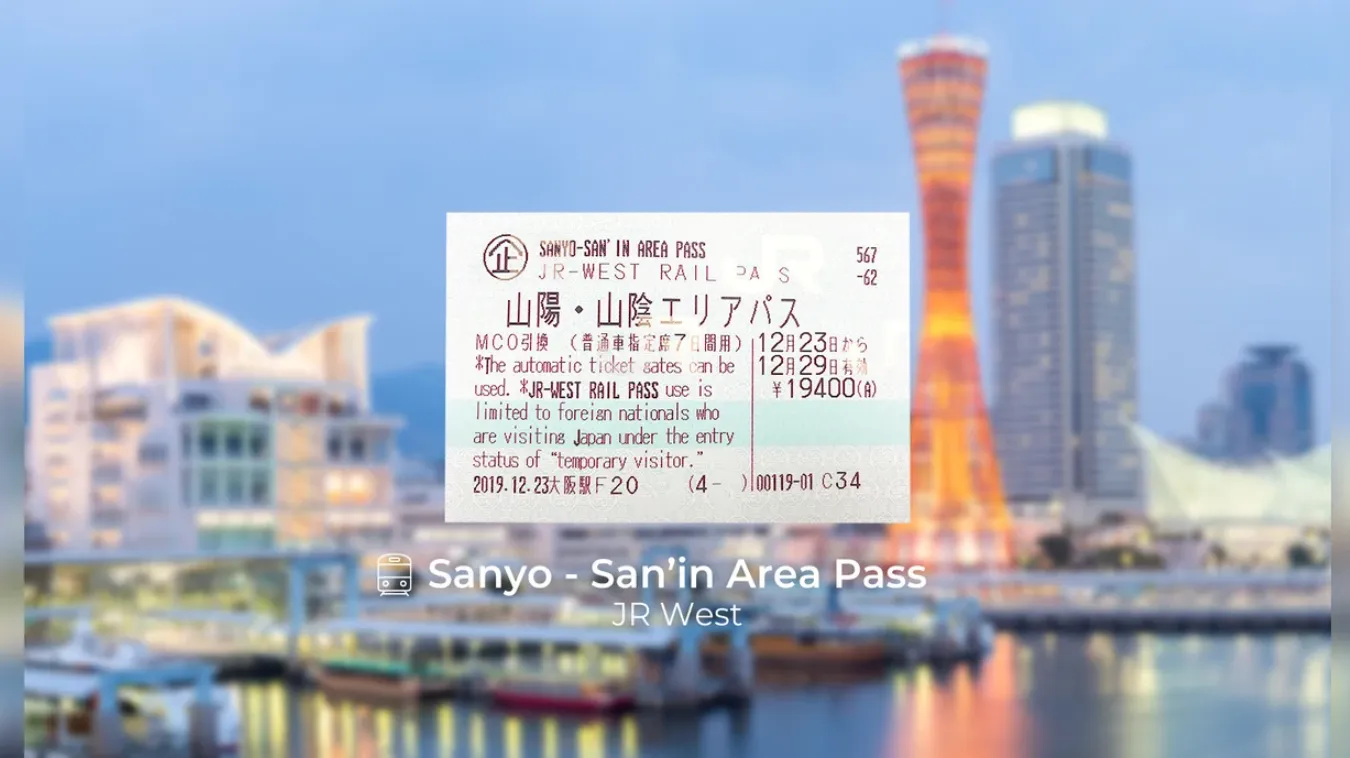
🔑Key Features:
-
Validity: 7 consecutive days.
-
Price:
-
Adult (12+): ¥23,000
-
Child (6-11): ¥11,500
-
-
Eligibility: Exclusive to "Temporary Visitor" visa holders (foreign tourists).
⚠️Note: Prices are based on the date of purchase. The official JR West website or authorized travel agents will display the current rate in your local currency when you book.
What's Covered?
This pass unlocks a massive area. It covers major cities including:
-
Osaka, Kyoto, Kobe
-
Himeji, Okayama
-
Hiroshima, Yamaguchi
-
Tottori, Matsue (San’in coast)
-
Hakata (Fukuoka)
This pass is worth considering if you’re arriving at Kansai Airport and planning to visit cities along the Sanyo and San'in coasts such as Himeji, Kobe, Okayama, and Hiroshima.
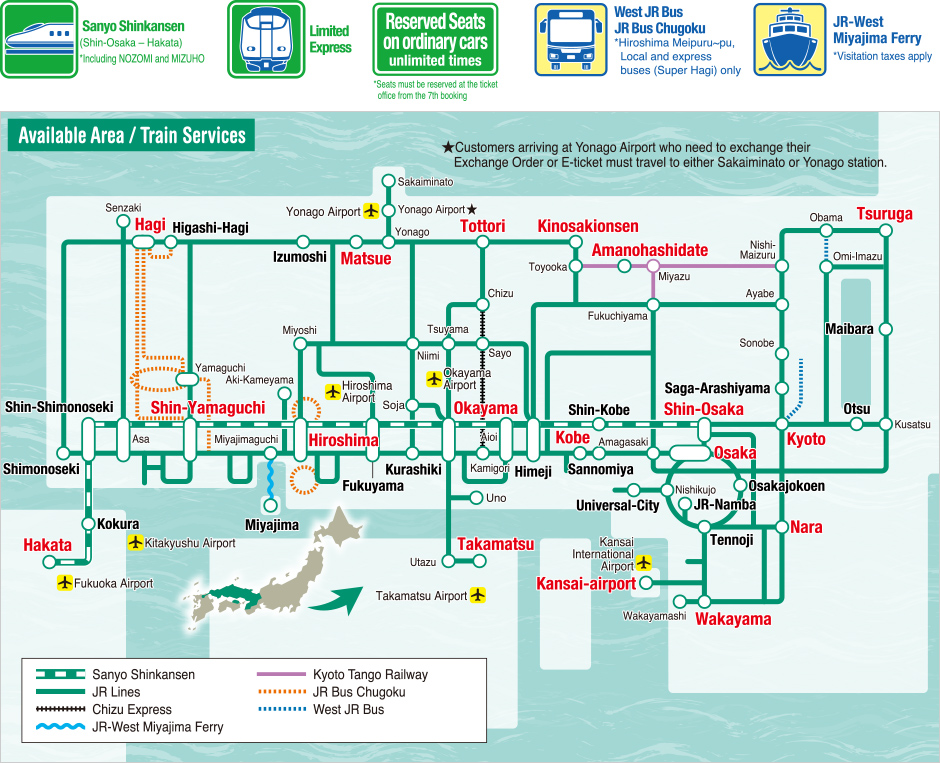
✔️The Sanyo San’in Area Pass includes the following privileges:
-
Unlimited travel on the Sanyo Shinkansen between Shin-Osaka and Hakata (Fukuoka).
-
Can also be used on the “Hello Kitty Shinkansen”.
-
Access to rapid and local JR services in the region depicted on the map above, within the validity period.
-
Valid on the Kyoto Tango Railway to Amanohashidate.
-
Local JR buses in Kyoto, Hiroshima, and Yamaguchi, including between Kyoto Station, Takao and Shuzan, and from Yamaguchi and Hagi to Akiyoshidai.
-
JR Express buses between Yamaguchi and Hagi.
-
JR ferry to Miyajima.
-
Complimentary bicycle rentals at select “Ekirin-kun” stations in the region.
✔️The pass can be used on the following Limited Express trains:
-
Haruka Express to Kansai Airport
-
Kuroshio
-
Thunderbird
-
Kounotori
-
Yakumo
-
Super Hakuto (including between Kamigori and Chizu)
-
Super Inaba
❌What's NOT Covered:
-
Tokaido Shinkansen (Osaka ⇄ Tokyo)
-
Kyushu Shinkansen (Hakata to Kagoshima-Chuo)
-
Some premium train seats (Green Car)
Who Should Use It?
This pass is ideal for those traveling between Osaka/Kansai and Fukuoka, allowing stops at major cities like Hiroshima and Okayama. It is particularly cost-effective if doing a round trip between Osaka and Fukuoka, or taking multiple Shinkansen trips, according to a Reddit discussion
How to Buy the Pass?
There are two main ways to secure your pass. JR West has heavily invested in automated machines to make this easier.
Option 1: Booking Online via Official Site (Recommended)
This is the most convenient method as it allows you to book seats online before you arrive in Japan.
-
Purchase: Buy the pass via the JR-WEST ONLINE TRAIN RESERVATION website up to one month before your travel date .
-
Payment: Pay by credit card immediately.
-
Pick-up: After arriving in Japan, use the designated ticket vending machines (marked with a passport icon) at major stations (Shin-Osaka, Hiroshima, Hakata, etc.). You will need your passport (with an IC chip), the reservation number, and the credit card used for payment
Option 2: Buying an Exchange Order (MCO/eMCO)
This is the traditional method using third-party vendors.
-
Purchase: Buy an "Exchange Order" (electronic voucher) online through travel agencies like Agoda, JTB, Klook or KKday.
-
Validity: The voucher is valid for 3 months from the issue date .
-
Exchange in Japan: Swap the voucher for the physical pass at a JR-West ticket office ("Midori no Madoguchi") or a ticketing machine
Unlimited Seat Reservations
For the Sanyo-San'in Area Pass, "unlimited seat reservations" is a standout feature that makes it one of the most flexible regional passes in Japan. Unlike the standard JR Pass or smaller regional versions, this pass does not cap the total number of reserved seats you can book during its 7-day validity.
You can book as many reserved seats as you need for the Sanyo Shinkansen (Shin-Osaka to Hakata/Fukuoka) and eligible Limited Express trains (like the Haruka, Yakumo, and Thunderbird).
1. Booking Methods & Limits
While the total number of reservations is unlimited, the method of booking has a "speed bump":
-
Green Ticket Machines: You can reserve up to 6 seats per pass directly at the automated machines.
-
Ticket Offices (Midori-no-madoguchi): Once you have used your 6 machine slots, you must go to a staffed ticket window for any subsequent reservations. There is no hard limit on how many you can request at the window, provided they are for your own travel.
-
Online Reservations: If you purchased your pass through the official JR-West Online Train Reservation site, you can typically book up to 9 reservations at a time via the website before you even arrive in Japan.
2. Why Reserved Seats are Vital in 2026
In 2026, seat reservations are more important than ever due to changes in JR policies:
-
Nozomi "All-Reserved" Periods: During peak seasons (Golden Week, Obon, New Year), the Nozomi Shinkansen—the fastest train on the Sanyo line—operates as 100% reserved seating. If you don't have a reservation during these times, you cannot board.
-
Limited Express Changes: Many regional "Limited Express" trains (like the Yakumo to Matsue or the Kuroshio to Wakayama) have switched to all-reserved seating year-round. You must have a reserved seat ticket to board these trains legally.
-
Oversized Baggage: If your luggage's total dimensions exceed 160cm, you are required to book a "Seat with Oversized Baggage Area." This is free with your pass but requires a specific reservation that can be made at the machines or counters.
‼️Summary Table: Seat Reservation Rules
|
Feature |
Rule / Limit |
|
Total Reservations |
Unlimited |
|
At Ticket Machines |
First 6 reservations only |
|
At Ticket Counters |
Unlimited (including after the 6th machine booking) |
|
Online (Official Site) |
Unlimited (can be done before arriving in Japan) |
|
Nozomi & Mizuho |
Fully included and reservable |
How to Use the Pass?
Using the Sanyo-San'in Area Pass is much more streamlined than the old "show the booklet to the guard" days. It is now a physical magnetic ticket that you use just like a standard train ticket.
1. Exchange Your Voucher
If you bought the pass online or through an agent, you'll have an "Exchange Order" (voucher).
-
Where: Look for the Green Ticket Vending Machines with a passport reader at major stations (Kansai Airport, Shin-Osaka, Kyoto, Hiroshima, Hakata).
-
Process: Scan the QR code on your voucher and your passport’s photo page. The machine will print your physical Sanyo-San'in Area Pass (a credit-card-sized ticket).
-
Tip: If the machine fails, you can always go to the "Midori-no-madoguchi" (staffed ticket office).
2. Passing Through Ticket Gates
-
Automatic Gates: Do not go to the side window to show a guard. Simply insert your pass into the slot at the automatic ticket gate.
-
Don't Forget It: The ticket will pop out at the other end of the gate. Make sure to grab it as you walk through!
-
Multiple Tickets: If you have a seat reservation ticket, insert both the area pass and the seat ticket into the slot at the same time. The machine will process both and return them to you.
3. Booking Seats (Step-by-Step)
Since many trains in 2026 are "Reserved Only," you should book seats before boarding.
-
At the Machine: Select "Rail Pass Reservation" on a green ticket machine.
-
Insert Pass: Put your physical area pass into the machine.
-
Find Train: Enter your starting station, destination, and time.
-
Pick Seat: Choose your car and seat from the seat map.
-
Collect Ticket: The machine will spit out your area pass plus a new seat reservation ticket.
4. On the Train
-
Keep Tickets Handy: Once you are in your reserved seat, keep your ticket accessible. Conductors on regional Limited Express trains (like the Yakumo) may check them, though Shinkansen conductors usually only check if you are sitting in the wrong seat.
-
Unreserved Cars: If you haven't made a reservation and the train has unreserved cars (check the platform displays), you can just hop on and sit anywhere in those specific cars (usually Cars 1–3).
Best 7-Day Itinerary
Recommended Route: Osaka → Tottori → Okayama → Hiroshima → Fukuoka.
|
Day |
Destination |
Highlights |
|
1 |
Osaka / Kyoto |
Arrive at KIX. Activate pass for Haruka Express. Explore Dotonbori (Osaka) or Gion (Kyoto). |
|
2 |
Tottori |
Take the Super Hakuto Limited Express. Visit the Tottori Sand Dunes and the Sand Museum. |
|
3 |
Matsue / Izumo |
Travel via Limited Express Super Matsukaze. Visit Izumo Taisha (one of Japan's oldest shrines) and Matsue Castle. |
|
4 |
Okayama / Kurashiki |
Head south to Okayama. Visit Korakuen Garden and the Kurashiki Bikan Historical Quarter (canal district). |
|
5 |
Hiroshima |
Take the Nozomi Shinkansen. Visit the Peace Memorial Park and the Atomic Bomb Dome. Stay in Hiroshima for okonomiyaki. |
|
6 |
Miyajima / Himeji |
Morning: JR Ferry to Miyajima (Itsukushima Shrine). Afternoon: Stop at Himeji Castle (White Heron) on the way to Fukuoka. |
|
7 |
Fukuoka (Hakata) |
Explore Ohori Park and feast at the Nakasu Yatai (food stalls). Depart via Hakata or return to Osaka by Shinkansen. |
Pro Tips for 2026
-
Nozomi vs. Hikari: Always take the Nozomi. It is the fastest and most frequent service. Nationwide JR Pass holders usually can't use it without a high surcharge, but your Sanyo-San'in pass covers it for free.
-
Miyajima Tax: As of late 2023, there is a ¥100 visitor tax for Miyajima. While your ferry fare is covered by the pass, you may need to pay this small fee separately.
-
Avoid the "Tokaido" Trap: This pass is not valid on the Shinkansen between Kyoto and Osaka. Use the "Special Rapid" local trains for that 25-minute hop instead.
-
Luggage Rules: If your suitcase is "oversized" (total dimensions > 160cm), you must book a seat with a dedicated luggage area on the Shinkansen. It's free with your pass, but required.
-
Passport: You must carry your physical passport with you at all times. Station staff may check it against your pass.
-
The "Hello Kitty" Shinkansen: There is a special themed train running between Shin-Osaka and Hakata. You can ride it for free with this pass, but you must reserve a seat in advance.
Frequently Asked Questions (Q&A)
Is the Sanyo-San'in Area Pass worth it?
Yes—if you plan long-distance travel like Osaka ⇄ Hiroshima ⇄ Fukuoka, the pass usually pays for itself within 1–2 Shinkansen trips. It’s especially valuable for 5–7 day itineraries covering multiple cities.
Can I use the pass for Kyoto to Osaka?
Yes—but only on JR local/rapid trains.
Does the pass cover Kansai Airport (KIX)?
Yes. You can take the HARUKA Express between:
-
Kansai Airport
-
Osaka / Kyoto
This makes the pass useful from the moment you arrive.
Can I use it for Miyajima?
Yes. The pass includes the JR Miyajima Ferry, so you can visit:
-
Itsukushima Shrine
-
Miyajima Island
at no extra cost.
Is "Unlimited Reservations" really unlimited?
Yes, but there is a logistical "step-up." You can book your first 6 seats at the green ticket vending machines. For your 7th seat and beyond, you must go to a staffed ticket window (Midori-no-madoguchi) to have them issued manually for free.
Do I need a reservation for every train?
In 2026, many trains have moved to "All-Reserved" status. This includes the Nozomi during peak holidays (Golden Week, Obon, New Year) and regional limited express trains like the Yakumo (to Matsue) and Kuroshio (to Wakayama). It is always safer to grab a free reservation.
I have a Japan Rail Pass. Do I need this one too?
No – pick one.
-
If you're only traveling between Osaka and Fukuoka, the Sanyo-San'in Pass is better (cheaper + includes Nozomi).
-
If you're going to Tokyo or Hokkaido, the Japan Rail Pass is better.
Can I leave and re-enter Japan during the 7 days?
No.The pass is invalid once you leave Japan (e.g., a day trip to Busan from Fukuoka).
Can I do this itinerary in 5 days instead of 7?
Technically yes, but it would be rushed.
-
Minimum recommended: 6 days (skip either Matsue/Tottori or Okayama/Kurashiki).
-
5 days is possible only if you focus on Osaka → Hiroshima → Miyajima → Fukuoka.