Navigating the sprawling metropolis of Tokyo and its surrounding prefectures can be as daunting as it is expensive. If you’re planning an extensive exploration of the Kanto region—from the neon lights of Shinjuku to the historic temples of Nikko—the Greater Tokyo Pass might be your ultimate travel hack. While the famous JR Pass often steals the spotlight, this non-JR transit pass provides unparalleled access to 13 private railway lines and dozens of bus routes that others miss. The Greater Tokyo Pass opens doors to efficient exploration, How do you get it, use it wisely, and save while seeing the most? In this guide, you’ll discover how to purchase the pass, make the most of its features, save money on transportation, and plan itineraries that fit your travel style.
What is the Greater Tokyo Pass?
➤ Validity: 5 consecutive days of unlimited travel.
➤ Format: Digital Ticket (Smartphone-based)
➤ Eligibility: Foreign tourists only (Short-term stay visa)
➤ Price: 6,500 yen for adults and 3,250 yen for children.
The Greater Tokyo Pass is a specialized multi-day transport ticket designed exclusively for international tourists. It allows 5 days of unrestricted travel on all train and tram lines that are members of the Greater Tokyo Pass Council, including all Tokyo Metro lines and some bus lines.It provides extensive, cost-effective travel to popular spots like Nikko, Kamakura, and Yokohama, but excludes JR lines and the Tokyo Monorail. This is a digital pass (shown on your smartphone) and present it to station staff or bus drivers instead of using automatic ticket gates.And you must show a valid foreign passport to use it.
1. What's Included?
The pass covers 13 private railway companies and over 30 bus companies, including:
-
Tokyo Metro & Toei Subway (all lines)
-
JR East Lines within the Tokyo Metropolitan Area (including the Yamanote Line, Chuo-Sobu Line, etc., but NOT the Shinkansen)
-
Buses (Tokyo Metro, Toei, and JR buses)
-
Other Railways: Often includes private railways like Tobu, Seibu, Keio, Keikyu, Tokyu, and more, extending to areas like Nikko, Chichibu, Kawagoe, Yokohama, Kamakura, and the Izu Peninsula.
| Valid Transportation Companies |
Railway and Tramline Companies:
|
| Bus Company: Toei Transportation (Toei Bus) |
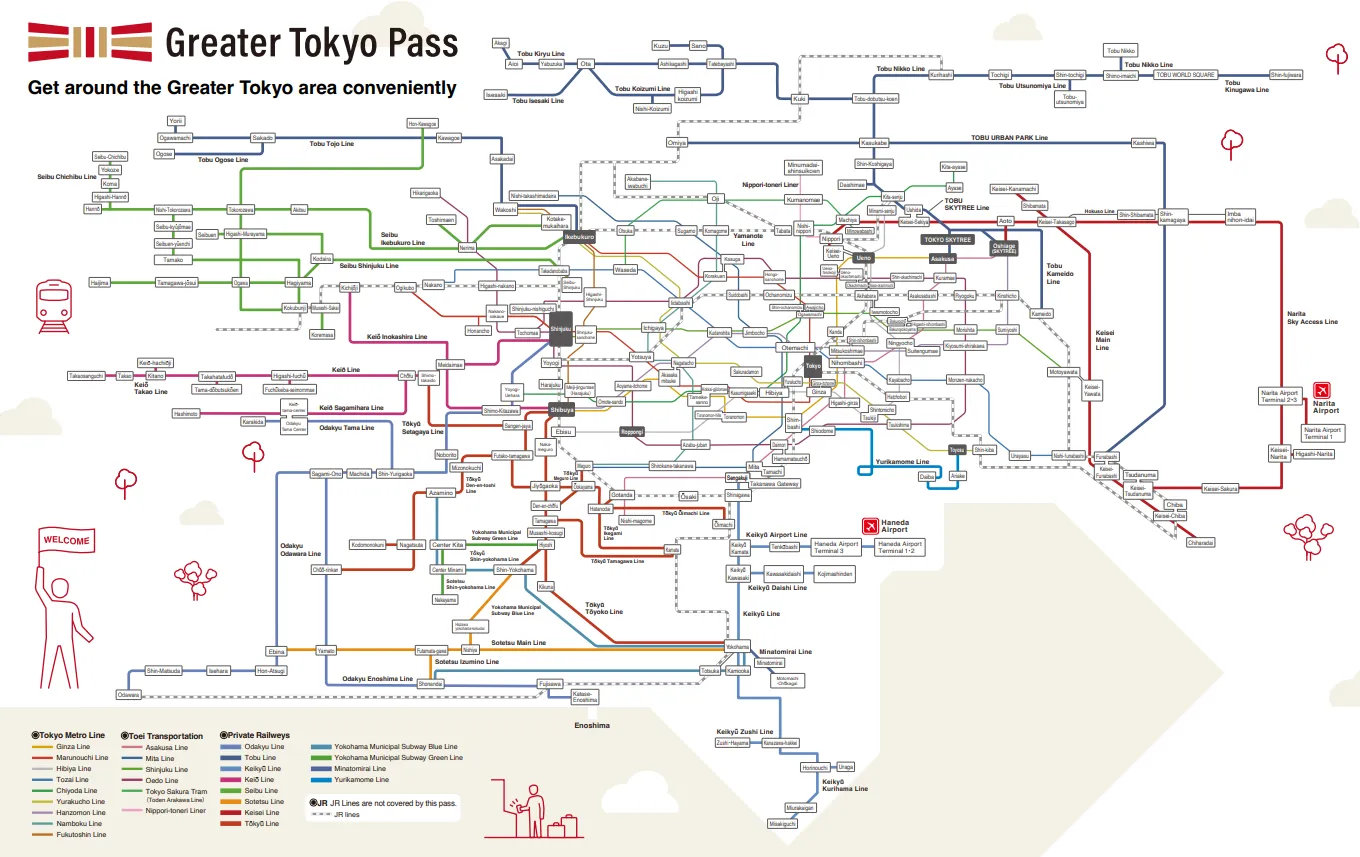
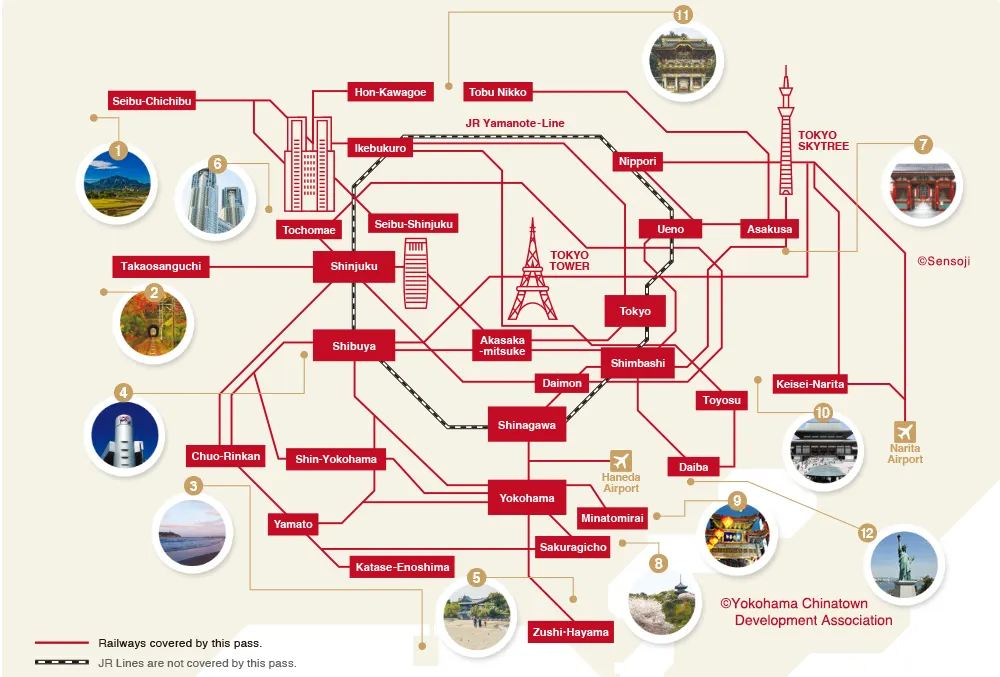
⚠️Major Exclusions (The "Catch"):
-
No JR Lines: This is the most important distinction. It cannot be used on JR East lines (like the Yamanote Line) or the Shinkansen.
-
No Tokyo Monorail: Travel to Haneda Airport via the Monorail is not covered (though the Keikyu Line is).
-
Limited Express Surcharges: While the base fare is covered, "Limited Express" or reserved-seat trains (like the Romancecar or Skyliner) require an additional surcharge ticket.
- Not for Airport Transfer: The pass does not cover the Narita Express (N'EX) or Tokyo Monorail from Haneda. You need to travel to a station within the pass's coverage area first.
Who Is It For?
-
Active tourists who want to explore extensively: If your itinerary involves jumping between central Tokyo, Yokohama, Kamakura, Nikko, and suburbs all in a few days, the savings can be significant.
-
Travelers who dislike calculating fares: The "all-you-can-ride" feature offers peace of mind.
The Greater Tokyo Pass is highly cost-effective if your itinerary involves day trips outside central Tokyo using private lines.
Is it Worth It?
The Greater Tokyo Pass is a high-value ticket, but it requires a busy itinerary to pay off.
Buy it if:
-
You are staying in Tokyo for 5 days and plan at least two major day trips (e.g., Nikko, Hakone, Mt. Takao, or Chichibu).
-
Your hotel is near a private railway station (like Shinjuku, Shibuya, or Asakusa) rather than a JR-only station.
-
You plan to use the bus frequently in Tokyo.
Skip it if:
-
You rely heavily on the JR Yamanote Line.
-
You are only staying within central Tokyo (the Tokyo Subway Ticket at ¥1,500 for 72 hours is much cheaper).
-
You prefer the convenience of "tapping and going" with a Suica/Pasmo card rather than talking to station staff at every gate.
How to Buy the Pass?
Buying the Greater Tokyo Pass in 2026 is simple, but there's a catch: it has shifted almost entirely to a digital-first system. You can no longer just walk up to a standard ticket machine and press a button to buy it.
1. Purchase Online (Recommended)
The most common way to buy the pass is through the official website or authorized travel partners.
-
Official Website: Visit the Greater Tokyo Pass Official Site.
-
Travel Platforms: Sites like Klook, KKday, or Rakuten Travel Experiences sell the pass.These often work similarly to the official site, but refund and support rules may vary depending on the agency you choose.
-
The Process:
-
Select your start date (must be used within 90 days of purchase).
-
Complete the payment via credit card or digital wallet.
-
You will receive a confirmation email with a link to your digital ticket.
-
You can activate (start using) the pass anytime within 3 months of purchase.
-
2. Purchase at Information Centers (Physical Assistance)
If you prefer face-to-face help or need to verify your passport in person, you can visit tourist information centers at major entry points:
-
Narita Airport: Keisei Skyliner & Keisei Information Center.
-
Haneda Airport: Keikyu Tourist Information Center (Terminal 3).
-
Major Stations: Select tourist hubs in Shinjuku, Shibuya, or Ueno (look for the "TIC" or "i" signs).
⚠️Note: Even at these locations, staff will often assist you in setting up the digital version on your phone rather than giving you a magnetic paper ticket.
‼️Critical "Must-Knows" Before You Buy:
-
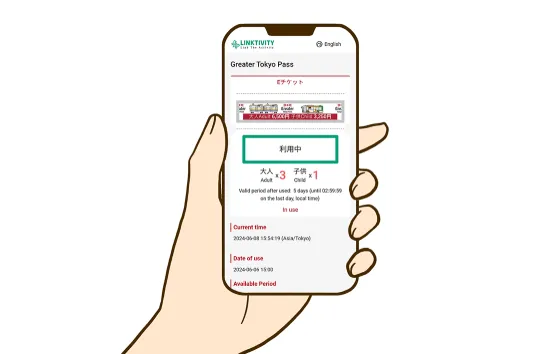
Digital Activation: If you buy the digital version, you must have a stable internet connection to display the ticket. A screenshot will not work; it must be the live web-page "In Use" screen.
-
No Automatic Gates: You cannot tap your phone at the glass gates. You must show your screen to the station staff at the manned window every time you enter or exit.
-
Passport Required: Whether buying online or in person, you must have your physical passport (with the "Temporary Visitor" stamp) ready for verification if asked by staff.
How to Use the Pass?
Using the Greater Tokyo Pass is slightly different from other Japanese rail passes because it is primarily a digital ticket. You won't be tapping a card or inserting a paper ticket into gates.Here is the exact procedure for using the pass on trains and buses:
1. Activating the Pass
Once you purchase the pass, you will receive a link to a digital ticket. Do not click the "USE" button until the moment you are ready to begin your first journey.
-
Open the digital pass on your smartphone (from the confirmation email or app).
-
Tap “Use” when you’re ready to start your trip — this activates the pass and starts your 5-day validity period.
Once activated, the pass is valid for 5 consecutive days. A "day" is defined from 3:00 AM to 2:59 AM the following morning.
2. Using on Trains & Subways
A. Entering and Exiting Train Stations
The most important rule: Do not use the automatic ticket gates.
-
Open the Ticket: Load the digital ticket on your smartphone. (Ensure you have a live internet connection; a screenshot is usually not accepted).
-
Find the Staff: Go to the manned ticket booth (the window next to the gates).
-
Show the Screen: Present the active "IN USE" screen to the station attendant.
-
Group Travel: If you bought passes for multiple people (up to 8) on one phone, you must all pass through the gate together while showing the single screen.
B. Using the Pass on Buses (Toei Bus & Others)
The pass covers Toei Buses and many private bus lines in the Kanto area.
-
Boarding/Exiting: Simply show the active digital pass screen to the bus driver when you get on or off (depending on the bus's payment system).
-
Exclusions: It does not cover "limited capacity" buses like airport limousines, highway express buses, or certain community buses.
C. Taking "Limited Express" Trains (Hakone, Nikko, etc.)
The pass covers the Base Fare, but not the luxury or speed:
-
Surcharges: If you want to ride "Limited Express" trains (like the Odakyu Romancecar to Hakone or the Tobu Revaty to Nikko), you must buy a separate Limited Express Ticket (Limited Express Fee).
-
How to Buy Surcharges: You can buy these at station vending machines or online via the railway company's website. You then show your digital Greater Tokyo Pass as your "base ticket" to the staff.
‼️Pro-Tips for a Smooth Experience:
- Carry your passport: You may be asked to show it as a foreign visitor (only eligible users can use the pass).
-
Unattended Gates: If you find a small station with no staff at the window, look for an intercom near the gate. Press it to speak with a remote operator who will verify your screen via camera.
-
Battery & Data: This is a 100% digital pass. If your phone dies or you have no data, you will be required to pay the full cash fare. Carry a power bank and consider an eSIM or pocket Wi-Fi.
- All riders must be present: If you’re using one pass for up to 8 people, they must all be together when you show it.
-
No JR Lines: If you accidentally enter a JR station (like the Yamanote Line), this pass will not work. You will need to pay for that specific trip using cash or an IC card (Suica/Pasmo).
Save & Best Itineraries for the Greater Tokyo Pass
💰 How to MAXIMIZE Savings: The Golden Rule
-
Calculate this before buying: Your total individual fares for planned trips MUST exceed the pass price.
-
Example: A 3-Day Wide Area Pass (~¥7,200) is only worth it if your 3 days of train/bus fares would cost over ¥7,200 individually.
Money-Saving Itinerary Principles:
-
Stack Long-Distance Trips: Cluster your most expensive journeys into consecutive days.
-
Use for Airport Transfers? No! The pass does not cover Narita Express (N'EX). Use cheaper alternatives like the Keisei Skyliner or Narita Access buses.
-
Avoid Redundancy: Don't buy the pass for days where you'll mostly walk (e.g., Asakusa to Ueno).
-
Compare Alternatives: Sometimes a regional 1-day pass (e.g., Enoshima-Kamakura Pass) + Tokyo Subway Ticket is cheaper.
🗺️ The "Max Value" 5-Day Itinerary
This route uses 100% covered private lines. ⚠️Note: "Limited Express" surcharges are extra.
Day 1: Airport Arrival & Old Tokyo
-
Morning: Arrive at Narita; take the Keisei Main Line to Ueno.
-
Afternoon: Explore Asakusa (Senso-ji Temple) and walk to Tokyo Skytree (Oshiage Station).
-
Evening: Use the Toei Subway to reach your hotel in Shinjuku or Ginza.
Day 2: The World Heritage Escape (Nikko)
-
Full Day: Take the Tobu Railway from Asakusa to Nikko.
-
See: Toshogu Shrine, the Shinkyo Bridge, and Lake Chuzenji (local buses in Nikko are covered!).
-
Savings: A round trip + local buses usually costs over ¥4,000.
Day 3: "Little Edo" & Hidden Mountains (Kawagoe & Chichibu)
-
Morning: Take the Seibu Railway from Seibu-Shinjuku to Kawagoe. Explore the 150-year-old warehouse district.
-
Afternoon: Continue on the Seibu line to Chichibu for Hitsujiyama Park (Moss Phlox) or the Mitsumine Shrine.
-
Evening: Return to Shinjuku.
Day 4: Coastal Wonders (Yokohama & Kamakura)
-
Morning: Take the Tokyu Toyoko Line from Shibuya to Yokohama. Visit Chinatown and Minatomirai.
-
Afternoon: Transfer to the Minatomirai Line or use local buses to head toward Kamakura (Great Buddha).
-
Evening: Enjoy the sunset at Enoshima before heading back to Tokyo.
Day 5: Mountain Hiking & Departure
-
Morning: Take the Keio Line from Shinjuku to Mt. Takao. Use the pass on the local bus to the cable car base.
-
Afternoon: Return to central Tokyo for last-minute shopping in Shibuya (Tokyu/Keio lines).
-
Evening: Take the Keikyu Line directly to Haneda Airport.
Greater Tokyo Pass Q & A (FAQ)
Q1: Does the pass cover JR lines like the Yamanote Line or Shinkansen?
No. This is the most important rule. The Greater Tokyo Pass is for private railways only. It does not cover any JR East lines, the Shinkansen, or the Tokyo Monorail. If you accidentally take a JR train, you will need to pay the fare separately using cash or an IC card (like Suica).
Q2: Can I use the pass for the "Romancecar" to Hakone or the "Skyliner" to Narita?
Yes and No. The pass covers the base fare (the basic cost of travel). However, for premium trains like the Odakyu Romancecar or Keisei Skyliner, you must purchase a separate Limited Express Surcharge or reserved seat ticket. You can buy these at station vending machines or online.
Q3: What if I lose my phone or my battery dies?
Since the pass is 100% digital, your phone is your ticket.
-
Dead Battery: If your phone dies, you cannot prove you have a valid pass and will be required to pay the full fare for that journey. Always carry a power bank!
-
Lost Phone: If you lose your phone, you can log in to your account on a new device to access your ticket.
Q4: Can I buy one pass on my phone for my whole family?
Yes. A single smartphone can hold a "Group Pass" for up to 8 people. However, the entire group must travel together at all times. You cannot split up, as you only have one digital screen to show the station staff.
Q5: Why can't I use the automatic ticket gates?
The digital pass requires visual verification by human staff. You must always use the manned ticket booth next to the gates. Show the attendant your active "In Use" screen (not a screenshot), and they will wave you through.
Q6: Is it valid for 120 hours or 5 calendar days?
It is valid for 5 consecutive calendar days. Each "day" starts at 3:00 AM and ends at 2:59 AM the following morning. Even if you start using it late in the evening on Day 1, that still counts as a full day.
Q7: Can I get a refund?
Refunds are usually allowed before activation.After you activate and start using the pass, refunds are not available.Policies may vary depending on where you buy it.
Q8: Can I use it for airport trains?
Partially.
-
❌ Tokyo Monorail (Haneda) is not included.
-
⚠️ Some private airport routes may be partly covered, but most travelers still need a separate ticket for airport access.
It’s best used after you arrive in the city.