Japan’s sightseeing trains are becoming just as popular as the destinations themselves, and the Aoniyoshi train stands out as one of the most stylish ways to travel across Kansai. Inspired by the elegance of ancient Nara, this limited-express service connects major cities like Kyoto, Osaka, and Nara while offering a relaxed atmosphere that feels very different from ordinary rail travel.In this complete guide, you’ll learn how to book seats, understand ticket options, navigate baggage restrictions, and plan the most worthwhile routes for first-time visitors and repeat travelers alike. From couples seeking a scenic journey to families exploring historic Japan, the Aoniyoshi experience combines comfort, convenience, and culture in a single ride.
What is the Aoniyoshi Train?
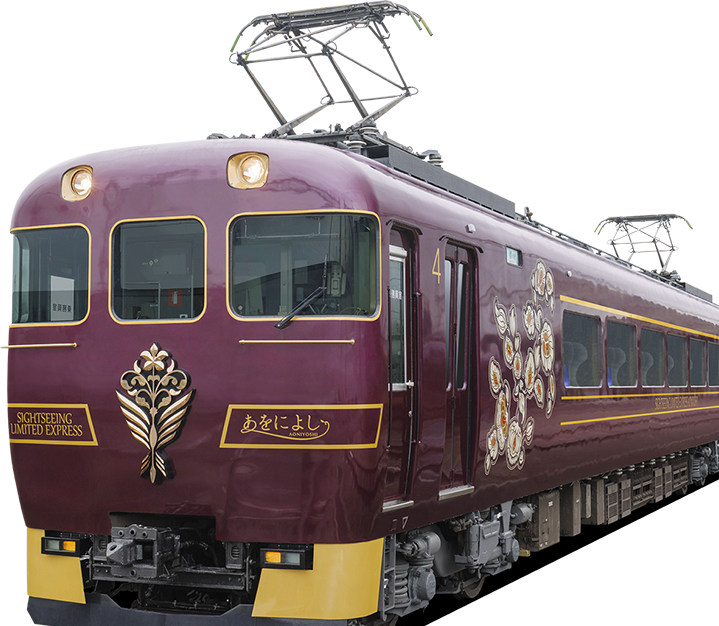
The Kintetsu Sightseeing Limited Express "Aoniyoshi" (あをによし) is a luxury sightseeing train launched in April 2022 that connects Osaka, Nara, and Kyoto without requiring any train transfers.The name "Aoniyoshi" is a classical Japanese poetic pillow word (枕詞) that refers to the ancient capital of Nara.
With a striking royal purple exterior inspired by 8th-century Tempyo-era culture and a premium, spacious interior designed for only 84 passengers per trip, securing a seat on the Aoniyoshi is a highlight of any Kansai itinerary.
🔻 Main Features:
-
Elegant purple exterior inspired by the Tenpyo era.
-
Spacious 2-seat and salon-style seating.
-
Large windows for scenic viewing.
-
Onboard food and souvenir counter.
-
Mini library/lounge area.
-
Free Wi-Fi.
-
Dedicated luggage compartments.
-
Reserved seating only.
Aoniyoshi Routes & Stops
The AONIYOSHI operates along a single continuous route connecting the three cities. Note that at Kintetsu-Nara Station, the train reverses direction, so forward-facing seats may become backward-facing for the remainder of the journey.
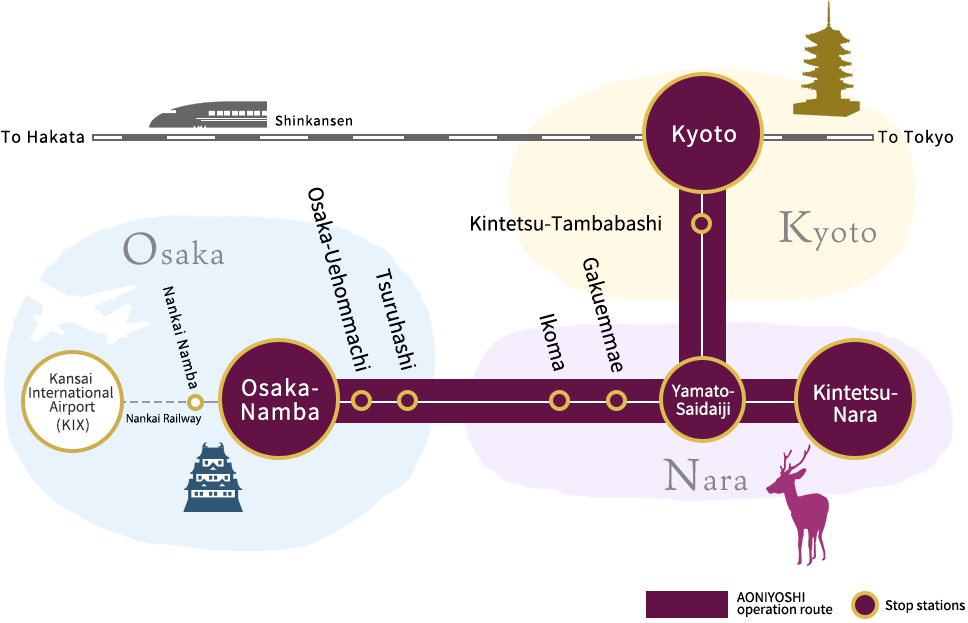
🔻 Full Station List (in order):
|
Station |
City |
|
Osaka-Namba |
Osaka |
|
Osaka Uehonmachi |
Osaka |
|
Tsuruhashi |
Osaka |
|
Ikoma |
Nara |
|
Gakuenmae |
Nara |
|
Kintetsu-Nara |
Nara |
|
Yamato-Saidaiji |
Nara |
|
Kintetsu-Tambabashi |
Kyoto |
|
Kyoto |
Kyoto |
The most popular segment is: Kyoto ⇄ Nara. There are also limited direct departures connecting Osaka and Kyoto via Nara.
🔻Approximate Travel Times:
|
Route |
Time |
|
Kyoto → Nara |
~35 min |
|
Osaka-Namba → Nara |
~35–40 min |
|
Osaka-Namba → Kyoto |
~75–85 min |
Seat Options & Train Layout
The train is remarkably intimate, composed of just four cars holding a maximum of 84 passengers. It sells out incredibly fast due to its unique layouts:
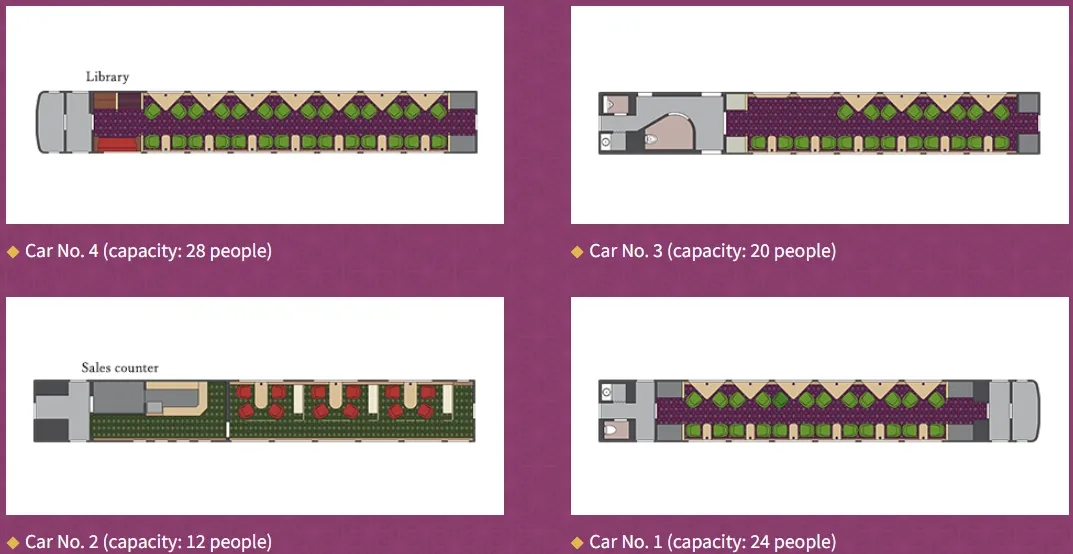
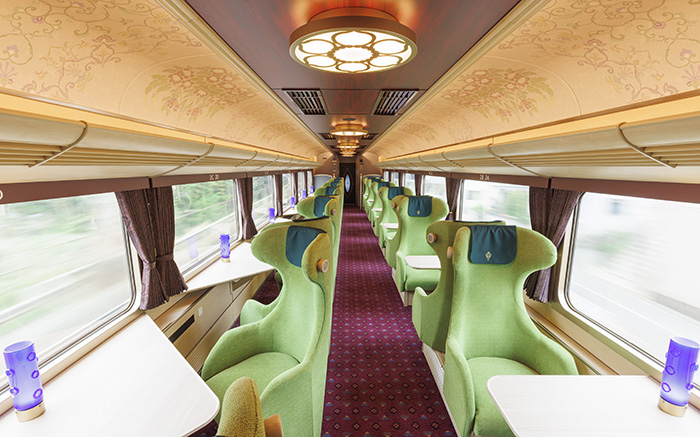
Twin Seats (Cars No. 1, 3, 4)
-
Capacity: Car No. 1 (24 people), Car No. 3 (20 people), Car No. 4 (28 people).
-
Seat Orientation Options:
-
Seats A & B: Face each other across a table (conversation-style).
-
Seats C & D: Angled toward the windows for better scenic views.
-
-
Amenities: Large table, electric outlet, overhead luggage storage.
-
Group Configuration: For 2 people sharing a twin seat compartment.
Salon Seats (Car No. 2)
-
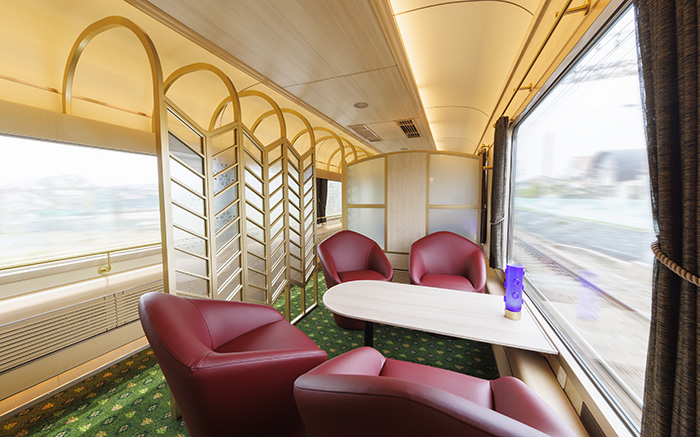
Capacity: 12 people (3 compartments of 4 seats).
-
Configuration: Semi-private booths for 3–4 passengers with partitions separating from the aisle.
-
Amenities: Large central table, electric outlet, luggage storage space.
-
Note: Salon seats cost the same as twin seats on a per-person basis (no extra charge).
-
Sales Counter Location: Also located in Car No. 2.
🔔 Seat Selection Tips:
-
Window-facing Seats (C & D): Highly recommended for scenery viewing, but sell out fastest.
-
Proximity to Sales Counter: Cars No. 1 and 3 are closest to the Car No. 2 sales counter.
-
Library Location: Car No. 4 has a library space with sofa seating.
Operating Schedule & Timetable
The Aoniyoshi runs every day except Thursdays (unless a major holiday falls on a Thursday). It operates on a specific daily rotation that links the three cities.
-
Exception Dates in 2026: March 26 (Thu), April 2 (Thu), April 30 (Thu), May 7 (Thu), and July 30 (Thu).
-
Number of Daily Services: The train operates 8 services per day between Osaka-Namba, Kintetsu-Nara, and Kyoto.
Sample Timetable (as of March 14, 2026):
1. Osaka-Namba → Kintetsu-Nara → Kyoto
|
Weekdays |
Saturdays and holidays |
|
|
Osaka-Namba (A01) |
9:10 |
9:10 |
|
Osaka-Uehommachi (A03/D03) |
9:13 |
9:13 |
|
Tsuruhashi (A04/D04) |
9:15 |
9:15 |
|
Kintetsu-Nara (A28) |
9:45 |
9:44 |
|
Kintetsu-Nara (A28) |
9:52 |
9:53 |
|
Yamato-Saidaiji (A26/B26) |
9:58 |
10:00 |
|
Kyoto (B01) |
10:31 |
10:29 |
2. Kyoto → Kintetsu-Nara
|
Weekdays |
Saturdays and holidays |
|
|
Kyoto (B01) |
10:55 |
10:55 |
|
Yamato-Saidaiji (A26/B26) |
11:24 |
11:25 |
|
Kintetsu-Nara (A28) |
11:30 |
11:31 |
3. Kyoto → Kintetsu-Nara
|
Weekdays |
Saturdays and holidays |
|
|
Kyoto (B01) |
12:55 |
12:55 |
|
Yamato-Saidaiji (A26/B26) |
13:23 |
13:23 |
|
Kintetsu-Nara (A28) |
13:28 |
13:28 |
Ticket Pricing & Fare Structure
To ride the Aoniyoshi, you must pay three separate fees combined into a "Base Fare" , a "Limited Express Fare" and a "Special Car Fare".Your total cost depends on your seating choice and group size:
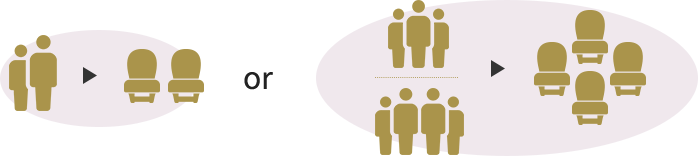
A. For 2 passengers using "Twin Seats" OR 3-4 passengers using "Salon Seats":
|
Route |
Adult Fare (per person) |
Child Fare (per person) |
|
Osaka-Namba ↔ Kyoto |
2,270 yen |
1,140 yen |
|
Osaka-Namba ↔ Kintetsu-Nara |
1,410 yen |
710 yen |
|
Kintetsu-Nara ↔ Kyoto |
1,490 yen |
750 yen |
B. For 1 passenger using a "Twin Seat" (Solo traveler):

|
Route |
Adult Fare (per person) |
Child Fare (per person) |
|
Osaka-Namba ↔ Kyoto |
2,840 yen |
1,710 yen |
|
Osaka-Namba ↔ Kintetsu-Nara |
1,780 yen |
1,080 yen |
|
Kintetsu-Nara ↔ Kyoto |
1,860 yen |
1,120 yen |
💡 Note: Fares are for a one-way trip. If you have a Kintetsu Rail Pass, you still need to purchase a Limited Express ticket and Special Car fare to board.
How to Book & Reservation a Seat?
The Aoniyoshi is a fully reserved train; you cannot board without a reservation. It's highly recommended to book early as seats are limited (84 seats total) and sell out quickly.
Reservation Opening Date
Tickets normally open:
-
1 month before departure
-
Around 10:30 AM Japan time
-
Example: To travel on October 15, you must log on to book on September 15 at 10:30 AM JST. Weekend slots and window-facing seats usually sell out within 5–10 minutes of release.
Popular dates can sell out very quickly, especially:
-
Cherry blossom season
-
Autumn foliage season
-
Weekends and holidays
How to Book?
-
Online (Recommended): The easiest way is through the Kintetsu Express Ticket Web Reservation Service. You can make a reservation and purchase your tickets at the same time using a smartphone or PC.
-
At Stations: While you can technically buy tickets at physical Kintetsu station counters marked with a red Limited Express sign, relying on this on the day of travel usually results in disappointment.
Booking Step-by-Step:
-
Reserve the Limited Express Ticket online: Visit the Kintetsu Railway official English e-ticket website. You do not need to create an account; you can checkout as a guest with a credit card.
-
Select "Aoniyoshi" from the train options. Choose your seats using the seat map (highly recommended so you can pick window-facing Twin Seats).
-
Save your e-ticket: You will receive a booking confirmation email with a QR code or transaction number. Keep this on your phone (no need to print it).
-
Pay the Base Fare on travel day: You do not need to buy the base fare online. Simply tap through the ticket gates at the station using a standard IC card (Suica, ICOCA, Pasmo, etc.) or purchase a paper local ticket on the day of travel.
Pass Coverage
-
JR Pass: Does not cover Kintetsu lines.
-
Kintetsu Rail Pass: Covers the Base Fare portion of your ticket. If you have a Kintetsu Rail Pass, you still need to purchase the Limited Express + Special Car ticket online or at a station counter to reserve your seat.
Luggage Rules & Storage
One of the most convenient features of the Aoniyoshi is its generous luggage policy, making it ideal for travelers with large suitcases.
-
Dedicated Luggage Compartments: Cars 1, 3, and 4 are equipped with dedicated luggage storage spaces that can accommodate large suitcases, so you don't need to keep your luggage at your seat.There are also overhead racks for smaller backpacks and coats.
-
Carry-On Allowance: There is no strict weight limit widely advertised for the Aoniyoshi itself. However, general Japanese train guidelines allow for two pieces of baggage per passenger, with the total dimensions (length + width + height) not exceeding 250 cm per piece, and a maximum weight of 30 kg per piece. This is very generous and easily accommodates standard checked luggage.
Insider Tips for the Ultimate Experience
-
Aim for Car 1 or Car 4 (Twin Seats): Car 1 and Car 4 are generally quieter than Car 3 because they are further away from the Cafe Counter in Car 2.
-
Sweets Sell Out Fast: If you want to try the signature grape macaron or regional craft beer, walk to Car 2's sales counter immediately after the train departs. The line gets long quickly, and popular items often sell out halfway through the journey.
-
The Scenic Stretch: When traveling between Nara and Kyoto, keep your eyes open around Yamato-Saidaiji Station—the train navigates a massive, complex flat junction that is a famous hotspot for train enthusiasts. Also, the crossing of the Uji River offers beautiful scenery.
-
Free Commemorative Stamp: Don't forget to grab the free commemorative postcard in Car 2 or 4 and use the Aoniyoshi ink stamp to mark your trip!
Frequently Asked Questions (FAQ)
Is the Aoniyoshi Worth It?
Yes — especially if:
-
You enjoy scenic trains.
-
You want a slower travel experience.
-
You are visiting Kyoto and Nara anyway.
-
You prefer comfort over speed.
However, it is not the fastest option. Standard Kintetsu express trains are cheaper and quicker for simple transportation.The Aoniyoshi works best when treated as part of the sightseeing experience itself, not merely a transfer.
Is the train covered by the Japan Rail Pass?
No. The Aoniyoshi is operated by Kintetsu Railway, not JR.
Can solo travelers ride?
Yes, though you may pay slightly more depending on seating availability.
Can I board the Aoniyoshi with a Japan Rail Pass (JR Pass)?
No. The Aoniyoshi is a Kintetsu train. It is not operated by JR, so the JR Pass is not valid. You must purchase a Kintetsu ticket or have a Kintetsu Rail Pass.
Can I bring a large suitcase on board?
Yes. Cars 1, 3, and 4 have dedicated luggage compartments specifically for large bags, so you can travel with peace of mind.
How far in advance should I book tickets?
As early as possible. Reservations open one month in advance and seats are very limited (only 84 total). It's common for weekend and holiday seats to sell out quickly.
Is there a one-person seat?
No. Solo travelers need to purchase a "Twin Seat" by buying one adult and one child ticket