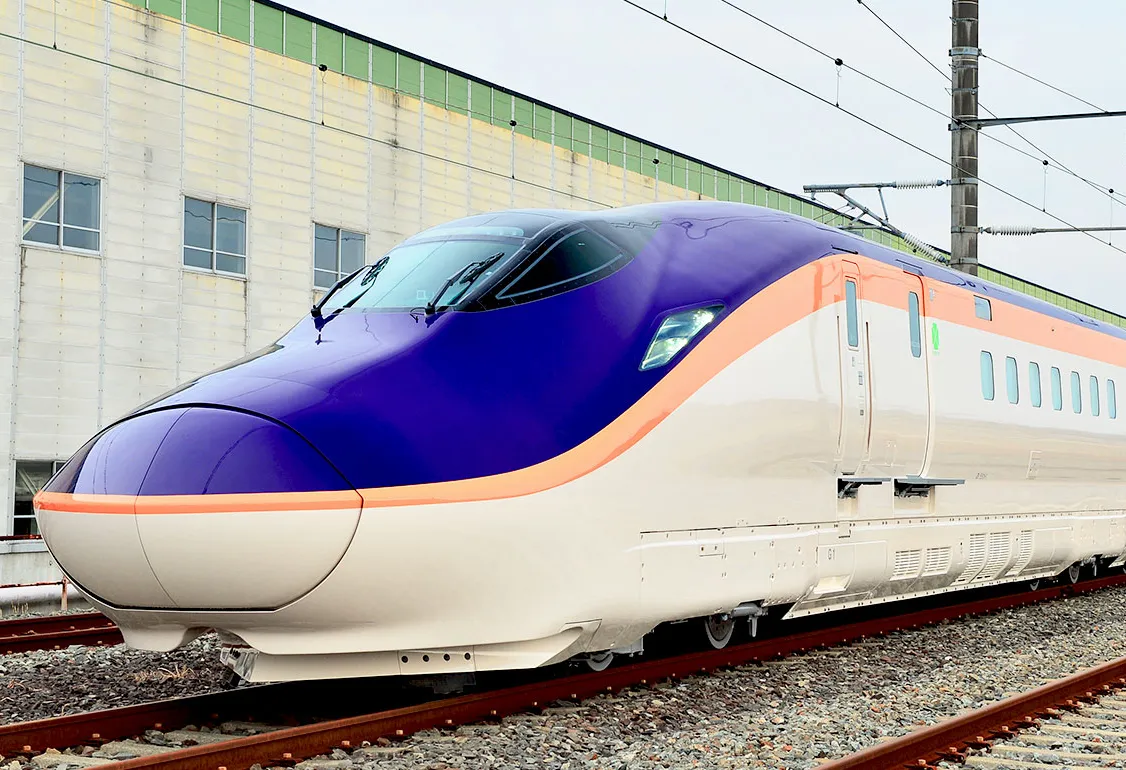
Japan’s famous bullet train network makes exploring the country fast and efficient, and the Yamagata Shinkansen is a key route for travelers heading into the heart of the Tohoku region. Running from Tokyo through Fukushima and onward to Yamagata and Shinjo, the line offers quick access to ski resorts, hot spring towns, and seasonal landscapes. For first-time visitors to Japan, understanding how tickets work, when to reserve seats, and what luggage rules apply can make the journey much smoother. In this comprehensive guide, I break down everything from fare structures and seat configurations to essential tips for storing your ski equipment, ensuring your journey to the "Fruit Kingdom" is as smooth as the ride itself.
What Is the Yamagata Shinkansen?
The Yamagata Shinkansen is one of the most scenic and convenient bullet train routes in Japan, connecting Tokyo with the mountains, hot springs, and historic towns of Yamagata Prefecture. Operated by JR East, the line is served by the Tsubasa train and offers a smooth ride from the capital to destinations such as Yonezawa, Kaminoyama-Onsen, and Yamagata City.
Here is the breakdown of what makes it special:
|
Aspect |
Details |
|
Official Name |
Yamagata Shinkansen (山形新幹線) |
|
Service Name |
Tsubasa (つばさ), meaning "wings" |
|
Type |
Mini-Shinkansen |
|
Operator |
East Japan Railway Company (JR East) |
|
Key Route |
Tokyo ↔ Fukushima ↔ Yamagata ↔ Shinjō |
|
Opened |
1992 (extended to Shinjō in 1999) |
|
Current Train |
E8 series (introduced March 2024) |
1. The "Mini-Shinkansen" Concept
The most distinctive feature of the Yamagata Shinkansen is that it's Japan's first "mini-shinkansen" . This means it's a special type of Shinkansen that can run on both dedicated high-speed tracks and conventional, local railway lines after they've been converted.Here's how it works:
-
The Journey from Tokyo to Fukushima: When it departs from Tokyo Station, the Tsubasa service shares the tracks and runs coupled together with a Tohoku Shinkansen train (like the Yamabiko) . This allows it to travel at high speeds out of the capital.
-
The Split at Fukushima Station: Upon reaching Fukushima Station, the two trains decouple . The Tohoku Shinkansen continues north to destinations like Sendai, while the Tsubasa train branches off onto its own line.
-
The Journey from Fukushima to Shinjō: For the rest of its journey, the Tsubasa runs on the Ōu Main Line, a conventional railway line that was converted from narrow gauge to standard gauge to accommodate the Shinkansen trains . On this section, it shares the tracks with local trains and runs at a maximum speed of 130 km/h (80 mph) .
2. The Fleet: The E8 Series "Tsubasa"
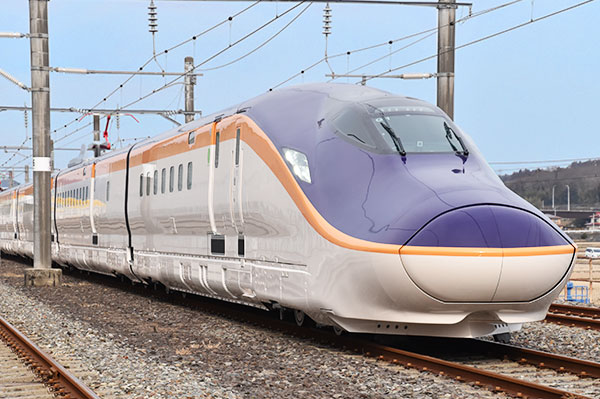
Since March 2024, the line has been served by the brand-new E8 series trains . These trains are designed for higher speeds (up to 300 km/h on the Tohoku Shinkansen section) and greater comfort.
-
Design: The colors are deeply symbolic of the region: "Zao White" (for the snow), "Safflower Yellow" (the prefectural flower), and "Mandarin Duck Purple" (the prefectural bird).
-
Speed: On the main high-speed section, the E8 can reach 300 km/h (186 mph), while on the "mini" section from Fukushima to Shinjo, it slows down to 130 km/h (81 mph) to navigate the mountains safely.
-
Coupling: A highlight for many travelers is watching the Tsubasa couple or uncouple from the Yamabiko (Tohoku Shinkansen) train at Fukushima Station.
Yamagata Shinkansen Route & Major Stations
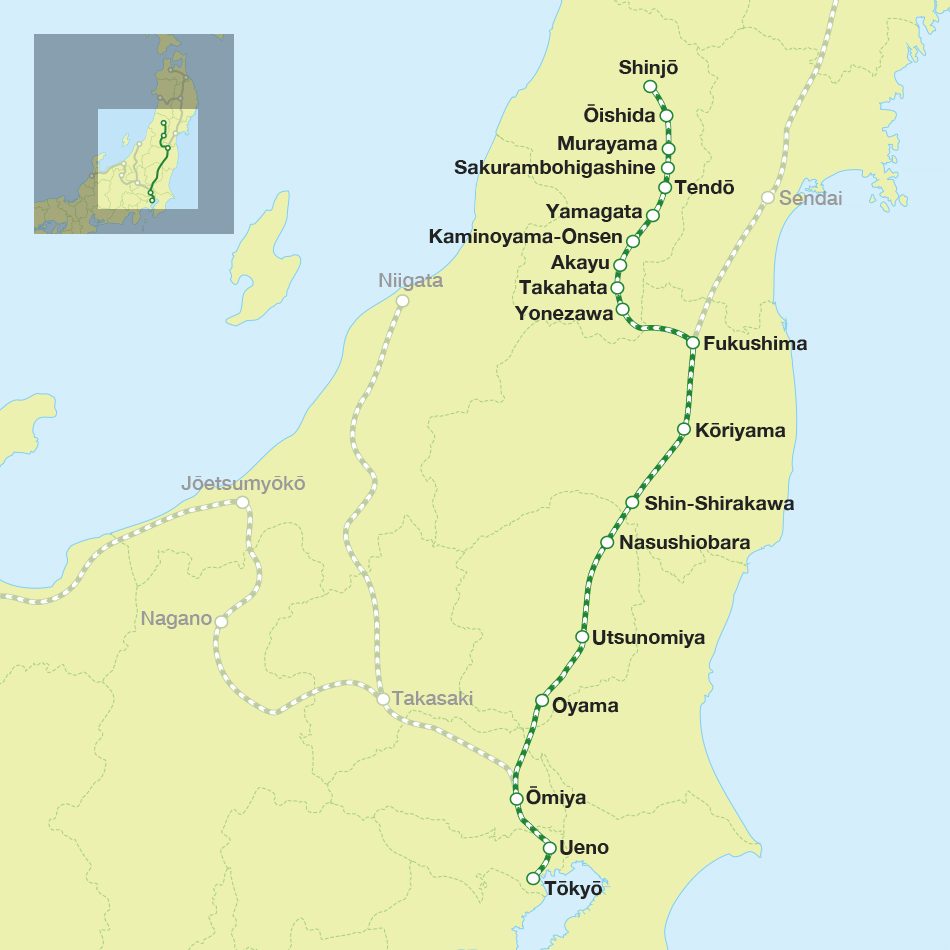
The journey of the Yamagata Shinkansen "Tsubasa" service is a story of two distinct halves, starting on high-speed dedicated tracks and transitioning to a unique shared local line. Below are the primary stops for the Tsubasa service, with approximate travel times from Tokyo Station.
|
Station Name |
Japanese |
Prefecture |
Cumulative Distance from Tokyo (km) |
Major Transfers & Notes |
|
Tokyo |
東京 |
Tokyo |
0.0 |
The main hub for all Shinkansen lines. |
|
Ueno |
上野 |
Tokyo |
3.6 |
Connects to multiple JR East commuter lines. |
|
Omiya |
大宮 |
Saitama |
30.3 |
Major hub for Tohoku, Joetsu, Hokuriku Shinkansen. |
|
Utsunomiya |
宇都宮 |
Tochigi |
109.0 |
Gateway to Nikko. |
|
Koriyama |
郡山 |
Fukushima |
226.7 |
Major hub in Fukushima Prefecture. |
|
Fukushima |
福島 |
Fukushima |
272.8 |
Transfer point for Tohoku Shinkansen; where Tsubasa couples/decouples . |
|
Yonezawa |
米沢 |
Yamagata |
312.9 |
Known for high-quality beef (Yonezawa-gyu). |
|
Takahata |
高畠 |
Yamagata |
322.7 |
Area known for wineries and fruit production. |
|
Akayu |
赤湯 |
Yamagata |
328.9 |
Gateway to the Flower Nagai Line. |
|
Kaminoyama-Onsen |
かみのやま温泉 |
Yamagata |
347.8 |
Famous hot spring resort town at the base of Mount Zao. |
|
Yamagata |
山形 |
Yamagata |
359.9 |
Prefectural capital; main hub for local lines . |
|
Tendō |
天童 |
Yamagata |
373.2 |
Famous for shogi (Japanese chess) piece production. |
|
Sakurambo-Higashine |
さくらんぼ東根 |
Yamagata |
380.9 |
Named after the region's famous cherries (sakurambo). |
|
Murayama |
村山 |
Yamagata |
386.3 |
Local access point. |
|
Ōishida |
大石田 |
Yamagata |
399.7 |
Gateway for Ginzan Onsen, a famous historic hot spring. |
|
Shinjō |
新庄 |
Yamagata |
421.4 |
Northern terminus of the line; connects to local Rikuu lines . |
‼️Recommended "Jump-Off" Points:
-
For Classic Aesthetics: Get off at Oishida. Local shuttle buses (approx. 35 mins) take you to Ginzan Onsen, the gas-lit town famous for its Taisho-era architecture.
-
For Nature & Skiing: Get off at Yamagata. From here, a 40-minute bus ride takes you to Zao Onsen, home to the famous "Snow Monsters" (Juhyo).
-
For Spiritual Hiking: Get off at Yamagata and take the local Senzan Line for 20 minutes to reach Yamadera, a temple complex with over 1,000 stone steps.
The Seat Map & Train Types
On the Yamagata Shinkansen, the seating experience is slightly different from other lines because the trains are "Mini-Shinkansen." This means the train bodies are narrower to fit onto local tracks, resulting in a 2+2 layout in almost all cars—no middle seats here!

By 2026, the fleet is primarily composed of the new E8 series, which has standardized modern amenities across the board.Here is a quick overview of the seat types available on the Yamagata Shinkansen:
1. Green Car (Car 11)
The Green Car is the "First Class" of the Yamagata Shinkansen. It occupies only one car (Car 11) at the end of the train.
-
Seating: 2+2 arrangement.
-
Design: Inspired by the greenery of Mount Gassan. The seats feature deep green upholstery and elegant cherry wood armrests.
-
Amenities:
- Electric leg rests and deeper recline.
-
Individual reading lights and a larger tray table.
-
More "pitch" (legroom) compared to ordinary cars (approx. 1,160 mm).
-
All seats have individual power outlets.
2. Ordinary Car (Cars 12–17)
The Ordinary cars are standard but highly comfortable. In 2026, these are notable for their vibrant regional colors.
-
Seating: 2+2 arrangement (unlike the 3+2 found on the Tokaido Shinkansen).
-
Design: Inspired by the Safflower (Yamagata’s prefectural flower). The seats feature a color gradient from bright yellow to rich red, mimicking the safflower dyeing process.
-
Amenities:
-
Traditional reclining seats with adjustable headrests.
-
Power outlets at every single seat (a major upgrade in the E8 series; older E3 series only had outlets at window seats).
-
Bottle holders and jacket hooks.
-
⚠️Note: The Yamagata Shinkansen (Tsubasa trains) is all-reserved seating. There are no non-reserved cars, and you must purchase a ticket with a designated seat before boarding. While some general Shinkansen guides might mention mixed seating, the specific Tsubasa service on the Yamagata line is fully reserved.
E8 Series Seat Map (Typical 7-Car Set):
|
Car No. |
Class |
Notable Features |
|
11 |
Green |
Quietest car; Wheelchair space; Best for business/long naps. |
|
12 |
Ordinary (Reserved Seat) |
Wheelchair-accessible seating (3 spaces); closest to Green car. |
|
13 |
Ordinary (Reserved Seat) |
Multipurpose room (for nursing/illness) and universal restroom nearby. |
|
14 |
Ordinary (Reserved Seat) |
Standard seating; luggage racks at car ends. |
|
15 |
Ordinary (Reserved Seat) |
Standard seating; luggage racks at car ends. |
|
16 |
Ordinary (Reserved Seat) |
Standard seating; luggage racks at car ends. |
|
17 |
Ordinary (Reserved Seat) |
Terminus end car; often has slightly more engine noise. |
🎒Amenities & Shared Facilities:
-
Luggage Storage: The E8 series includes large, dedicated luggage racks in every car, so you don't have to struggle with oversized bags in the overhead bins.
-
Restrooms: Located between cars 11/12, 13/14, and 15/16. The restroom between 12 and 13 is a large, universal-access type.
-
Wi-Fi: Free "JR-EAST FREE Wi-Fi" is available throughout the train, though signal can be spotty when passing through the tunnels of the Itaya Pass.
Tickets and Reservations
The ticketing system for the Yamagata Shinkansen has shifted toward a more streamlined, digital-first approach. The biggest change this year is the consolidation of regional rail passes and the full enforcement of "Reserved-Only" seating for the Tsubasa service.
A. How to Buy Yamagata Shinkansen Tickets
Purchasing tickets for the Yamagata Shinkansen is more digitized and user-friendly than ever. Since the Tsubasa service is all-reserved, having a strategy to secure your seat before you arrive at the platform is essential.There are several convenient ways to buy tickets:
1. Online Booking
1) JR East's Official "Ekinet" Service
From October 31, 2025, JR East launched a service allowing reservations up to three months in advance for travel from January 10, 2026. This is the official way to book directly. It also introduced features for fee-free refunds or changes if your reserved train is cancelled or significantly delayed.
-
Platform: JR-EAST Train Reservation (Eki-Net)
-
Benefits:
-
Seat Map: You can visually select your preferred seat (choose D for mountain views going north).
-
E-Tickets: You can link your purchase to a Suica, PASMO, or Welcome Suica. This allows you to tap through the Shinkansen gates using your phone or IC card—no paper ticket required.
-
Early Bird Discounts: Look for "Tokudane" fares, which can save you 10% to 30% if booked 14–20 days in advance.
-
2) Online Booking Platforms
These are convenient for international travelers, often allow you to pay in your own currency, and provide a QR code for boarding. Some platforms allow you to reserve seats with extra luggage space.
2. At the Station: Automated Kiosks
If you prefer to buy in person, skip the long lines at the ticket office and head to the Reserved Seat Ticket Vending Machines (usually purple).
-
Passport Scanning: As of 2026, many of these machines include passport readers. If you bought a JR East Pass online, you can simply scan your passport and QR code at the machine to print your pass and reserve seats instantly.
-
Ease of Use: The machines have a "World Language" button (English, Chinese, Korean, etc.).
-
Payment: They accept cash, but international credit cards (Visa, Mastercard, Amex) are now widely accepted via chip-and-pin.
3. Ticket Offices (Midori no Madoguchi)
Tickets can be purchased at JR ticket counters (Midori no Madoguchi) in major stations such as:
-
Tokyo Station
-
Ueno Station
-
Shinjuku Station
Staff can help you select seats and reserve specific trains.If you have a complex request or need a refund, look for the Green Window (Midori no Madoguchi) or the JR East Travel Service Centers located in major stations like Tokyo, Ueno, or Yamagata.
⚠️Note: These can have long wait times during peak hours.
B. Ticket Types & Pricing
The Yamagata Shinkansen operates under a "Reserved-Only" model, meaning you must secure a seat assignment before boarding. Pricing is determined by a combination of the base fare and the Shinkansen express surcharge.
1. Standard One-Way Fares (from Tokyo)
Prices vary slightly depending on whether you travel during "Off-Peak," "Regular," or "Peak" seasons (usually a difference of about ¥200–¥400).
|
Destination |
Ordinary Reserved |
Green Car (Premium) |
|
Yonezawa |
~¥10,700 |
~¥14,400 |
|
Yamagata |
~¥11,600 |
~¥15,300 |
|
Oishida (for Ginzan Onsen) |
~¥12,600 |
~¥16,200 |
|
Shinjo |
~¥13,000 |
~¥17,900 |
-
Children aged 6–11 travel at 50% of the adult fare.
-
Children under 6 travel free unless they require their own reserved seat.
2. Discounted Ticket Types
If you aren't using a rail pass, you can save money by booking digitally:
-
Eki-Net "Tokudane" Discounts: By booking through the official JR East website (Eki-Net) 14 to 20 days in advance, you can secure discounts of 10%, 30%, or even 50% on select "Tsubasa" departures.
-
Shinkansen e-Ticket: By linking your digital ticket to a Suica or Welcome Suica, you save ¥200 per ticket and bypass the need to print paper tickets at the station.
3. Using JR Pass
You can also use a JR Pass on the Yamagata Shinkansen! It's a great way to save money if you're doing multiple long-distance trips.However, reservations are still recommended.
Several JR passes include the Yamagata Shinkansen "Tsubasa" service. Here are your main options:
|
Pass Name |
Coverage Area |
Price (Ordinary Car) |
Best For |
|
Unlimited rides on JR East lines (including Yamagata Shinkansen) in the Tohoku region, Kanto area (Tokyo), and Niigata. |
5 days: ¥35,000 10 days: ¥50,000 |
Travelers exploring Tohoku region from Tokyo, with flexibility for day trips. |
|
|
JR East area + South Hokkaido (as far as Sapporo) on 6 consecutive days. |
¥40,000 (from March 14, 2026) |
Those continuing from Tohoku to Hokkaido. |
|
|
Tohoku region + South Hokkaido on 6 consecutive days. Does not cover Tokyo. |
¥32,000 (from March 14, 2026) |
Travelers starting in Tohoku (e.g., Sendai) and heading to Hokkaido. |
|
|
All JR trains nationwide, including Yamagata Shinkansen. |
7 days: ¥50,000 14 days: ¥80,000 21 days: ¥100,000 |
Long-distance travelers visiting multiple regions across Japan. |
C. How to Reserve Seats
The Tsubasa is an All-Reserved train. You cannot board without a specific seat assignment.
-
Online (Recommended): Use the JR-East Train Reservation site. You can pick your exact seat from a digital map.
-
Digital Integration: You can link your digital ticket to a Suica or Welcome Suica (including Apple Wallet). Instead of a paper ticket, you simply tap your phone at the Shinkansen gates.
-
Ticket Machines: Look for the purple "Reserved Seat" machines. In 2026, most major stations have machines with passport scanners, allowing tourists to pick up rail passes without waiting in line at the ticket office.
🗓️Reservation Timeline:
-
Opening: Reservations open 1 month (at 10:00 AM JST) before your departure date.
-
Peak Seasons: If traveling during Golden Week (late April/early May), Obon (mid-August), or New Year, book the moment the window opens. These trains are smaller (only 7 cars) and sell out faster than the massive 17-car trains on the main Tohoku line.
The Travel Time and Timetable
Here are the travel times and timetables for the Yamagata Shinkansen.
Travel Time Overview
|
Route |
Typical Travel Time |
Fastest Journey |
|
Tokyo → Yamagata |
~2h 38m - 2h 45m |
~2h 38m |
|
Tokyo → Shinjō (Terminus) |
~3h 20m - 3h 30m |
~3h 20m |
|
Yamagata → Tokyo |
~2h 38m - 2h 45m |
~2h 38m |
|
Yamagata → Omiya (Saitama) |
~2h 15m - 2h 20m |
~2h 8m |
‼️Note on March 2026 Timetable Change: With the full introduction of E8 series trains operating at 300 km/h, travel times between Tokyo and Yamagata have been reduced by 4 minutes. The new standard travel time is approximately 2 hours 38-41 minutes
2026 Timetable Overview
Trains generally depart Tokyo Station every hour, usually on the hour or shortly after. Note that the Tsubasa is often coupled with a Yamabiko train for the first leg of the journey; they split at Fukushima Station.
Northbound (Outbound from Tokyo)
-
First Train: Departs Tokyo at 06:12 (Tsubasa 121), arriving in Yamagata at 08:59 and Shinjo at 09:55.
-
Morning Peak: Frequent departures at 07:12, 08:00, 08:56, and 09:24.
-
Evening/Last Train: The final service to reach the terminus (Shinjo) usually departs Tokyo around 19:16. A later train at 20:44 (Tsubasa 159) goes as far as Yamagata, arriving at 23:26.
Southbound (Inbound to Tokyo)
-
First Train: Departs Shinjo at 05:40 or Yamagata at 06:02, arriving in Tokyo by 08:48.
-
Last Train: Departs Shinjo around 19:57, arriving in Tokyo at 23:28.
🔍How to Read the 2026 Schedule:
When checking schedules at the station or online (via the JR East Timetable page):
-
"つ" (Tsu): Indicates the Tsubasa service.
-
"新" (Shin): Indicates the train goes all the way to Shinjo.
-
"山" (Yama): Indicates the train terminates at Yamagata.
-
The "Coupling" Symbol (◇): In 2026, this indicates the train will combine with an E5 series "Yamabiko" at Fukushima. Ensure you are in Cars 11–17 to stay on the Yamagata branch!
The Luggage Rules
On the Yamagata Shinkansen, the luggage rules are notably different from the Tokaido Shinkansen (the line to Kyoto/Osaka). Because it is operated by JR East, the strict "Oversized Luggage Reservation" system is not enforced, but the new E8 series trains have been designed with specific storage solutions in mind.
1. Luggage Rules by Size
The rules are based on the total dimensions (Length + Width + Height) of your bag.
|
Bag Size |
Dimension (L+W+H) |
Storage Location |
Reservation Needed? |
|
Small/Medium |
Under 160 cm |
Overhead rack or at feet |
No |
|
Oversized |
160 cm to 250 cm |
Luggage racks / Behind last row |
No (Unique to JR East) |
|
Prohibited |
Over 250 cm |
Not allowed on board |
N/A (Use Takkyubin) |
2. Where to Store Your Bags
The E8 Series trains (full rollout in 2026) are a major upgrade for travelers with bags.
-
Dedicated Luggage Racks: Unlike older trains, the E8 features large, multi-tier luggage racks in every car. These are located near the doors and are free to use on a first-come, first-served basis.
-
Overhead Racks: These are surprisingly deep and can fit most "checked" suitcases (approx. 70L–80L) as long as you can lift them safely.
-
Behind the Last Row: While you don't need a reservation to use the space behind the last row of seats, it is etiquette to only use this space if you are actually sitting in that row.
3. Skis, Snowboards & Strollers
Yamagata is a major ski destination (Zao Onsen), so the rules for sports gear are very relaxed.
-
Sports Gear: Skis, snowboards, and surfboards are exempt from the size rules. You can bring them on board for free.
-
Strollers: You can keep these at your seat or use the multipurpose room (usually near Car 13) if it’s vacant.
-
Pro-Tip: If you have skis, try to reserve a seat in the last row of the car. This allows you to slide your gear behind your seat without blocking the aisle or other passengers' luggage.
4. Hands-Free Travel (Takkyubin)
If you are traveling with multiple 250 cm bags, or just don't want to navigate stations with heavy gear, use a luggage delivery service.
-
Yamato Transport (Black Cat): You can send a suitcase from your hotel in Tokyo to your ryokan in Yamagata for roughly ¥2,500–¥3,500.
-
Timing: Bags sent before 10:00 AM usually arrive the next day. This is the "pro" way to travel to Ginzan Onsen, as the local buses from Oishida Station have very limited luggage space.
Pro-Tips for Travelers
-
Arrive Early at the Station: Arrive 15–20 minutes before departure to navigate ticket gates, find your platform, and board calmly.Larger stations like Tokyo Station and Omiya Station can be busy during peak hours.
-
Bring Snacks and Drinks: While the journey is relatively short, many passengers like to enjoy bento boxes or regional snacks purchased at Tokyo or Fukushima stations.Vending machines or trolley services are limited on Tsubasa trains compared to longer Shinkansen lines.
-
Know Train Coupling Points: At Fukushima Station, Tsubasa trains may couple or decouple from the Yamabiko Shinkansen.Make sure you board the correct car and check your ticket to avoid being on the wrong segment.
-
The "Split" at Fukushima: Many Tsubasa trains are coupled with Yamabiko trains (Tohoku Shinkansen) from Tokyo. They decouple at Fukushima. Ensure you are in the correct car (Cars 11-17) before reaching Fukushima if you are heading to Yamagata.
-
Use Station Amenities: Major stations along the line (Tokyo, Omiya, Koriyama) have coin lockers, waiting lounges, and convenience stores.If you’re carrying luggage, consider storing large bags at a locker for day trips.
-
Travel During Off-Peak Times: Early morning and late evening departures are less crowded.Midday rides allow you to enjoy window views and a quieter cabin.
Frequently Asked Questions
Is the Yamagata Shinkansen covered by the Japan Rail Pass?
Yes. The Japan Rail Pass fully covers the Yamagata Shinkansen, including seat reservations.
How fast is the Yamagata Shinkansen?
Maximum speed is about 275 km/h between Tokyo and Fukushima, though speeds are lower on the mini-Shinkansen sections.
Do I need to reserve a seat?
Yes. All seats on the Tsubasa Shinkansen are reserved.
Can I bring large suitcases?
Yes. Most luggage can be stored in overhead racks or behind seats, and strict oversized luggage rules usually do not apply.
How to choose your seat?
Here are a few tips to help you decide:
-
For the Best Scenery: The journey between Fukushima and Yamagata/Shinjō offers breathtaking views of the Fukushima basin, the Zao mountain range, and even glimpses of the Dewa Sanzan mountains . To maximize your viewing pleasure, a window seat on either side will offer beautiful perspectives. As the train winds through the mountains, both sides have something to offer.
-
For Peace and Quiet: The Green Car (Car 11) is your best bet for a tranquil environment. It's less crowded and offers a more premium experience .
-
For Convenience with Luggage: If you are traveling with a large suitcase (total dimensions 160cm - 250cm), remember you must reserve a specific seat with oversized baggage space . On the E8 series, Car 12 has a designated baggage storage area, making it the most convenient choice .When you book your ticket online or at a station, simply look for the option to select a "Seat with oversized baggage area."
How do I know if I am on the new E8 train?
By 2026, most services use the E8 series. You can identify it by its 9-meter long nose and the "Mandarin Duck Purple" and "Safflower Yellow" exterior. On your booking screen, the E8 is usually noted, and it features power outlets at every seat, unlike the older E3 models.
Is there a fee for large suitcases?
No. Unlike the Shinkansen lines going to Osaka, the Yamagata Shinkansen (JR East) does not require a paid reservation or a special fee for oversized bags. You can use the large luggage racks at the end of each car for free.
Which station is best for Ginzan Onsen?
Oishida Station. From there, you take a 35-minute bus. Note that the bus is not covered by the JR Pass and usually costs about ¥1,000 (cash only).
How do I get to Zao Onsen?
Get off at Yamagata Station and take the bus from the East Exit (approx. 40 minutes).
Final Thoughts: The Yamagata Shinkansen offers one of the most comfortable and scenic ways to reach northern Japan from Tokyo. With fast travel times, reliable service, and easy connections, it’s an excellent choice for exploring Yamagata’s hot springs, mountains, and cultural attractions.
By understanding how tickets work, when to reserve seats, how the train layout is organized, and what luggage rules apply, you can plan your trip with confidence and enjoy a smooth Shinkansen journey.