Navigating public transportation in Hokkaido has never been easier thanks to Kitaca, the rechargeable smart card designed for hassle-free travel. Whether you’re commuting daily, exploring Sapporo, or hopping between cities, understanding how to purchase, reload, and manage your Kitaca card can save both time and money. This guide breaks down everything you need to know, from usage tips to refund procedures, ensuring a smooth journey throughout the region.
What is Kitaca?
Kitaca is a rechargeable contactless smart card issued by JR Hokkaido. It functions as a fare card for trains and buses and also serves as electronic money for shopping. While it is the primary IC card for Sapporo and Hokkaido, it is part of the nationwide IC card interoperability network, meaning you can use it across Japan (with some exceptions).Its mascot is the adorable Ezo Momonga (Hokkaido flying squirrel).
🔸Key Details:
-
Functionality: Beyond transportation, it acts as electronic money for purchases at convenience stores, vending machines, and other retailers.
-
Compatibility: It is interoperable with major Japanese IC cards like Suica and Pasmo, meaning it works nationwide.
-
Usage & Cost: The card costs ¥2,000, which includes a ¥500 refundable deposit and ¥1,500 in usable fare.
-
Mascot: The card features an ezo momonga (flying squirrel) designed by illustrator Sora.
-
Validity: The card is valid for 10 years.
Where Can You Use Kitaca?
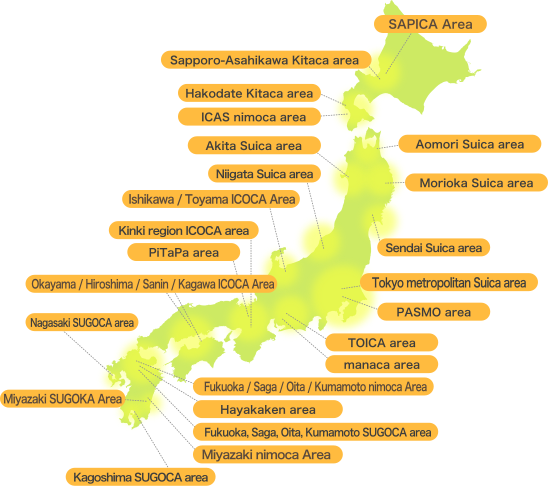
Kitaca is essentially a "master key" for transit and shopping, not just in Hokkaido but across almost all of Japan. Because it is part of the Nationwide Mutual Usage network, you can use it anywhere you see the "IC" logo.
A. Using Kitaca in Hokkaido
While Kitaca is issued by JR Hokkaido, it covers much more than just their trains.
-
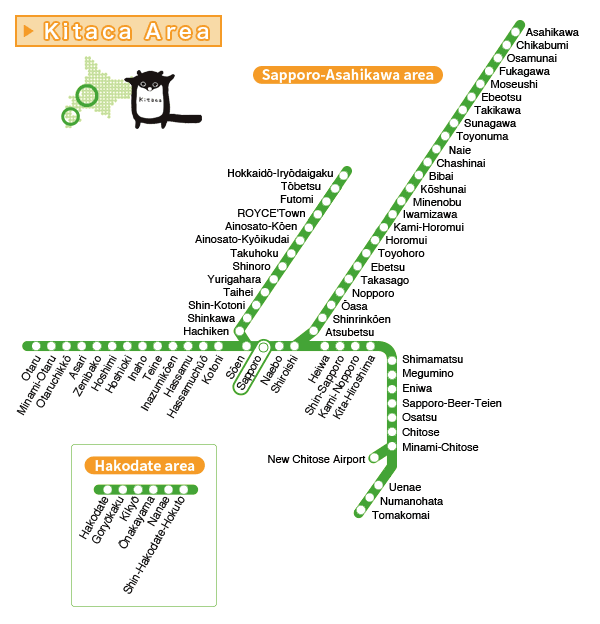
JR Hokkaido Trains: Use it in the greater Sapporo-Asahikawa area and the Hakodate area.
-
Key Route: New Chitose Airport ↔ Sapporo ↔ Otaru.
-
Extended: It now reaches stations as far as Asahikawa and Iwamizawa.
-
-
Sapporo City Transit: It is fully compatible with:
-
Sapporo Subway (Namboku, Tozai, and Toho lines).
-
Sapporo Streetcar (Tram).
-
-
Buses: Most major bus operators in Hokkaido accept Kitaca, including:
-
Hokkaido Chuo Bus, JR Hokkaido Bus, and Jotetsu Bus.
-
Hakodate area buses (which also use the ICAS nimoca system).
-
Kitaca Usable Area
B. Using Kitaca Nationwide
Thanks to the "Mutual Usage" agreement, your Kitaca card works in these major regions exactly like a local card would:
|
Region |
Local Equivalent |
Where it Works |
|
Tokyo / Kanto |
Suica / PASMO |
All JR lines, Tokyo Metro, Subways, and private railways. |
|
Osaka / Kyoto |
ICOCA / PiTaPa |
JR West, Hankyu, Kintetsu, and Keihan lines. |
|
Nagoya |
TOICA / manaca |
JR Central and Meitetsu lines. |
|
Fukuoka / Kyushu |
SUGOCA / nimoca |
JR Kyushu and Fukuoka Subway. |
C. Shopping and Electronic Money
You can use your Kitaca balance to pay at millions of locations:
-
Convenience Stores: 7-Eleven, Lawson, FamilyMart, and Seicomart (Hokkaido's local favorite).
-
Vending Machines: Look for the card reader on the machine.
-
Retailers: Drugstores, Bic Camera, Uniqlo, and many restaurants inside train stations.
-
Coin Lockers: Use the card to pay for and lock/unlock lockers at major stations.
⚠️Where You CANNOT Use It:
-
Crossing Regions: You cannot tap "in" at a station in the Sapporo area and tap "out" in the Hakodate area. These are separate IC zones.
-
Rural Areas: Many smaller stations in Hokkaido (like those in Furano, Biei, or near Shiretoko) do not have IC card readers. You will need a paper ticket for these.
-
Shinkansen: You cannot use your Kitaca balance to pay for Shinkansen fares directly at the gate. You must link it to a specific service (like "Smart EX") or buy a separate ticket.
-
Limited Express Surcharges: While the card covers the base fare, it does not cover the reserved seat fee or limited express fee. You must buy a separate supplement ticket from a machine or staff.
Kitaca Card Types & How to Buy
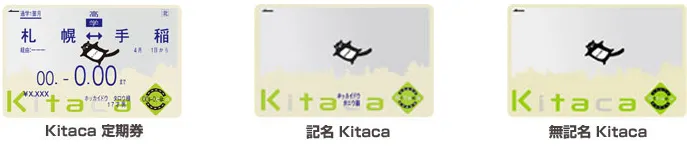
JR Hokkaido offers three main types of Kitaca cards, each designed for different user needs. All cards have a common stored-value (SF) function for seamless travel and shopping.
|
Feature |
Anonymous Kitaca (無記名Kitaca) |
Registered Kitaca (記名Kitaca) |
Kitaca Commuter Pass (Kitaca定期券) |
|
Primary User |
Short-term tourists, casual users |
Long-term visitors, residents |
Commuters, students |
|
Price |
¥2,000 (includes ¥1,500 balance + ¥500 deposit) |
¥2,000 (includes ¥1,500 balance + ¥500 deposit) |
Commuter fare + ¥500 deposit |
|
Available For |
Adults only |
Adults & Children |
Adults & Children |
|
Re-issuance if Lost? |
❌ No |
✅ Yes (fee applies) |
✅ Yes (fee applies) |
|
Purchase Locations |
Kitaca vending machines, JR Ticket Offices (Midori-no-madoguchi), Reserved Seat Vending Machines |
JR Ticket Offices (Midori-no-madoguchi) only |
JR Ticket Offices (Midori-no-madoguchi) |
1. Kitaca Commuter Pass (Kitaca定期券)
This card combines a period-commuter pass (teiki-ken) with all the functions of a standard Kitaca.
-
Who it's for: Commuters, students, or anyone who travels the same route every day for a fixed period (e.g., 1, 3, or 6 months). It offers significant savings for regular travel between two specific stations .
-
Cost: The price is the cost of your commuter pass for the selected period, plus the ¥500 deposit for the card itself .
-
How it Works: The card functions as a train pass for unlimited travel on your chosen route for the duration of the pass. It also holds a separate stored-value balance, so you can :
-
Travel outside your pass section (the extra fare is automatically deducted from the stored balance).
-
Use it for shopping and on other train lines (like the subway) like a normal IC card.
-
-
Re-issuance: Like the Registered Kitaca, this card can be re-issued if lost (fee applies).
- Purchase Locations: Can be purchased at JR Ticket Offices.
2. Registered Kitaca (記名 Kitaca)
This card is linked to your personal information, offering the security of re-issuance if lost.
-
Who it's for: Ideal for longer-term visitors, students, or residents who want the peace of mind that their money is safe if the card is lost or stolen. It is available for both adults and children (child fares apply) .
-
Cost: The initial cost is ¥2,000 (¥1,500 balance + ¥500 deposit) .
-
Key Feature - Re-issuance: If you lose your Registered Kitaca, you can apply for a new one at a ticket office . The card will be re-issued with your balance and deposit transferred. A re-issuance fee of ¥1,020 (which includes a ¥520 handling fee and a ¥500 deposit for the new card) applies.
-
How to Buy: Because it requires registration, it is only sold at JR Ticket Offices (Midori-no-madoguchi) . You will need to provide your name and other details.
3. Anonymous Kitaca (無記名 Kitaca)
This is the standard, no-questions-asked card, perfect for most tourists.
-
Who it's for: This card is designed for adults only who want a simple, rechargeable card for getting around Sapporo and using it nationwide . It does not require any personal information to purchase.
-
Cost: You pay ¥2,000 upfront. This includes a ¥1,500 pre-paid balance (SF) that you can use immediately for fares and shopping, plus a ¥500 refundable deposit.
-
Purchase Locations: It is the most widely available card. You can buy it from :
-
Kitaca Vending Machines (marked with the Kitaca logo).
-
JR Ticket Offices (Midori-no-madoguchi).
-
Reserved Seat Vending Machines (指定席券売機).
-
-
Important Notes:
-
If you lose this card, it cannot be re-issued . Treat it like cash.
-
You can get a refund for the remaining balance and deposit at a JR Ticket Office in Hokkaido (a ¥220 handling fee applies to the balance) .
-
⚠️Note: While other regions (like Tokyo) have pushed heavily into mobile versions, Kitaca is still primarily a physical card experience for most users.If you have an iPhone, you can technically "skip" the Kitaca by adding a Mobile Suica or Mobile PASMO to your Apple Wallet. They work perfectly on all Sapporo subways and JR Hokkaido lines, and you can top them up with your credit card instantly.
How to Use Kitaca?
Kitaca uses NFC (Near Field Communication) technology. You don't need to swipe; just tap.
For Trains (Tapping In and Out):
This is the most common use.
-
Tapping In: Hold your Kitaca flat against the card reader on the automatic ticket gate as you enter the station. You will hear a beep, and the display will show your remaining balance. You must tap the same card you tapped in with.
-
Tapping Out: When you exit at your destination station, tap the card on the reader at the gate. The fare will be automatically calculated and deducted from your balance. The gate will open.
If your balance is insufficient to pay the fare, the gate will not open. You will need to charge your card at a Fare Adjustment Machine before exiting.
For Buses & Trams:
Tap when boarding AND when exiting.
For Shopping (Electronic Money):
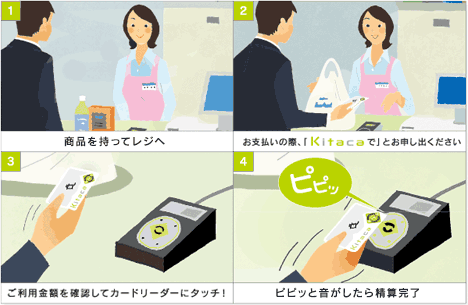
If you see the Kitaca logo or the IC Co-mark (Interoperability logo) at a convenience store (like 7-Eleven, Lawson, FamilyMart), vending machine, or restaurant, you can pay with your card.
-
Tell the cashier you will pay with IC (or just look for the card reader).
-
Place your Kitaca flat on the payment terminal.
-
The amount will be deducted automatically once the transaction is complete.
⚠️Important Note: You cannot use IC cards to travel between different regions (e.g., you can't tap in at Sapporo and tap out in Hakodate). For long-distance travel, use the card for the base fare but purchase a separate Limited Express ticket.
How to Charge (Add Value)?
Charging, also known as "recharging" or "adding value," can be done at any JR Hokkaido station with Kitaca functionality.
➤ Minimum Charge: ¥1,000 (in most machines).
➤ Maximum Balance: The card can hold up to ¥20,000.
➤ Payment Methods: Japanese Yen (Cash) only. Credit cards are generally not accepted for charging IC cards at ticket machines.
Where to Charge:
-
At Ticket Vending Machines: Insert your Kitaca into the machine (or tap it on the designated area, depending on the model). Insert cash, and the machine will add the value to your card.
-
At Fare Adjustment Machines: You can also use these to charge your card.
-
At Convenience Stores: You can often charge your Kitaca at the register in convenience stores that accept it as payment. Just ask: "Kitaca no charji o onegaishimasu."
How to Get a Refund?
If you are finishing your trip in 2026 and want to get your money back, the refund process for a Kitaca is straightforward but geographically strict.
The Golden Rule: JR Hokkaido Only
You can only refund a Kitaca card at JR Hokkaido stations.
-
Yes: New Chitose Airport, Sapporo, Otaru, Asahikawa, Hakodate.
-
No: You cannot refund a Kitaca in Tokyo (JR East), Osaka (JR West), or at Narita/Haneda airports. If you leave Hokkaido with a Kitaca, you’ll either have to keep it for your next trip (it's valid for 10 years) or keep it as a squirrel-themed souvenir.
How the Refund is Calculated
The refund consists of your remaining balance and your ¥500 deposit, but there is a small catch involving a handling fee.
|
Component |
Amount |
|
Deposit |
¥500 (Always returned in full) |
|
Handling Fee |
¥220 (Deducted from the balance only) |
‼️The Formula: (Remaining Balance - ¥220 Handling Fee) + ¥500 Deposit = Your Total Refund
🔔Peer Tip: If your balance is less than ¥220, the handling fee simply wipes out the remaining balance, but they cannot touch your ¥500 deposit. To get the most money back, spend your balance down to exactly ¥0 at a convenience store (like Seicomart or Lawson) first. Then, you will receive the full ¥500 back with no fees deducted.
Step-by-Step at the Station
-
Locate the Ticket Office: Look for the Midori-no-madoguchi (Green Window) at any major JR Hokkaido station.
-
Request the Refund: Show your card to the staff and say: "Refund, please" or "Haraimodoshi, onegai shimasu."
-
Hand over the Card: They will process the refund on the spot and give you the cash. Note that once you refund it, you must surrender the physical card.
Frequently Asked Questions (Q&A)
I bought my Kitaca in Sapporo. Can I use it in Tokyo?
Yes, absolutely. You can use it on JR East lines (Yamanote Line, etc.), the Tokyo Metro, and Toei Subway. Simply tap the card on the gate just like you do in Sapporo.
Can I charge my Kitaca in Tokyo if I run out of money?
Generally, no. You can only charge Kitaca at machines in Hokkaido. If you run low on funds while in Tokyo, you will need to use it until the balance is gone or buy single tickets. Some convenience stores in Tokyo might be able to charge it, but it is not guaranteed. It's best to ensure you have sufficient balance before leaving Hokkaido.
Can I get a refund for my Kitaca in Tokyo?
No. Refunds can only be processed at JR Hokkaido ticket offices (e.g., Sapporo Station, New Chitose Airport Station). You cannot get a refund at JR East stations in Tokyo.
Can I keep the card as a souvenir?
Yes! If you don't want the ¥500 deposit back, you can simply keep the card. It makes a great, functional souvenir from Hokkaido.
Can I use Kitaca on the Shinkansen?
Not directly by "tapping" the gate with your balance. To use Kitaca for the Shinkansen, you must first book a "Shinkansen e-Ticket" online (via the JR East or JR West reservation websites) and link your Kitaca’s 17-digit ID number to that reservation. Otherwise, you must buy a physical paper ticket.
Can two people share one Kitaca?
No. Each traveler must have their own card for transportation because the system needs to "tag" your specific entry and exit stations to calculate the fare. You can, however, share a card to pay for items at a convenience store or vending machine.
I lost my Kitaca. Can I get my money back?
-
If it was a "Non-registered" card: No. It is treated like lost cash.
-
If it was a "Registered" (My Kitaca) card: Yes. Go to a JR Ticket Counter with your ID. They can "freeze" the old card and issue a new one with your remaining balance for a small replacement fee (approx. ¥1,020).
Is there a "Mobile Kitaca" app for my iPhone or Android?
As of 2026, there is no official Mobile Kitaca app for international tourists.If you want a card on your phone, add a Mobile Suica or Mobile PASMO to your Apple/Google Wallet. These "Tokyo" cards work perfectly on all Kitaca-compatible readers in Hokkaido.