Stretching from the vibrant heart of Tokyo deep into the untamed beauty of the Japan Alps, the Hokuriku Shinkansen is more than just a railway—it is your gateway to discovering the soul of central Japan. Whether you are yearning for the historic charm of Kanazawa’s samurai districts, the snowy landscapes of Echigo-Yuzawa, or fresh crab delicacies along the coast, this high-speed line offers speed without skimping on scenery. However, navigating Japan’s complex fare system and train etiquette can be daunting for first-timers. In this comprehensive guide, I break down everything from securing the perfect seat with a view to understanding the latest baggage regulations, ensuring your journey through the Japanese Alps is as smooth as the ride itself.
What is Hokuriku Shinkansen?
The Hokuriku Shinkansen is a high-speed bullet train line in Japan, jointly operated by JR East and JR West, connecting Tokyo to Tsuruga (Fukui Prefecture) via Nagano and Toyama.It connects the capital, Tokyo, with the Hokuriku region on the coast of the Sea of Japan.Historically known as the "Nagano Shinkansen" when it only ran to Nagano for the 1998 Winter Olympics, it has since been extended twice. In 2015, it reached the famous gold-leaf city of Kanazawa, and as of March 16, 2024, it officially extends all the way to Tsuruga in Fukui Prefecture.Future plans aim to extend the line further to Kyoto and Osaka by 2046.
The line runs at speeds up to 260 km/h, offering a scenic route through the Japanese Alps. Known for its speed, comfort, and beautiful alpine scenery, it is one of the best ways for travelers to explore central Japan.
1. Route and Major Stations
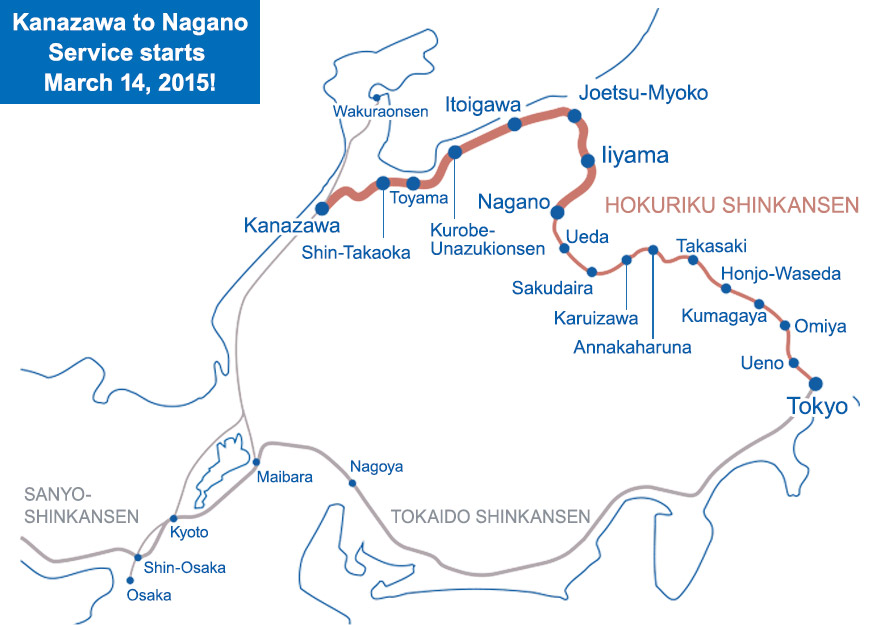
The Hokuriku Shinkansen runs from Tokyo across the mountains of central Japan to Tsuruga on the Sea of Japan coast.The line is divided into two sections by administrative control, though trains run seamlessly between them:
-
Tokyo to Jōetsumyōkō: Operated by JR East.
-
Jōetsumyōkō to Tsuruga: Operated by JR West.
The line passes through several prefectures—including Saitama, Gunma, Nagano, Niigata, Toyama, Ishikawa, and Fukui—making it a key corridor connecting eastern Japan with the Hokuriku region.Here are the full station list:
|
# |
Station Name |
Prefecture |
Service Notes |
|
1 |
Tokyo |
Tokyo |
Main terminus; all trains stop here. |
|
2 |
Ueno |
Tokyo |
All services stop here. |
|
3 |
Omiya |
Saitama |
Major hub; all services stop here. |
|
4 |
Kumagaya |
Saitama |
Mostly Asama and Hakutaka services. |
|
5 |
Honjo-Waseda |
Saitama |
Mostly Asama and Hakutaka services. |
|
6 |
Takasaki |
Gunma |
Transfer for Joetsu Shinkansen. |
|
7 |
Annaka-Haruna |
Gunma |
Local stops only. |
|
8 |
Karuizawa |
Nagano |
Major resort stop; many Kagayaki skip this. |
|
9 |
Sakudaira |
Nagano |
Mostly Asama and Hakutaka services. |
|
10 |
Ueda |
Nagano |
Mostly Asama and Hakutaka services. |
|
11 |
Nagano |
Nagano |
Major stop; all services stop here. |
|
12 |
Iiyama |
Nagano |
Gateway to Nozawa Onsen skiing. |
|
13 |
Joetsumyoko |
Niigata |
Boundary between JR East and JR West. |
|
14 |
Itoigawa |
Niigata |
Coastline stop; only Hakutaka stops here. |
|
15 |
Kurobe-Unazukionsen |
Toyama |
Near the Kurobe Gorge Railway. |
|
16 |
Toyama |
Toyama |
Major stop; all services stop here. |
|
17 |
Shin-Takaoka |
Toyama |
Hakutaka and Tsurugi only. |
|
18 |
Kanazawa |
Ishikawa |
Major stop; former terminus until 2024. |
|
19 |
Komatsu |
Ishikawa |
Part of the 2024 Extension. |
|
20 |
Kaga-Onsen |
Ishikawa |
Part of the 2024 Extension. |
|
21 |
Awara-Onsen |
Fukui |
Part of the 2024 Extension. |
|
22 |
Fukui |
Fukui |
Major stop; all services stop here. |
|
23 |
Echizen-Takefu |
Fukui |
New Shinkansen-only station. |
|
24 |
Tsuruga |
Fukui |
Current Terminus; transfer for Kyoto/Osaka. |
📍Travel Tips for Specific Stations:
-
The "Ski Stations": If you are heading for the snow, Nagano (Hakuba), Iiyama (Nozawa), and Joetsumyoko (Myoko Kogen) are your primary drop-off points.
-
The "Onsen Stations": The section between Kanazawa and Tsuruga is famous for hot springs. Kaga-Onsen and Awara-Onsen put you right in the heart of traditional bathhouse towns.
-
The Terminus Hub: At Tsuruga, the Shinkansen platforms are located on the 3rd floor. To catch the Thunderbird or Shirasagi limited express trains to Kyoto, Osaka, or Nagoya, you simply move down to the dedicated transfer platforms on the 1st floor.
2. Types of Trains on the Line
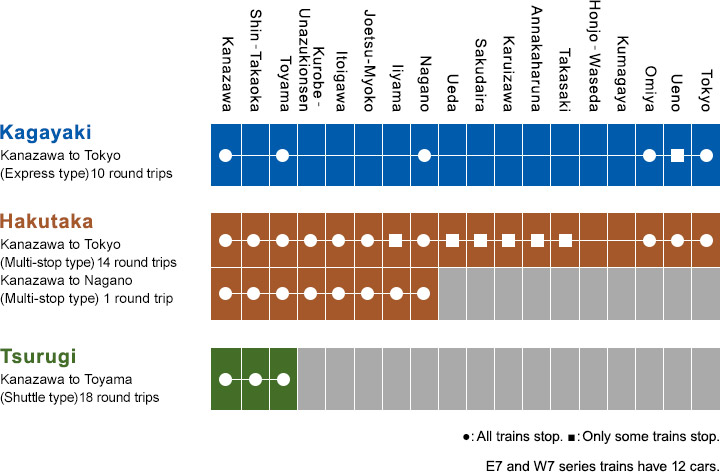
Four types of services operate on the Hokuriku Shinkansen, each with different stopping patterns and speeds. All trains feature the modern E7 series (or W7 series) rolling stock.
-
Kagayaki: The fastest express service. It skips smaller stations and only stops at major cities. All seats are reserved; you cannot board without a specific seat booking.
-
Hakutaka: The "standard" service. It stops at more stations than the Kagayaki and offers non-reserved seating.
-
Asama: A local shuttle that runs only between Tokyo and Nagano.
-
Tsurugi: A regional shuttle service connecting Toyama, Kanazawa, and Tsuruga, primarily used by commuters and travelers moving between these nearby cities.
|
Service |
Route |
Frequency |
Speed/Stops |
Seating |
|
Kagayaki |
Tokyo ↔ Tsuruga |
Mornings & Evenings |
Fastest. Stops only at major stations (Nagano, Toyama, Kanazawa, etc.). |
Reserved Only. No non-reserved cars. |
|
Hakutaka |
Tokyo ↔ Tsuruga |
Throughout the day |
Semi-Fast. Stops at most stations between Nagano and Tsuruga. |
Reserved & Non-Reserved available. |
|
Asama |
Tokyo ↔ Nagano |
Throughout the day |
Local. Stops at all stations between Tokyo and Nagano. |
Reserved & Non-Reserved available. |
|
Tsurugi |
Toyama ↔ Tsuruga |
Throughout the day |
Shuttle. Connects the Hokuriku region; useful for transfers to Osaka/Kyoto. |
Reserved & Non-Reserved available. |
🔔Travel tip: If you want the fastest journey, choose the Kagayaki service. If you need more departure options or are traveling to intermediate stations, Hakutaka trains provide more frequent stops and flexibility.
3. Onboard Classes & Amenities
The Hokuriku Shinkansen offers three classes of service to suit different budgets and comfort levels. All cars are non-smoking and feature power outlets at every seat.
|
Feature |
Ordinary Class |
Green Car |
Gran Class |
|
Layout |
3+2 (standard) |
2+2 (spacious) |
1+2 (luxury) |
|
Seat Material |
Fabric |
High-quality Fabric |
Genuine Leather |
|
Recline |
Standard manual |
Deep motor-assisted |
45° full electric "shell" |
|
Footrest |
No |
Yes (adjustable) |
Yes (leg rest + footrest) |
|
Capacity |
~90 seats per car |
~65 seats per car |
18 seats (max privacy) |
-
Ordinary Car: This is the standard class. Seats are arranged in a 2+3 configuration. They are comfortable and recline, with ample legroom. Overhead storage is available, but space for large suitcases is limited. Trolley service with snacks and drinks is available on most trains.
-
Green Car (Business Class): The Green Car offers enhanced comfort with seats in a 2+2 configuration, providing more width and legroom. It is quieter and often used by business travelers. Amenities include reading lights, footrests, and more space for luggage.
-
Gran Class (First Class): Gran Class is the pinnacle of luxury on the Shinkansen. Seats are arranged in a 2+1 configuration, featuring leather, fully-automated reclining seats. Passengers receive complimentary refreshments and snacks, and are attended by a dedicated cabin attendant.
🔌 Amenities & Convenience (All Classes):
Regardless of your ticket, you’ll find these features on every train:
-
Power Outlets: Available at every single seat, located either on the armrest or the wall below the window.
-
Washlets: All restrooms are equipped with heated seats and bidet functions.
-
Wi-Fi: Free "Shinkansen Free Wi-Fi" is available throughout the train.
-
Wheelchair Space: Dedicated cars feature accessible seating and extra-large restrooms.
4. Travel Time and Timetables
The Hokuriku Shinkansen is efficient, but your travel time will vary significantly depending on whether you board a "Limited Stop" or a "Local" service. Since the 2024 extension, the line has become a major corridor for reaching the Fukui region in under three hours.
Average Travel Times (from Tokyo):
The times below are based on the fastest available Kagayaki services.
|
To Station |
Fastest Time (Kagayaki) |
Standard Time (Hakutaka) |
|
Nagano |
~1 hour 20 mins |
~1 hour 40 mins |
|
Toyama |
~2 hours 08 mins |
~2 hours 40 mins |
|
Kanazawa |
~2 hours 25 mins |
~3 hours 05 mins |
|
Fukui |
~2 hours 50 mins |
~3 hours 30 mins |
|
Tsuruga |
~3 hours 08 mins |
~3 hours 50 mins |
The fastest Kagayaki trains connect Tokyo and Kanazawa in roughly 2 hours 28 minutes, while the journey from Tokyo to Nagano takes about 80 minutes.
Train Frequency:
The Hokuriku Shinkansen operates frequently throughout the day.
-
Tokyo → Nagano: about 2–3 trains per hour
-
Tokyo → Kanazawa / Tsuruga: about 1–2 trains per hour
-
Regional sections (Toyama–Kanazawa–Tsuruga): usually 1 train per hour
Most departures from Tokyo Station begin around 6:00 AM, with the last trains leaving around 10:00 PM depending on the destination.
How to Check Timetables:
Travelers can check real-time schedules and plan routes using:
Schedules can change slightly depending on the season, but the overall frequency remains consistent year-round.
5. Ticket Prices
Hokuriku Shinkansen ticket prices are divided into three components: the Base Fare, the Limited Express Fee, and the Seat Surcharge (Ordinary, Green, or Gran Class).Here’s an overview of typical one‑way fare ranges on the Hokuriku Shinkansen for adult passengers (ordinary one‑way tickets).
Prices for the Kagayaki (fastest) and Hakutaka (semi-fast) are generally the same for reserved seats.Prices for reserved seats typically fluctuate by ¥200–¥400 depending on whether you travel during the "Off-Season," "Regular Season," or "Peak Season" (e.g., Cherry Blossom week or New Year).
|
Destination (from Tokyo) |
Ordinary (Reserved) |
Green Car |
Gran Class |
|
Nagano |
~¥10,870 |
~¥14,530 |
~¥21,500 |
|
Toyama |
~¥14,940 |
~¥21,200 |
~¥28,500 |
|
Kanazawa |
~¥16,910 |
~¥23,370 |
~¥31,840 |
|
Fukui |
~¥18,100 |
~¥23,660 |
~¥34,660 |
|
Tsuruga |
~¥18,890 |
~¥26,740 |
~¥35,210 |
💡Non‑reserved seat prices are cheaper but you may have to stand if trains are busy. Reserved seats guarantee an assigned seat. Gran Class is the premium luxury class with the highest fares.
How to Get Discounts:
-
Shinkansen e-Ticket: Booking via the Eki-Net (JR East) or JR West Online portals and linking your ticket to an IC card (Suica/PASMO) often provides a small discount of ¥200 per ticket.
-
Hayatoku (Early Bird): If you book 14 to 30 days in advance through the official Japanese apps, you can sometimes find "Hayatoku" fares which discount the price by 10% to 30%, though these sell out almost instantly for popular times.
-
Child Fares: Children aged 6–11 travel at 50% of the adult fare. Children under 6 travel free if they do not occupy their own seat.
How to Buy Hokuriku Shinkansen Tickets?
Travelers can easily purchase tickets for the Hokuriku Shinkansen through several convenient methods. Whether you prefer booking online before your trip or buying tickets after arriving in Japan, there are multiple options available.
1. Online Booking (Best for Planning Ahead)
Most travelers now book online to avoid long queues at major stations like Tokyo or Kanazawa.
-
JR East Reservation (Eki-Net): This is the primary official site for the Hokuriku Shinkansen. You can book up to one month in advance.You can link your ticket to a physical or mobile IC card (like Suica or PASMO) and simply "tap-and-go" through the Shinkansen gates.
-
JR West Online Reservation: Since the line is shared, the JR West site also works well and is sometimes more "friendly" toward international credit cards that fail on other Japanese sites.
-
Third-Party Platforms (Klook / Omio / Navitime): These are popular for international tourists because they accept various currencies and have a simpler English interface. They usually issue a QR code that you scan at a station kiosk to print your physical ticket.
🔔Tips: If you book via JR East (Eki-Net), ensure you pick up your paper tickets at a JR East station (like Tokyo, Ueno, or Nagano). If you book via JR West, pick them up at a JR West station (like Kanazawa or Tsuruga).
2. In-Person (Best for Flexibility)
If you prefer not to use an app, you can buy tickets directly at any JR station:
-
Ticket Offices (Midori-no-Madoguchi): Look for the green sign with a person reclining in a seat. Staff can help you choose the best train and handle seat reservations.
-
Reserved Seat Vending Machines: These have English menus. You can select your departure, arrival, and even pick your specific seat from a map.
3. Using a Rail Pass
If you are a foreign tourist on a "Temporary Visitor" visa, a rail pass can offer significant savings.
-
JR Hokuriku Arch Pass: This pass is ideal if you are traveling from Tokyo to the Hokuriku region and onward to the Kansai area (Kyoto/Osaka). It offers 7 consecutive days of unlimited travel on the Hokuriku Shinkansen between Tokyo and Kanazawa, as well as limited express trains to Kyoto and Osaka.
-
JR East Pass (Nagano, Niigata area): This pass is valid for 5 flexible days within a 14-day period. It covers the Hokuriku Shinkansen as far as Nagano.
-
Nationwide Japan Rail Pass: This pass covers the entire Hokuriku Shinkansen line, including the new extension to Tsuruga. It's a good value only if you plan on doing multiple long-distance trips across Japan within a 7, 14, or 21-day period.
How to Buy and Use a Pass:
-
Purchase an Exchange Order: You must buy the pass before arriving in Japan through official websites, online travel agencies, or authorized travel agents abroad .
-
Redeem in Japan: After arrival, take your Exchange Order and passport to a JR ticket office (like at Tokyo Station or Narita Airport) to redeem it for the actual pass.
-
Make Seat Reservations: With your active pass, you can then make free seat reservations for the Shinkansen at any ticket machine or ticket office, ensuring you have a guaranteed seat.
The Luggage Rules
Traveling on the Hokuriku Shinkansen is generally convenient, but there are specific rules regarding luggage size, storage, and restrictions. Understanding these rules can help ensure a smooth boarding experience.
Size Categories:
Japanese Railways (JR) uses the "Total Dimension" rule (Length + Width + Height).
-
Small/Medium (Under 160 cm): Standard carry-ons and most checked suitcases. No reservation is needed. Use the overhead racks.
-
Oversized (160 cm – 250 cm): Very large suitcases.
-
Rule: Unlike the Tokyo–Osaka route, the Hokuriku Shinkansen does not require a specific "oversized baggage seat" reservation.
-
Storage: You can use the dedicated luggage racks at the ends of the cars or the space behind the last row of seats.
-
-
Prohibited (Over 250 cm): Cannot be brought on the train. You must use a delivery service (Takkyubin).
Storage Options Onboard:
The E7/W7 series trains used on the Hokuriku line are designed for travelers with gear (skis, large bags, etc.).
-
Overhead Racks: Surprisingly deep and sturdy. Most "large" international suitcases actually fit here if you can lift them.
-
End-of-Car Racks: Most cars on the Hokuriku Shinkansen feature luggage racks near the doors. These are first-come, first-served. Some are equipped with IC card locks (use your Suica or PASMO to lock them).
-
Behind the Last Row: This space is traditionally used for large items. While no reservation is mandatory, it is common courtesy to book the last row of seats if you plan to use the space behind them.
Special Items (Skis, Bikes, Strollers):
-
Skis & Snowboards: Very common on this line (heading to Nagano/Myoko). You can bring these for free. Use the luggage racks at the ends of the cars.
-
Bicycles: Must be folded or disassembled and placed in a dedicated bike bag (Rinko bag).
-
Strollers: Can be brought for free. It is highly recommended to book a last-row seat so you can tuck the folded stroller behind you without blocking the aisle.
⚠️Important Exceptions:
-
❶ The "Thunderbird" Transfer: If your journey involves transferring at Tsuruga to the Thunderbird or Shirasagi limited express trains (to Kyoto/Osaka), be aware that these trains have much less luggage space than the Shinkansen.
-
❷ Connecting to the Tokaido Line: If you switch to the Tokaido Shinkansen at Tokyo or Nagoya, the rules change. On those lines, you must book a "Seat with Oversized Baggage Area" or pay a ¥1,000 penalty.
🔔Hands-Free Travel: If you have multiple large bags, use a Luggage Forwarding Service (Takkyubin). You can send a suitcase from your Tokyo hotel to your Kanazawa hotel for about ¥2,500–¥3,500. It usually arrives the next day, saving you the hassle of navigating station stairs.
Tips for a Smooth Travel
-
Reserve Seats in Advance:: During peak seasons (Golden Week, Obon, New Year), the line is extremely busy. Book up to 30 days in advance via Eki-Net (JR East) or JR-West Online.
-
Know Your Train: Remember that the fastest Kagayaki trains are all-reserved, so you must have a reserved seat ticket to board.
-
Arrive Early: Plan to arrive at the platform 15-20 minutes early. Trains depart exactly on time, and doors close shortly before departure.
-
Keep Your Ticket Safe: You will need your ticket to exit the gate at your destination station. If you lose it, you may have to pay the fare again.
-
Ticket Gate Tips: When using a rail pass or a pre-booked ticket, you will usually receive two tickets (a fare ticket and an express ticket). You must insert both into the ticket gate at the same time.
-
Platform Etiquette: Pay attention to the markings on the platform floor indicating where the doors for your specific car (e.g., Car 1, Car 5) will stop. Line up in the queue to allow passengers to alight before you board.
-
The "Thunderbird" Transfer: If you are heading to Kyoto or Osaka from Tokyo via this line, you must change from the Shinkansen to the Limited Express Thunderbird at Tsuruga Station. The transfer is designed to be seamless (usually 10–15 minutes).
-
Views: For the best views of the Japanese Alps, try to sit on the left side (Seat E) when traveling from Tokyo toward Kanazawa.
Frequently Asked Questions (Q&A)
Q: Do I need a reservation to board?
A: It depends on the train.
-
Kagayaki (Fastest): YES. It is a "Reserved Only" train. You cannot board without a specific seat assignment.
-
Hakutaka & Asama: NO. These trains have non-reserved cars (usually Cars 1–4). You can just show up and hop on.
Q: Can I use the Japan Rail Pass on the fastest train?
A: Yes. Unlike the Nozomi on the Tokyo–Osaka line, the Kagayaki (the fastest service on this line) is fully covered by the Japan Rail Pass at no extra charge. You just need to stop at a ticket machine or office to book your free seat reservation.
Q: Is there food sold on the train?
A: Very limited.
-
Ordinary & Green Class: There is no trolley service (food cart) on most Hokuriku Shinkansen trains. You should buy your "Ekiben" (station bento) and drinks at the station before boarding.
-
Gran Class: Complimentary light meals and unlimited drinks are served by an attendant (except on certain short-distance or "no-service" flights).
Q: What is the "Tsuruga Transfer"?
A: Since the Shinkansen currently ends at Tsuruga, if you are going to Kyoto or Osaka, you must change trains. Tsuruga station is designed for this; you arrive on the top floor and go down to the first floor to catch the Thunderbird Limited Express. The transfer is usually timed for about 10–15 minutes.
Q: Is there Wi-Fi and Power?
A: Yes. All E7/W7 trains (the only models on this line) have free public Wi-Fi and power outlets at every single seat, including Ordinary Class.
Q: Which side should I sit on for the best views?
A:
-
Heading West (Tokyo → Kanazawa): Sit on the right side (Seat E) for glimpses of the Sea of Japan coast near Itoigawa.
-
Heading East (Kanazawa → Tokyo): Sit on the left side for the coast, or the right side for a better view of the Tateyama Mountain Range near Toyama.
Q: Can I bring food and drinks onboard?
A:
-
Yes, passengers may bring snacks, meals, and drinks.
-
Many stations have bento boxes (ekiben) and vending machines.
-
Some trains also have a trolley service offering snacks and drinks.
Q: What happens if I miss my train?
A: If you have a non-reserved ticket, you can usually board the next available train (of the same type, e.g., Hakutaka). If you have a reserved seat ticket, you should go to the ticket office (Midori-no-madoguchi) to exchange it for the next available train. This may incur a fee depending on your ticket type.
Q: Where is the best place to sit with a large suitcase?
A: Book a seat in the last row of any car. There is a spacious area behind the final seat specifically designed for large luggage.