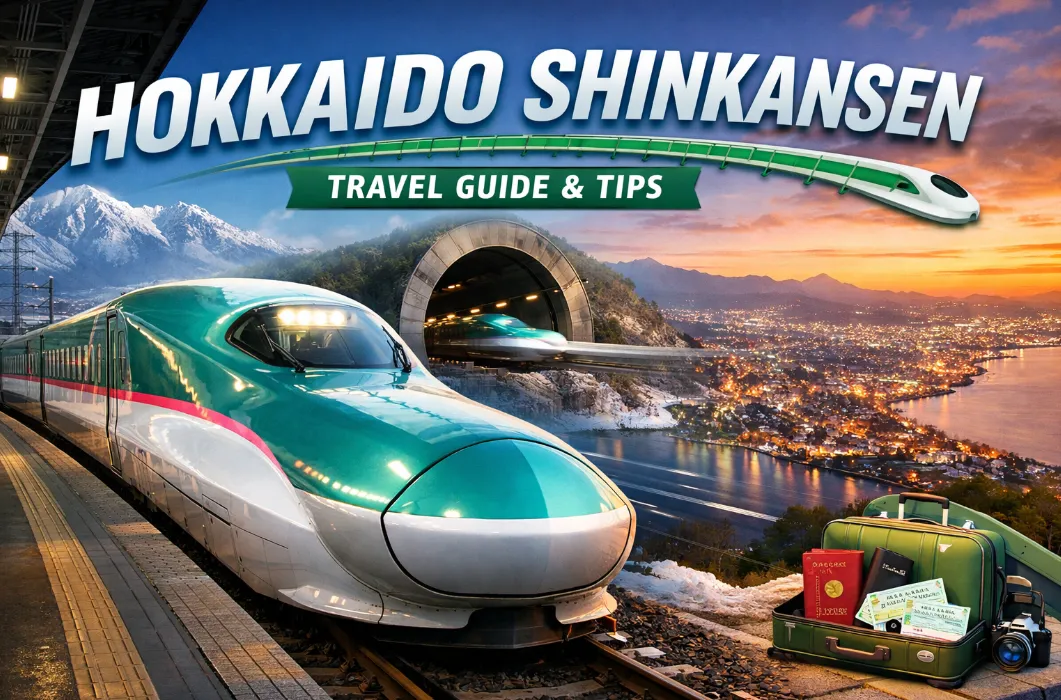
There is no more iconic way to reach the snowy peaks and seafood markets of the north than via the Hokkaido Shinkansen.As the premier rail link between Tokyo and Hakodate, this high-speed bullet train offers unparalleled comfort and scenic views. Whether you’re heading north for winter festivals, fresh seafood, or wide-open landscapes, understanding how the service works can save you both time and money. In this guide, you’ll learn how to choose fares, make seat bookings, understand carriage layouts, and handle baggage smoothly for a stress-free journey.
What is the Hokkaido Shinkansen?
➤ Opened: In 2016.
➤ Operator: JR Hokkaido and JR East.
➤ Route: Connects Tokyo Station to Shin-Aomori Station, serving major cities like Sendai and Morioka.
➤ Max speed: Up to 320 km/h.
➤ Notable Feature: Passes through the Seikan Tunnel, the world’s longest undersea tunnel (~54 km).
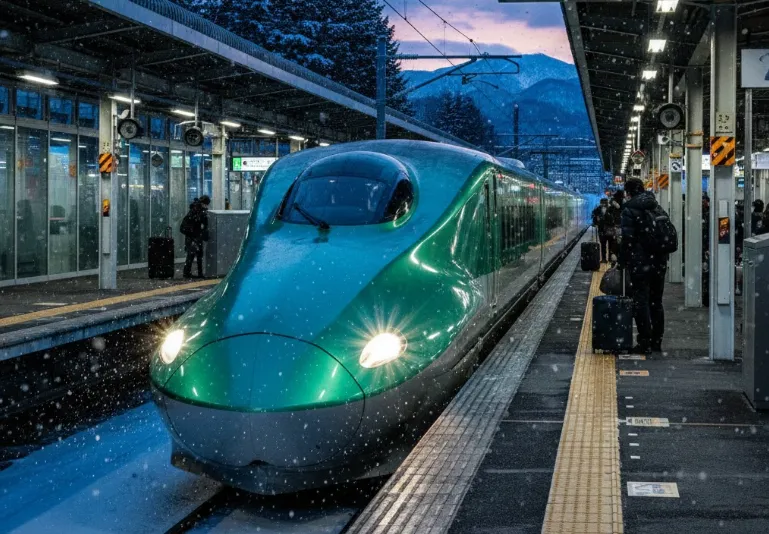
The Hokkaido Shinkansen is Japan’s northernmost high-speed rail line, famously known for being the first and only bullet train to travel under the ocean to connect the main island of Honshu to the northern island of Hokkaido.It is operated by JR Hokkaido and JR East.The line provides a seamless link between Tokyo and southern Hokkaido via the world’s longest undersea tunnel.It offers one of the most scenic and unique travel experiences in Japan.Operating since March 2016, it links Tokyo to Shin-Hakodate-Hokuto in approximately 4 hours, utilizing the speedy Hayabusa trains that reach up to 260 km/h (162 mph). Extension to Sapporo is expected by 2030–2031.
1. Current Route & Key Stations
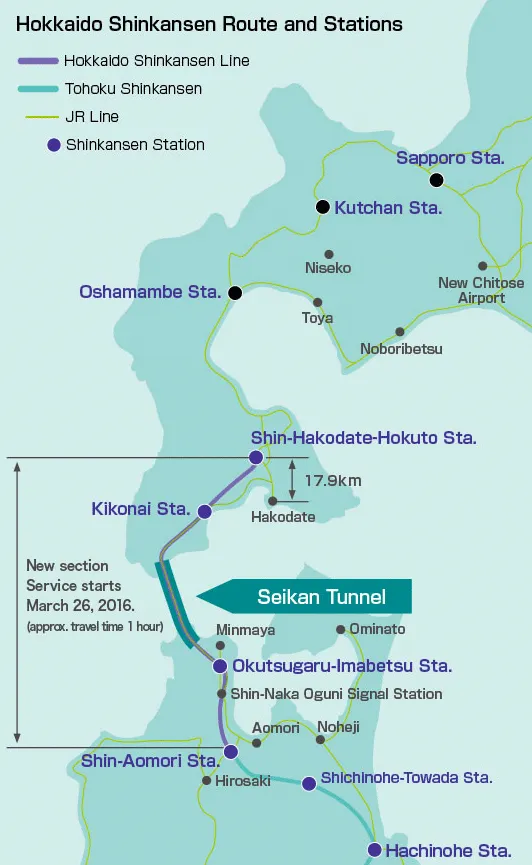
The line officially begins at Shin-Aomori and ends at Shin-Hakodate-Hokuto. While the line is physically in Hokkaido, its service is deeply integrated with the Tohoku Shinkansen, meaning your journey likely begins in Tokyo and transitions seamlessly into the Hokkaido segment at Shin-Aomori.
🗺️ The Route Layout
The Hokkaido Shinkansen officially covers the 149 km stretch from the tip of Honshu (main island) into Hokkaido.
The "Big Three" Hubs:
-
Tokyo Station: The primary starting point. While not technically on the "Hokkaido" line, the Hayabusa trains start here and run through to Hokkaido without you needing to change trains.
-
Shin-Aomori Station: The transition point. This is where the Tohoku Shinkansen ends and the Hokkaido Shinkansen officially begins.
-
Shin-Hakodate-Hokuto Station: The current northern terminus. This is as far north as the Shinkansen currently goes.
🚉 Key Stations & What's Nearby
There are only four official stations on the Hokkaido Shinkansen line itself.
|
Station |
Island |
Key Connections |
Why Stop There? |
|
Shin-Aomori |
Honshu |
Transfer to Tohoku Shinkansen (to Tokyo) & local JR lines.
|
Gateway to Aomori City, famous for the Nebuta Festival and fresh apples. |
|
Okutsugaru-Imabetsu |
Honshu |
The least populated Shinkansen station; gateway to Cape Tappi. |
The "hidden" station. It’s the smallest Shinkansen town in Japan, serving a tiny rural population before the train enters the Seikan Tunnel. |
|
Kikonai |
Hokkaido |
Gateway to southern Hokkaido coastal towns.
|
The first stop on the island. A great base for visiting the historic town of Matsumae (famous for its castle and cherry blossoms). |
|
Shin-Hakodate-Hokuto |
Hokkaido |
Current Terminus. Transfer here to the "Hakodate Liner" (20 mins) to reach central Hakodate City.
|
The end of the line. Transfer here for the Hakodate Liner (20 mins to central Hakodate) or the Hokuto Limited Express (3.5 hours to Sapporo). |
🌊 The Seikan Tunnel
Between Okutsugaru-Imabetsu and Kikonai, the train passes through the Seikan Tunnel.
-
Duration: You’ll be underground/undersea for about 25 minutes.
-
Experience: Watch the electronic display inside the car; it will often announce when you are entering and exiting the tunnel. Because the tunnel is shared with freight trains, the Shinkansen maintains a steady speed of 160 km/h here to prevent air pressure issues for passing cargo.
🏗️ The Future: Extension to Sapporo
Construction is currently underway to extend the tracks further north. By approximately 2038, the route will include:
-
Shin-Yakumo (Tentative name)
-
Oshamambe
-
Kutchan (The gateway to Niseko ski resorts)
-
Shin-Otaru (Tentative name)
-
Sapporo (The final destination)
‼️Tip: Don't wait at the Shinkansen station! Shin-Hakodate-Hokuto is in a rural area. Unless you have a hotel specifically there, jump on the "Hakodate Liner" shuttle immediately to reach the actual city of Hakodate where the morning markets and sightseeing are located.
2. Train Types & Classes
A. Train Types
There are two main services on this line.Both use the high-speed E5/H5 train sets, but they serve different purposes.Both are reserved seating only (no non-reserved cars).
-
Hayabusa: The fastest service, running through from Tokyo to Hokkaido.
-
Hayate: Primarily shuttle services between Morioka/Shin-Aomori and Hokkaido.
|
Route |
Speed |
Frequency |
Seating Type |
Best For |
|
|
Hayabusa (はやぶさ) |
Tokyo ↔ Shin-Hakodate-Hokuto |
Reaches up to 320 km/h on the Tohoku section (though it slows down to 160–260 km/h in the undersea tunnel). |
Usually one train per hour. |
All Reserved |
Travelers coming directly from Tokyo, Sendai, or Morioka. |
|
Hayate (はやて) |
Shin-Aomori ↔ Shin-Hakodate-Hokuto |
Up to 260 km/h. |
Very limited (often just 1–2 round trips per day). |
All Reserved |
Travelers already in the northern Tohoku region who just need to "hop over" the tunnel to Hokkaido. |
‼️Tip: Most travelers from Tokyo to Hokkaido use Hayabusa because it is the fastest, comfortable, and has better amenities.
B. Seating Classes
The Hokkaido Shinkansen has three main seat classes.Every train on this line is Reserved Seating Only. You cannot board with a "Non-Reserved" ticket.
|
Feature |
Ordinary |
Green Car |
Gran Class |
|
Seating |
3 + 2 |
2 + 2 |
1 + 2 |
|
Legroom |
1,040 mm |
1,160 mm |
1,300 mm |
|
Meal |
None |
None |
Gourmet Light Meal |
|
Drinks |
Vending machine |
Vending machine |
Open Bar (Free) |
|
Attendant |
No |
No |
Dedicated Cabin Staff |
|
Best For |
Travelers on a budget who still want a fast, comfy ride. |
Business travelers or those wanting a quiet nap. |
Honeymoons, special occasions, or "bucket list" luxury. |
01. Ordinary/Standard Class (普通車)
-
Availability: Cars 5-10
-
Sub-types:
-
Reserved (指定席): Guaranteed seat (cars 7-10)
-
Non-reserved (自由席): Not available on Hokkaido section trains but available on some connecting Tohoku Shinkansen services
-
-
Features:
-
3+2 seat configuration
-
Reasonable legroom (1040mm pitch)
-
Power outlets, fold-down tables
-
Overhead luggage racks
-
02. Green Car (グリーン車) - First Class
-
Availability: Car 4 on Hayabusa/Hayate
-
Features:
-
2+2 seat configuration
-
Wider seats than standard (1160mm width)
-
45-50° recline, leg/foot rests
-
Complimentary drinks, hot towels
-
Quieter cabin
-
-
Fare: Base fare + Express + Green Car fee (≈¥5,000 premium over standard)
03. Gran Class (グランクラス) - Premium First Class
-
Availability: Cars 1-3 on Hayabusa services
-
Features:
-
2+1 seat configuration (18 seats total)
-
Extra-wide leather reclining seats (130° recline)
-
Complimentary food/drink service (multi-course meals)
-
Attendant service, blankets, slippers
-
Personal entertainment system
-
-
Fare: Base fare + Express + Gran Class fee (≈¥30,000+ Tokyo-Shin-Hakodate)
3. Travel Times & Timetable
Here's a detailed guide to Hokkaido Shinkansen travel times and timetable for planning your trip:
A. Travel Times (Approximate)
The journey time depends largely on how many stops the specific "Hayabusa" service makes in the Tohoku region.
|
Route Segment |
Duration (approx.) |
|
Tokyo ↔ Shin-Hakodate-Hokuto |
3h 57m – 4h 30m |
|
Sendai ↔ Shin-Hakodate-Hokuto |
2h 30m |
|
Shin-Aomori ↔ Shin-Hakodate-Hokuto |
1h 00m |
|
Tokyo ↔ Sapporo (Train + Transfer) |
7.5 – 8 hours |
The "magic number" for this line is 3 hours and 57 minutes. This is the fastest possible time for the express Hayabusa services that skip smaller stations.
B. Typical Service Frequency
-
Tokyo → Shin-Hakodate-Hokuto (Hayabusa): ~8–10 trains per day.
-
Shin-Aomori → Shin-Hakodate-Hokuto: ~12–16 trains per day.
-
Early morning & late evening services: Fewer trains; check timetable before planning.
C. Typical Daily Timetable
Trains generally run once per hour from Tokyo. Below are the typical 2026 departure windows for the direct Hayabusa service.
✅From Tokyo (Northbound):
-
Early Bird: The first train usually departs Tokyo around 06:32, arriving in Hokkaido by 10:53.
-
Mid-Morning: The "Fastest" services (like Hayabusa 5 and 11) typically leave between 08:15 and 09:40.
-
Last Direct Train: To reach Hakodate on the same day, you must generally leave Tokyo by 19:20 (arriving at 23:29).
✅From Shin-Hakodate-Hokuto (Southbound):
-
Early Bird: The first southbound train to Tokyo departs around 06:39.
-
Evening Peak: Several trains depart between 16:00 and 18:40 for late-night arrivals in Tokyo.
-
Last Train: The final departure for Tokyo is usually around 19:41, though this often only goes as far as Sendai or Morioka.
How to Check Real-Time Schedules:
📱 Recommended Apps & Tools
For real-time updates on delays or platform changes, these three are the gold standard:
-
Japan Travel by NAVITIME (Best Overall):
-
Features: Provides real-time status alerts for delays. It has a specific "Japan Rail Pass" mode that filters results only for trains you can use with your pass.
-
Pro Tip: It also shows the platform number, which is a lifesaver in massive stations like Tokyo or Sendai.
-
-
-
Features: Reliable for basic schedules and platform info.
-
Constraint: It is great for live locations, but it doesn't have a "JR Pass" filter, so it might suggest expensive "Nozomi" trains (on other lines) or flights by default.
-
-
Jorudan (Japan Transit Planner):
-
Features: Very detailed. If there is a "signal failure" or "heavy snow" delay in Hokkaido, Jorudan often has the most granular text updates on exactly what is happening.
-
🌐 Official Real-Time Status Pages
If you suspect a delay (common during Hokkaido's winter snow season), use the official dashboards. These are updated every few minutes:
-
JR Hokkaido Train Location: A live "map" view. You can actually see the little train icons moving along the track between Shin-Aomori and Shin-Hakodate-Hokuto.
-
JR East Service Status: Covers the "Hayabusa" while it is still on the main island (Tokyo to Aomori). If there is a delay in Tokyo, this is where you'll see it first.
🚉 At the Station
-
Full-Color LED Boards: Every Shinkansen station has massive overhead displays in English and Japanese.
-
The 3-Color Rule:
-
Green/White text: The train is on time.
-
Red/Yellow text: There is a delay (the display will say "Delayed X min").
-
-
QR Codes: Most 2026 JR posters at the gate now have a QR code you can scan with your phone to immediately pull up the live English status page for that specific station.
Ticketing for Hokkaido Shinkansen
Ticketing for the Hokkaido Shinkansen is unique because the line is Reserved Seating Only. You cannot simply tap an IC card (like Suica) and hop on; you must have a seat assignment before boarding.
1. The Fare Structure
The total fare is made up of three main parts:
- Base Fare (Kihon-ryo / きほん料金)
-
Depends on distance traveled.
-
Covers the basic right to ride a train.
-
-
Shinkansen Surcharge (Tokkyu-ryo / 特急料金)
-
Extra fee for using a Shinkansen (bullet train).
-
Varies by seat class:
-
Ordinary (standard)
-
Green Car (first class)
-
Gran Class (luxury, Hayabusa only)
-
-
- Seat Reservation Fee: Because the Hokkaido Shinkansen has no non-reserved cars, this fee is mandatory and included in your total.
Sometimes these are printed on two separate physical tickets, and sometimes they are combined into one. If you have two, insert both into the gate at the same time, one on top of the other!
2. Ticket Prices (Tokyo ↔ Shin-Hakodate-Hokuto)
Expect to pay the following for a one-way trip from Tokyo. Prices fluctuate slightly based on peak season (New Year, Golden Week, Obon).
|
Class |
Price (Approx.) |
|
Reserved seat |
¥23,560 |
|
Green Car |
¥32,430 |
|
Gran Class |
¥43,430 |
👶 Child & Infant Fares:
-
Children (6–11): Exactly 50% off the Adult Base Fare and Express Fee.
-
Infants (1–5): Free if they sit on your lap. However, because this line is "Reserved Only," if you want a dedicated seat for your toddler, you must pay the Child Fare.
3. Pass Options That Affect Fare
If you are a tourist, a rail pass is almost always better value than buying individual tickets.
01. Japan Rail Pass (National)
-
Price: ¥70,000 for 7-day; ¥110,000 for 14-day; ¥140,000 for 21-day.
-
Coverage: Fully covers the base fare and express fee for the Hayabusa and Hayate.
02. JR East-South Hokkaido Rail Pass
-
Price: The price for this 6-day pass is ¥35,370.
-
Area: Covers everything from Tokyo up to Sapporo. It is the most cost-effective option if you are only visiting the Tokyo and Hokkaido regions.
4. How to Buy & Reserve Online
In 2026, there are three main ways to book without standing in line at the station:
A. The Primary Booking Portal
The JR-EAST Train Reservation website is the official and most reliable tool for the Hokkaido Shinkansen.
-
Window: You can reserve seats up to one month in advance (or even 1 year in advance for some specific products).
-
Pick-up: If you choose physical tickets, you can collect them at any JR East or JR Hokkaido station (like Tokyo, Shin-Aomori, or Hakodate) using a QR code at the green "Reserved Seat" vending machines.
B. The "Tap-and-Go" Method (Ticketless)
This is the most modern way to travel. You can link your Shinkansen ticket directly to your IC Card (Suica, Pasmo, or Icoca), including the digital versions in your Apple or Google Wallet.
-
Register: Create an account on the JR East Reservation site.
-
Buy an "e-Ticket": Select the Shinkansen e-Ticket option during checkout.
-
Link your Card: Enter the 17-digit number found on the back of your IC card (or in your phone's "Card Information" section).
-
Board: At the Shinkansen gates, simply tap your phone/card. The gate will spit out a small Seat Information slip—keep this, as it has your car and seat number!
C. Buying with a Rail Pass
If you are using a Japan Rail Pass or a JR East-South Hokkaido Pass:
-
Online: You can now make seat reservations for free on the same JR East website by selecting the "Seat reservation (Use a pass)" option.
-
In-Person: You can go to any green ticket machine at the station, scan your pass's QR code (and passport if required), and pick your seats on the touch screen.
D. Third Party (Klook / Traveloka)
Popular for those who want to pay in their local currency. They provide a QR code which you scan at a station kiosk to print your physical tickets.
💡Important Tips for 2026:
-
The "SmartEX" Confusion: You might see the SmartEX app mentioned online. Do not use it for Hokkaido. SmartEX only works for the Tokaido/Sanyo lines (Tokyo to Osaka/Fukuoka). For the North (Tohoku/Hokkaido), you must use the JR East system.
-
Credit Card Issues: Some foreign Visa/Mastercard users occasionally experience "3D Secure" authentication errors on Japanese rail sites. If this happens, try using American Express or booking through a third-party site like Klook, which accepts international payments more easily.
-
Early Bird Discounts: Look for the "Hayatoku" label when booking online. These are limited-quantity tickets that offer 5% to 30% off if booked at least 14 days in advance.
-
The Round-Trip Discount: If your one-way journey is over 601 km (Tokyo to Hakodate is 823 km), you get 10% off the Base Fare portion if you buy the return ticket at the same time.
-
The "Transit Discount": In 2026, if you transfer from the Shinkansen to a Limited Express train (like the Hokuto to Sapporo) at Shin-Hakodate-Hokuto, the Express Fee for the second train is often halved.
The Luggage Rules
Japan's Shinkansen is very luggage-friendly, but there are strict size rules—especially on long routes like Tokyo → Shin-Hakodate-Hokuto. Knowing them in advance helps you avoid boarding problems or extra fees.
1. The "160 cm" Rule
The standard for what counts as "large" is the same across all Japanese trains. You calculate this by adding the Length + Width + Height of your bag.
-
Under 160 cm (Standard): Most "checked-bag" size suitcases fit this. You can store these in the overhead racks without a reservation.
-
160 cm to 250 cm (Oversize): These are typically very large "hard-shell" suitcases or bulky sports gear.
-
Over 250 cm: Not allowed on the Shinkansen.
2. Reservation Rules (Crucial Difference)
Unlike the Tokaido Shinkansen (Tokyo ↔ Osaka), the Hokkaido Shinkansen does NOT require a mandatory luggage reservation.On the Tohoku & Hokkaido Shinkansen (JR East/JR Hokkaido), there are currently no "Seats with Oversize Luggage Area" that require a specific booking. You can bring your large bags on board freely, provided they are within the 250 cm limit.
3. Where to Put Your Bags
Even though a reservation isn't mandatory, you still need a place to put your suitcase:
-
Overhead Racks: Surprisingly deep and sturdy. They can easily hold a 20kg–23kg suitcase.
-
Luggage Shelves: At the end of many cars on the E5/H5 trains, there are dedicated luggage racks for large suitcases. These are first-come, first-served.
-
Behind the Last Row: While not "reserved" for specific seats on this line, the space behind the final row of seats is the best spot for massive bags. Etiquette Tip: If you aren't sitting in the last row, it is polite to ask the person sitting there if they mind you placing your bag behind them.
-
At Your Seat: The legroom on the Hokkaido Shinkansen is massive (over 100 cm). You can comfortably fit a carry-on bag in front of your knees and still have room to sit.
4. Special Items (Skis, Snowboards, Bikes)
Since you're heading to Hokkaido, you're likely bringing gear:
-
Skis & Snowboards: You can bring these for free. They are usually tucked into the luggage shelves or placed in the space behind the last row of seats.
-
Bicycles: Must be folded and placed in a dedicated bicycle bag (Rinko bag).
-
Strollers: Can be brought on for free and usually fit in the overhead rack or behind the last row.
Frequently Asked Questions
Q1: Can I use a JR Pass for Hokkaido Shinkansen?
Yes, ordinary and Green Cars (except Gran Class) are included.
Q2: Are there direct trains from Tokyo to Hakodate?
Yes, Hayabusa trains connect Tokyo → Shin-Hakodate-Hokuto, then transfer to Hakodate.
Q3: Is there Wi-Fi onboard?
Limited free Wi-Fi on some trains; many travelers rely on mobile hotspots or SIM/eSIM.
Q4: How long does it take from Tokyo to Hakodate by Shinkansen?
The fastest Hayabusa service takes about 4 hours from Tokyo to Shin-Hakodate-Hokuto, then about 20 minutes by local train to Hakodate city, totaling around 4.5 hours.
Q5: Which train should I take on the Hokkaido Shinkansen?
Most travelers choose Hayabusa, the fastest service with fewer stops and better amenities. Hayate is slower and stops at more stations.
Q6: Does the Shinkansen go directly to Hakodate city?
No. The Shinkansen terminates at Shin-Hakodate-Hokuto. From there, you transfer to a local or limited express train to reach Hakodate Station in about 20 minutes.
Q7: What seat is best on the Hokkaido Shinkansen?
For scenery, choose a window seat, especially when entering Hokkaido. If you have large luggage, select the last row with baggage space.
Q8: Can I eat and drink on the train?
Yes. Eating is normal on Shinkansen. You can buy ekiben (station bento) before boarding, and Gran Class includes complimentary refreshments.
Q9: How early should I arrive at the station?
Arrive at least 20–30 minutes early for long-distance Shinkansen trips so you can find platforms, buy food, and board calmly.
Q10: Is the Hokkaido Shinkansen better than flying?
It depends. The Shinkansen offers city-center to city-center travel, comfort, and no baggage check-in, while flying is often faster for long distances. Many travelers prefer the Shinkansen for convenience and scenery.
Q11: Why can't I find "Non-Reserved" seats on the Hayabusa?
Because they don't exist. All seats on the Hayabusa and Hayate are reserved-only. If the train is fully booked, you can purchase a "Standing Ticket," but you must have a physical reservation to board.
Q12: Does the Shinkansen stop running when it snows?
Rarely. The Hokkaido Shinkansen is designed with "snow-melting" pipes and compressed air blowers. However, the transfer train (the Hokuto Limited Express to Sapporo) is much more likely to be delayed by heavy snow than the Shinkansen itself.
Q13: What happens if I miss my reserved train?
If you miss your Hayabusa reservation, your ticket remains valid for standing room only on any subsequent Hayabusa train on the same day. You cannot simply sit in a Green Car or another reserved seat without paying a change fee.