Fukuoka holds a unique advantage: its airport is exceptionally close to the city center. But with great proximity comes a multitude of choices. Should you hop on the public rail system, book a shared shuttle, or simply rent a car?In the transit overview, I weigh the pros and cons of each method to help you save both time and money. Whether you are traveling light with a backpack or hauling heavy luggage, find out the smartest way to navigate between Hakata Station, Canal City, and the runways.
Overview of Fukuoka Airport
-
Status: 3rd busiest airport in Japan and the busiest in Kyushu . In 2024, it served a record 8.5 million international travelers.
-
Location: A mere 2.6 km (1.6 miles) from Hakata Station, the city's main rail hub, making it one of the most centrally located airports in the nation.
-
Distance to city center: ~5 km
-
To Hakata Station: ~5 minutes by subway
-
To Tenjin: ~10–12 minutes
-
- IATA Code: FUK
Fukuoka Airport (IATA: FUK) is one of Japan’s busiest and most conveniently located airports, serving as a major gateway to Kyushu and nearby Asian destinations. What makes it truly stand out is its exceptional proximity to the city center—just minutes away from downtown Fukuoka.Whether you’re heading to Hakata Station, the city centre, or beyond to other Kyushu destinations, getting from Fukuoka Airport to city is fast, affordable, and stress-free.
Fukuoka Airport has cemented its status as one of Asia's premier hubs. Following massive infrastructure projects completed in late 2025, the airport now offers a "5-Star Regional Airport" experience (certified by Skytrax) with significantly higher flight capacity and world-class passenger facilities.
The airport is divided into two main terminals, which are located on opposite sides of the runway and are connected by a free shuttle bus.
|
Terminal |
Description |
|
Domestic Terminal |
This terminal serves flights to destinations all over Japan, operated by major carriers like JAL, ANA, Skymark, and Peach . It's a large facility with a wide array of shops, restaurants, and a convenience store. The Fukuoka City Subway station is located directly beneath this terminal. |
|
International Terminal |
This terminal handles all international flights to and from major cities in East and Southeast Asia, including Seoul, Busan, Taipei, Hong Kong, Bangkok, Shanghai, and Singapore . It is a modern facility located across the runway from the domestic terminal. |
Both terminals have convenience stores (like 7-Eleven and Lawson) and cafes, perfect for a quick snack or drink upon arrival.Other services include currency exchange, tourist information centers, and Wi-Fi rental services are available, especially in the newly expanded International Terminal arrivals hall.
A. International Terminal
In March 2025, the International Terminal completed a significant expansion and renovation, dramatically enhancing the passenger experience . As of 2026, these new facilities are in full operation.
-
Expanded Arrivals Lobby (Access Hall) : The arrivals area has been greatly expanded to improve the flow of passengers and provide better access to ground transportation, making your arrival smoother than ever.
-
Larger Departures & Security:
-
Security Checkpoint: The security area has been expanded and now features "Smart Lanes." These high-tech lanes allow up to four passengers to prepare at once, use automatic tray return, and permit laptops to stay in bags, doubling the processing capacity.
-
Duty-Free Shopping: The duty-free area is now four times larger (approx. 6,000 sqm). It features a walk-through layout with a much wider selection of fashion, cosmetics, and alcohol, including a new boutique dedicated to Japanese brands.
-
-
New Dining Options:
-
Food Court (HAKATA FOOD HALL) : A new food court with eight restaurants has opened in the departures area, offering travelers a chance to enjoy Kyushu and Fukuoka specialties like ramen, yakitori, and udon before their flight.
-
Arrival Duty-Free: A new duty-free shop (mainly for alcohol and tobacco) is now available in the baggage claim area, allowing you to shop after your flight.
-
-
Enhanced Lounges:
-
Lounge Fukuoka: The airline lounge has been renovated and is now nearly double its previous size, featuring traditional Hakata crafts and an upgraded food and drink menu.
-
ANA Lounge: Designed by renowned architect Kengo Kuma, this lounge offers a sophisticated space inspired by the concept of "Ichigo Ichie" (treasuring every encounter) .
-
B. Domestic Terminal
A key feature is its direct connection to the city’s subway system, providing unbeatable access to downtown. This building is divided into North and South sections to accommodate different airlines.While the International Terminal is finished, construction is currently active on an 11-story complex adjacent to the Domestic Terminal.
-
Status: Scheduled to open in Summer 2027.
-
Features: Will house a Solaria Nishitetsu Hotel (upper floors) and a massive "Asian Food Floor" with over 180 new shops.
-
Dining Upgrades: The 2nd-floor food court was recently relocated to the 3rd floor (reopening April 1, 2026) with specialized zones for business travelers and families.
Inter-Terminal Transfer (Crucial First Step)
Since the International and Domestic terminals are on opposite sides of the runway, the Free Shuttle Bus is the only official way to transfer.
-
Cost: ¥0 (Completely Free).
-
Frequency:
- Peak Hours (7:00 AM – 8:00 PM): Every 5–6 minutes.
-
Off-Peak: Every 10–15 minutes.
-
Travel Time: Approximately 10–15 minutes.
⚠️Note: While the physical distance is short, the bus must navigate a specific "airport-only" road that crosses taxiways, so it can occasionally pause for passing aircraft.
Where to Find the Bus:
-
International Terminal: Exit the 1F Arrivals Hall and look for Bus Stop #1.
-
Domestic Terminal: Look for the "Shuttle Bus" signs on the 1F level. The bus stops at multiple points along the long Domestic Terminal (usually near the North and South arrivals).
🔔Transfer Tips:
-
❶ Subway Access: Remember that the Subway is only at the Domestic Terminal. If you land internationally and want to take the train to Hakata or Tenjin, you must take the shuttle bus first.
-
❷ The "Access Hall" Shortcut: If you are arriving at the International Terminal, head straight to the new Access Hall (completed late 2024/2025). It’s an indoor, climate-controlled space designed specifically to make the transition to the shuttle bus more comfortable.
-
❸ Check-in Time: If you are transferring from a Domestic flight to an International one, allow at least 45 minutes for the total transfer process (getting off the plane, taking the shuttle, and reaching the international check-in counters).
Transportation Options from Fukuoka Airport to City
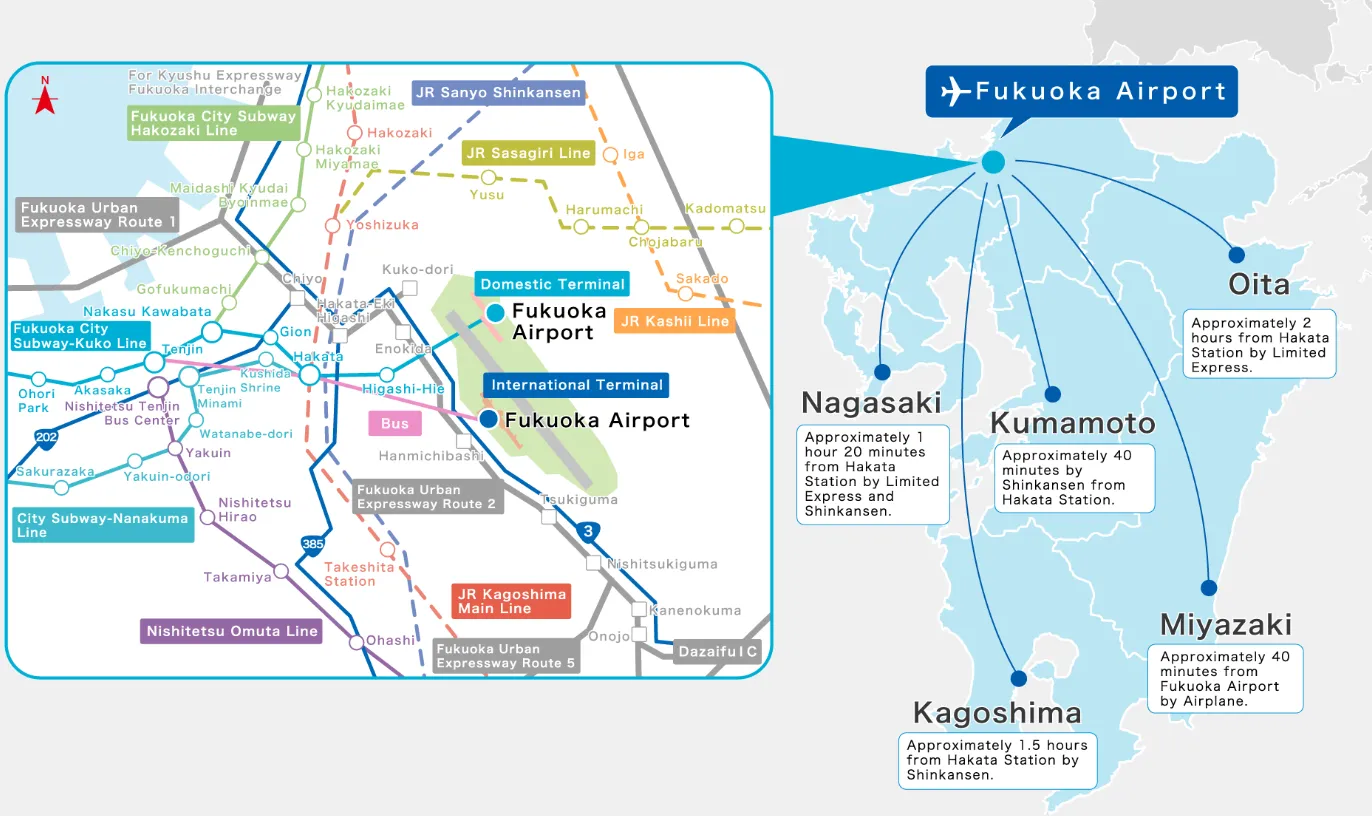
Depending on whether you land at the Domestic or International terminal, your options vary slightly in terms of convenience and price.Here are the primary ways to get from Fukuoka Airport to the city center (Hakata, Tenjin) and beyond.
|
Transport |
Best For |
Route |
Time to City |
Cost |
Frequency |
Transfer Required? |
|
Subway |
Solo travelers, couples, speed |
Int'l Terminal → (Shuttle) →→ Domestic Terminal |
5 mins (to Hakata) |
¥260 |
Every 4-8 mins |
Yes (Shuttle + Subway) |
|
Bus (City) |
Heavy luggage, direct to hotels |
Int'l Terminal Direct |
15-20 mins (to Hakata) |
¥310 - ¥1,000 |
Every 10-15 mins |
No |
|
Taxi |
Groups (3-4 pax), families, comfort |
Int'l Terminal Direct |
10-15 mins (to Hakata) |
¥1,500-¥2,500 |
On-demand |
No |
|
Rental Car |
Kyushu road trips |
Int'l Terminal Counter |
Immediate pickup |
Varies |
Reservations recommended |
No (but need shuttle to lot) |
1. Subway (Fastest & Best Value)
The subway is the preferred choice for most travelers due to its speed, low cost, and frequency. However, the subway station is located at the Domestic Terminal, so international arrivals must take a free shuttle bus(approx. 10–15 mins) to reach the subway.
-
Operating Hours: Approximately 5:30 AM to 12:30 AM.
-
Frequency: Trains run every 4–8 minutes.
-
Payment Options:
-
IC Cards: Suica, Pasmo, ICOCA, Nimoca (touch and go).
-
Tickets: Purchase from vending machines at the station.
- All 36 stations now fully support Contactless Tap-to-Pay (Visa, Mastercard, JCB, etc.).
-
Time & Fare:
|
Destination |
Approx. Travel Time |
Approx. Fare |
Notes |
|
Hakata Station |
5 minutes (2 stops) |
¥260 |
Fukuoka's main JR and Shinkansen hub. |
|
Tenjin Station |
11 minutes (5 stops) |
¥260 |
The city's main shopping and entertainment district. |
|
Nakasu-Kawabata Station |
8 minutes |
¥260 |
Access to Canal City Hakata and the Nakasu entertainment district. |
Pros & Cons:
-
✅ Fastest option to Hakata and Tenjin.
-
✅ Most affordable for solo travelers.
-
✅ Very frequent.
-
❌ Requires a free shuttle bus transfer from International Terminal.
-
❌ Not ideal for those with heavy luggage or mobility concerns.
How to Take:
-
If landing at the Domestic Terminal: Simply follow the "Subway" signs to the B1 level. Escalators and elevators are located throughout the arrivals hall.
-
If landing at the International Terminal: You must take the Free Shuttle Bus (at Bus Stop #1) to the Domestic Terminal first. The bus will drop you off right in front of the subway entrance.
2. Airport Bus (Best for International Arrivals)
If you land internationally and don't want to bother with the shuttle bus to the subway, the direct bus is your best bet.hey are an excellent choice for travelers with large suitcases or those who prefer a direct, hassle-free ride.
-
Boarding Location: Platform 1–2 outside the International Terminal arrivals lobby
-
Payment:
-
IC Card: Tap your Suica, Nimoca, or other IC card upon boarding (at the front door)
-
Cash: Take a numbered ticket upon boarding and pay the fare displayed on the board when exiting.¥1,000 bills can be changed on the bus; larger bills are not accepted.
- Contactless (Tap-to-Pay): Look for the blue/yellow reader. Tap your Visa/Mastercard/Amex/JCB (or phone) when you enter (at the middle door) AND again when you exit (at the front).
-
Time & Fare:
|
Route |
Destination |
Approx. Travel Time |
Approx. Fare |
Frequency |
|
Hakata Station |
Hakata Bus Terminal (connected to JR Hakata Station) |
15–20 minutes |
¥310 |
Every 10–15 minutes |
|
Tenjin |
Tenjin area (Nishitetsu Grand Hotel, etc.) |
25–30 minutes |
¥310 |
Every 15–20 minutes |
|
Canal City Hakata |
Major shopping and entertainment complex |
20–25 minutes |
¥310 |
Several times per hour |
|
LaLaport Fukuoka |
Large shopping mall with life-sized Gundam statue |
15–20 minutes |
¥260 |
Several times per hour |
|
Dazaifu |
Famous Dazaifu Tenmangu Shrine |
35–40 minutes |
¥600–¥1,000 |
Regular departures |
Pros & Cons:
-
✅ No terminal transfer required — depart directly from International Terminal.
-
✅ Great for heavy luggage.
-
✅ Direct access to hotels and tourist spots.
-
❌ Slower than subway during peak traffic hours.
-
❌ Slightly more expensive than subway.
How to Take:
From the International Terminal (Most Convenient):
If you land here, walk straight out of the Arrivals Hall (1F).
-
Bus Stop #2: Direct "Airport Bus" to Hakata Station.
-
Bus Stop #4: Buses to LaLaport Fukuoka (the giant Gundam mall).
-
Bus Stops #6–10: Highway buses to other cities (Beppu, Yufuin, Nagasaki, Kumamoto).
From the Domestic Terminal:
-
Bus Stop #1 & #2: Local buses to Hakata Station and Fukuoka Tower.
-
Bus Stop #9–11: Highway buses to other prefectures in Kyushu.
3. Taxi & Rideshare (Best for Groups/Luggage)
Taxis offer door-to-door service and are ideal for groups, families with children, or travelers with significant luggage. Given the airport's proximity to the city, taxi fares are relatively reasonable compared to other Japanese cities.
-
Location: Dedicated taxi stands outside both terminals.
- Payment: Cash, credit cards, and IC cards are widely accepted in 2026.
Time & Fare:
|
Destination |
Approx. Travel Time |
Approx. Fare |
Suitable For |
|
Hakata Station |
10–15 minutes |
¥1,500 – ¥2,500 |
1–4 passengers |
|
Tenjin |
15–20 minutes |
¥2,000 – ¥3,000 |
1–4 passengers |
|
Canal City / Nakasu |
15–20 minutes |
¥2,000 – ¥3,000 |
1–4 passengers |
Pros & Cons:
-
✅ Door-to-door service — ideal for first-time visitors.
-
✅ No transfers — direct to your hotel.
-
✅ Very affordable for groups (¥500–¥800 per person for 3–4 people).
-
❌ Most expensive option for solo travelers.
-
❌ Can be slower during rush hour traffic.
How to Take:
-
Pick-up Location: Taxi stand (Platform 3) directly outside the International Terminal arrivals lobby.
-
No reservation needed: Taxis are typically available at all hours.
- Late Night: A 20% surcharge usually applies between 10:00 PM and 5:00 AM.
4. Rental Cars (Best for Exploring Kyushu)
If you plan to travel beyond Fukuoka city (e.g., to Yufuin, Beppu, Kumamoto, Nagasaki), renting a car directly at the airport is a convenient option.
-
Counters: Located on the 1F of both Domestic and International terminals.
-
Major Companies: Toyota Rent-a-Car, Nippon Rent-A-Car, Times Car, Nissan Rent-A-Car.
-
Requirement: You must have a valid International Driving Permit (IDP) based on the 1949 Geneva Convention.
Cost by Car Type:
Here are indicative daily rates from various providers:
|
Car Type / Company |
Approximate Daily Rate |
Notes |
|
Compact Car (JCS Rent-A-Car) |
From ¥8,200 (approx. $55 USD) |
Most popular choice |
|
Small Car (Times) |
Aapprox. ¥5,600 - ¥12,200) |
Most affordable option |
|
Economy Car (Various) |
From $33 USD (approx. ¥5,000) |
Lowest possible rate |
|
Weekly Rental |
From $212 USD (approx. ¥32,000) |
Better value for longer trips |
Pros & Cons:
-
✅ Essential for exploring Kyushu beyond Fukuoka
-
✅ Convenient pick-up at the airport
-
❌ Not recommended for staying only in Fukuoka city (parking is costly and public transport is excellent)
How to Rent:
-
Visit the rental car counters in the International Terminal arrivals lobby (Toyota Rent a Car, Times Car Rental, Nippon Rent-A-Car, Orix, Nissan, etc.) .
-
Complete the paperwork at the counter.
-
Staff will direct you to a free shuttle bus that takes you to their nearby rental lot (5–10 minutes away) to pick up your vehicle.
⚠️Important Notes:
-
Highway Tolls: Kyushu Expressway tolls can be expensive. Consider purchasing a Kyushu Expressway Pass (fixed-rate pass for foreign tourists) from participating rental companies .
-
Parking in Fukuoka City: Parking in central Fukuoka can be expensive (¥500–¥1,500 per night). If you are staying only in the city, it is not recommended to rent a car.
For most travelers, the subway is the best option—it’s incredibly fast, cheap, and runs frequently. However, if you value convenience or have heavy luggage, the bus or taxi can be more comfortable.
Essential Tips for a Smooth Journey
-
IC Cards for Convenience: If you already have a rechargeable IC card (Suica, Pasmo, ICOCA) from a previous trip to Japan, you can use it on Fukuoka's subways and buses. You can also buy a local "Nimoca" card at the airport.
-
Free Shuttle Bus is Key: Remember, the subway is at the Domestic Terminal. The free shuttle bus from the International Terminal runs every 5-10 minutes and takes about 10 minutes . Plan for this when calculating your travel time.
-
Late Night / Early Morning Flights: Fukuoka Airport has a curfew due to its city location, so very late-night arrivals (after 10:00 PM) are rare. However, the first trains start around 5:30 AM, and the last trains are just after midnight . Taxis are always available.
-
Souvenir Shopping: The Domestic Terminal has a far greater selection of shops and famous Fukuoka snacks (like Karashi Mentaiko and Hakata Torimon) than the International Terminal. If you have time, take the shuttle to the Domestic Terminal for last-minute shopping before checking in for your international flight.
-
Cash for Buses: If paying cash on the bus, have small bills or coins ready. ¥1,000 bills can be changed, but larger bills are not accepted.
-
Ride-Sharing: Uber and other ride-sharing apps operate in Fukuoka, but they primarily connect you to licensed taxis. They are not cheaper than hailing a taxi directly from the stand.
Quick-Fire Q&A
Can I Walk between terminals?
No. Walking between terminals is strictly prohibited and physically impossible due to the runway and security fencing separating the two sides. If you attempted to walk using public roads outside the airport perimeter, it would take over 45 minutes and is not recommended with luggage.
What is the fastest way to get to the city center?
The fastest option is the subway from the Domestic Terminal.
Is there a direct train from the International Terminal?
No, there is no train station at the International Terminal.You must transfer via shuttle bus or use a direct airport bus/taxi.
What is the cheapest way to get into the city?
The subway is the cheapest option.It’s also the most efficient choice overall.
Is the airport and transportation accessible for wheelchairs?
Yes. Fukuoka Airport and its transportation systems are generally accessible:
-
The free shuttle bus has space for wheelchairs.
-
Subway stations have elevators and accessible gates.
-
Buses have low floors or ramps.
-
Taxis can accommodate foldable wheelchairs.
What if I have an early morning flight?
The first subway trains start around 5:30 AM. If you need to arrive earlier, a taxi is your best option. Direct buses to the International Terminal also operate from Hakata and Tenjin starting early morning.
I have three large suitcases. Should I take the bus?
No. City buses have very limited floor space and no dedicated luggage racks. If you have heavy luggage, a Taxi (approx. ¥1,500–¥2,000 to Hakata) or the Subway (which has more standing room) is much better.
Is there Uber or Grab in Fukuoka?
Uber and DiDi work in Fukuoka, but they essentially just hail a standard licensed taxi for you. There are no private "UberX" drivers in Japan. The fare will be the same as a metered taxi, plus a small app dispatch fee.
Does the Subway have a "Day Pass"?
Yes, but in 2026, you don't need to buy one. If you use Credit Card Tap-to-Pay (Visa, Mastercard, etc.), the system automatically caps your total daily fare at ¥640. Since a paper day pass costs ¥660, tapping your card is actually cheaper and easier.