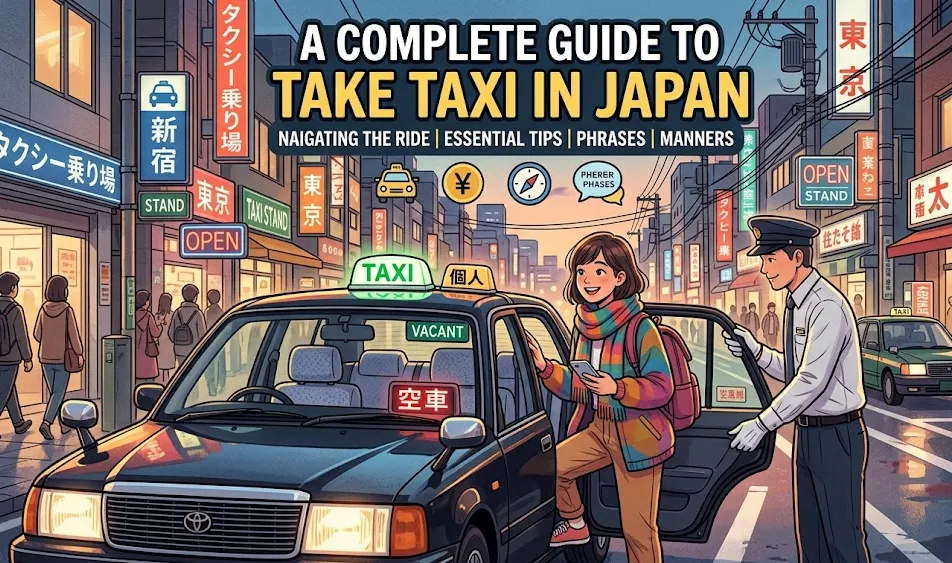
Whether you’re arriving late at night, heading to a remote destination, or simply looking for a more comfortable way to travel, taxis in Japan offer a safe and dependable option. Japan’s taxi system is one of the safest, cleanest, and most reliable in the world. While it may seem intimidating at first—especially with language barriers and unfamiliar rules—taking a taxi in Japan is actually very straightforward once you know the basics.How to call a taxi in Japan?How much does Japan taxi cost per km?This guide will help you understand how the system works, what to expect during your ride, and how to avoid common mistakes while traveling across Japan.
How to Identify a Legal Taxi in Japan?
Spotting a legal taxi in Japan is much easier than in many other countries because the industry is strictly regulated. To avoid "shiro-taku" (illegal white-plate taxis), you just need to look for a few specific visual markers.
1. The License Plate (The Most Important Sign)
Unlike many countries where taxis have a uniform color, Japanese taxis come in various colors—black, white, green, yellow, and even blue. The easiest way to identify a legitimate taxi is by looking at the license plate:
-
Green license plate with white characters – Standard legal taxi
-
Black license plate with yellow characters – Light-vehicle legal taxi
-
White license plate – Private vehicle. NEVER get into a car with a white plate claiming to be a taxi; these are illegal and potentially unsafe.
‼️The Exception: Some specially licensed "National Strategic Zone" taxis or Olympic-branded plates may be white but will have a distinct green border.
2. The Roof Light (Shatō-purampu)
Every legal taxi is equipped with a roof light that displays the company’s logo or name.The taxis always have a TAXI sign on the roof and the word “タクシー” or “TAXI” displayed on the side.
Famous companies like Nihon Kotsu (colorful cherry blossom) or Kokusai Motos (yellow/orange circles) are unmistakable.
3. Vehicle Appearance
Legal taxis are kept in pristine condition.
-
White Lace Seat Covers: Almost all Japanese taxis feature clean, white lace covers over the seats.
-
The Driver’s Uniform: Drivers are professional "salarymen" of the road. They almost always wear a suit or a crisp uniform, a hat, and white gloves.
-
Automatic Doors: If the rear door opens automatically as you approach, it is a professional fleet vehicle.
How to Catch a Taxi?
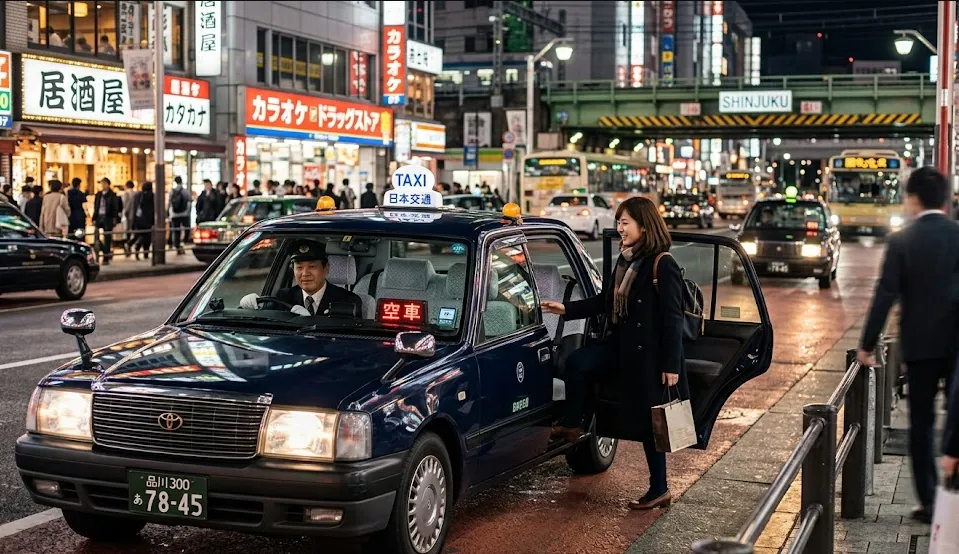
A. Hailing on the Street
B. Taxi Stands
C. Taxi Apps
The most convenient method in 2026.Taxi apps are highly recommended for international visitors as they eliminate language barriers and allow cashless payment.Apps like Uber and GO in Japan function as taxi-hailing apps—they connect you to licensed taxis, not private drivers.
Here are the top taxi apps for foreign travelers in Japan:
|
App |
Coverage |
Languages |
Payment |
Notes |
|
46 prefectures nationwide (largest coverage) |
English, Japanese, 50+ languages |
Cash, credit card, PayPay, Apple Pay |
Most popular; over 80% market share; app handling fee ~¥100 plus reservation fee |
|
|
33 prefectures (major cities) |
50+ languages |
Credit card, debit card, PayPay, Apple Pay, cash |
No Japanese phone number required for registration |
|
|
Multiple regions across Japan |
English, Chinese |
Credit card, cash |
Joint venture with SoftBank |
|
|
Major airports (Narita, Haneda, Kansai, Fukuoka) |
English, Japanese |
Credit/debit card only |
Flat-rate airport taxis; jumbo taxis for up to 9 passengers |
|
|
Major cities |
Japanese (limited English) |
Various |
Operated by Sony |
Understanding the Taxi Signs
Before you wave your hand, look at the LED sign in the lower corner of the windshield. The colors can be counter-intuitive:
|
Sign (Japanese) |
Color |
Meaning |
Can You Hail? |
|
空車 (Kūsha)
|
Red |
Vacant / Empty |
✅ Yes |
|
賃走 (Chinsō)
|
Green |
Occupied (already has passenger) |
❌ No |
|
予約車 (Yoyakusha)
|
Orange |
Reserved / Pre-booked |
❌ No |
|
割増 (Warimashi)
|
Green |
Increased Night Fare – Between the hours of 10 pm-5 am, taxis charge an additional 20% fare so you will see this sign on many taxis available during that timeframe. |
✅ Yes (but fare is higher) |
|
迎車 (Geisha)
|
Orange |
Reserved, on the way to a pick-up |
❌ No |
|
回送 (Kaisō)
|
Orange |
Out of service / returning to depot |
❌ No |



As you can see, Orange has three meanings, but they all simply mean that the taxi isn’t available to you. A red light on the dashboard typically means the taxi is vacant, while a green light means it is occupied.
Payment and Pricing
A. Base Fare and Distance Charges
Taxi fares in Japan are regulated by region and consist of:
-
Base Fare (Typical): Starts around ¥400–¥700 (~$3–$5 USD), covers the first 1.0–1.6 km.
-
Additional Charges:
-
Additional distance charge – per 200–300 meters after the initial distance
-
Time charge – applies when the taxi is moving very slowly (typically under 10 km/h)
-
-
Extra Fees:
-
Night Surcharge: A 20% premium is typically added between 10:00 PM and 5:00 AM.
-
Highway Tolls: If you take a toll road, the cost is added to the final meter fare.
-
Airport pickup fees (in some cities).
-
Winter surcharge: Some regions (e.g., Hokkaido) add a 20% surcharge from December to March.
-
Dispatch fee: When booking via phone or hotel, a small fee (usually ~¥100–¥400) may apply.
-
App service fee: Apps like GO and Uber add a service fee (typically ~¥100 plus a variable reservation fee of ¥370–¥980 depending on demand).
-
Example fares in major cities (as of 2025–2026):
|
City / Region |
Initial Fare |
Initial Distance |
Additional Charge |
|
Tokyo (23 wards) |
~¥500 |
~1.0–1.3 km |
~¥100 per 255–272 m |
|
Osaka |
~¥600–¥680 |
~1.3 km |
~¥100 per 260 m |
|
Kyoto |
~¥500–¥610 |
~1.0–1.3 km |
~¥100 per 279 m |
|
Fukuoka |
~¥830 |
~1.6 km |
~¥100 per 268 m |
|
Sapporo |
~¥670 |
~1.28 km |
~¥100 per 268 m |
⚠️Note: Fares vary by taxi company within each region, and some regions allow pricing within approved ranges.
B. Typical Trip Costs
|
Trip |
Estimated Fare |
|
Short ride (2–3 km) |
~¥1,000–¥1,500 |
|
Medium ride (5 km) |
~¥2,000–¥2,200 (Tokyo) |
|
10 km ride |
~¥3,500–¥4,500 |
|
Haneda Airport to central Tokyo |
~¥6,000–¥8,000 |
|
Narita Airport to central Tokyo |
~¥20,000–¥30,000 |
C. Payment Methods
-
Cash: Still widely accepted and sometimes preferred in rural areas.
-
Credit Cards: Most urban taxis accept Visa, Mastercard, and AMEX. Look for stickers on the window.
-
IC Cards: You can often pay with Suica or Pasmo in major cities.
- Apps: Automatically charged to your registered card when using GO, Uber, DiDi, etc.
⚠️Important: Not all taxis accept credit cards or IC cards, especially in rural areas or older vehicles. Look for payment stickers on the rear passenger windows or doors. The safest approach is to always carry some cash or use a taxi app that handles payment digitally.
Step-by-Step: How to Ride a Taxi
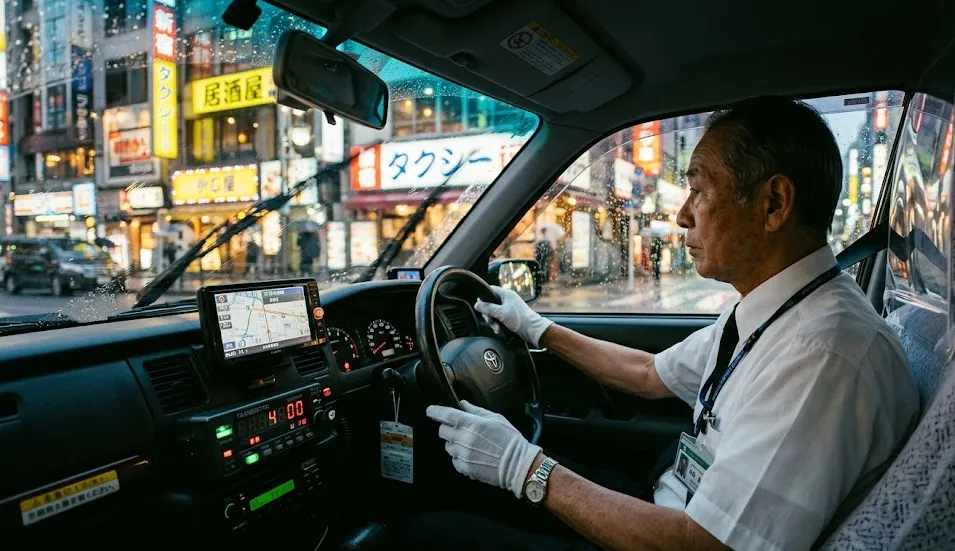
Step 1: Boarding
-
Do not touch the door! Japanese taxis have automatic rear doors controlled by the driver. Simply wait by the curb.
-
The driver will open the left rear door for you.
-
Sit inside and fasten your seatbelt — since 2008, seatbelts are mandatory for all passengers, including those in the back seat.
Step 2: Telling the Driver Your Destination
If you don‘t speak Japanese, showing your destination on your phone map is the most reliable method. Many taxis now have multilingual input tablets in the back seat.
If you‘re carrying large suitcases, ask the driver before placing them in the trunk — they’ll typically open it for you.
Useful Japanese Phrases:
|
Situation |
Japanese |
Romaji (Pronunciation) |
|
Destination |
[Place] までお願いします |
[Place] made onegai shimasu |
|
To this address |
この住所までお願いします |
Kono jusho made onegai shimasu |
|
Stop here |
ここで止めてください |
Koko de tomete kudasai |
|
Right / Left |
右 / 左 |
Migi / Hidari |
|
Straight |
まっすぐ |
Massugu |
|
Card payment? |
カードは使えますか? |
Kaado wa tsukaemasu ka? |
|
Receipt please |
領収書をください |
Ryoushuusho o kudasai |
|
Thank you |
ありがとうございました |
Arigato gozaimashita |
Step 3: During the Ride
-
Most passengers sit in the back seat. If traveling with 3 or 4 people, one may sit in the front.
-
Taxis are exceptionally clean, often with white seat covers — keep it that way.
-
Drivers are highly professional and practice omotenashi (Japanese hospitality).
Step 4: Payment
At your destination, the meter will display the total fare. Payment options include:
|
Payment Method |
Acceptance Level |
Notes |
|
Cash (Japanese Yen) |
Nearly 100% |
Use smaller bills (¥1,000, ¥5,000) if possible |
|
Credit/Debit Cards |
Widely increasing |
Look for stickers on windows; confirm with driver before boarding |
|
Transportation IC Cards |
Common in cities |
Suica, Pasmo — tap on the dashboard reader |
|
QR Code Payments |
Growing |
PayPay, Rakuten Pay, Apple Pay |
Never attempt to pay with foreign currency — only Japanese Yen is accepted.
Step 5: Exiting
-
Do not touch the door to open it — the driver will open it automatically.
-
Wait for the door to open fully before stepping out.
-
Always request a receipt (領収書 — ryōshūsho). It contains the taxi company‘s contact information, which is crucial for reporting lost items.
Luggage Guidelines
1. Capacity by Vehicle Type
Japanese taxis come in two main sizes. Knowing which to hail is the difference between a smooth ride and a cramped disaster.
|
Taxi Type |
Max Passengers |
Luggage Capacity |
|
Standard (Sedan) |
4 people |
2 Large Suitcases (or 3 medium). If the car uses LPG, the tank takes up space in the trunk! |
|
JPN Taxi (Tall Wagon) |
4 people |
3-4 Large Suitcases. These are the newer, indigo-blue "London-style" cabs. Much better for airport runs. |
|
Van / Jumbo Taxi |
5–9 people |
Variable. Can fit 5–10 large bags depending on the model (Alphard vs. HiAce). |
2. The "Hidden" Luggage Space
-
The Front Seat: If you are a solo traveler or a duo, drivers will often let you put a suitcase in the front passenger seat if the trunk is full.
-
The Floorboards: In the newer JPN Taxi models, the flat floor is spacious enough to keep a carry-on or backpack at your feet without feeling cramped.
3. Large or Unusual Items
If you are traveling with sports gear or oversized items, keep these rules in mind:
-
Skis & Snowboards: These rarely fit in a standard sedan. You will almost certainly need to book a Wagon or Van via an app (like GO or S.RIDE) or use a luggage delivery service.
-
Bicycles: Must be disassembled and placed in a Rinko bag (bike carry bag). Drivers may refuse a bike if it isn't bagged to protect the car's interior.
-
Strollers: Drivers will happily help you fold these and put them in the trunk. There is no extra charge for this.
4. Luggage Etiquette
-
Wait for Help: The driver will usually hop out to open the trunk and help you load. You don't have to do it yourself, though helping with heavy bags is always appreciated.
-
No Extra Fees: Unlike some countries, there is no "per-bag" fee in Japan. You pay for the distance, not the number of suitcases.
-
Cleanliness: Japanese drivers take immense pride in their cars. If your wheels are covered in mud or slush, try to give them a quick wipe before they go into the carpeted trunk.
5. The "Takkyubin" Alternative
If you have more than two large suitcases per person, the best "taxi hack" in Japan isn't a bigger car—it's Hands-Free Travel.
-
Use Yamato Transport (Kuroneko) or Sagawa to send your bags from the airport directly to your hotel, or between hotels.
-
It usually costs about ¥2,500–¥4,000 per bag and arrives the next day. This allows you to take a standard taxi or the train without wrestling with heavy luggage.
Lost Items — What to Do
Don't panic! Japan is world-famous for its honesty, and the chances of recovering a lost item in a taxi are incredibly high—provided you act quickly. The recovery process depends entirely on whether you have your receipt.
1. If You Have the Receipt (The Golden Ticket)
The receipt is your most powerful tool because it contains the Taxi Number, Company Name, and Phone Number.
-
Call the Company: Look for the phone number printed at the top or bottom of the receipt.
-
Provide Details: Tell them your name, what you lost, and the time of your ride.
-
Arrange Recovery: If they find it, the driver can often bring it back to you (you will usually have to pay the metered fare for the trip) or you can go to the taxi depot to pick it up for free.
2. If You Used an App (GO, S.RIDE, Uber)
If you hailed the car via an app, you are in luck. Your ride history is digitally logged.
-
In the App: Go to "Ride History" or "Past Trips."
-
Contact Driver: Most apps have a "Contact Driver" or "I lost an item" button available for 24–48 hours after the ride.
-
Customer Support: If you can't reach the driver, use the app's support chat. They can track the exact vehicle and notify the depot immediately.
3. If You Paid Cash & Have No Receipt
This is the trickiest scenario, but not impossible. You need to identify which taxi company you used.
-
Go Back to the Stand: If you took the taxi from a specific hotel or station stand, go back and ask the staff. Taxis often work in "territories," and the attendants might know which companies were operating there.
-
Identify the Color/Logo: Do you remember the car’s color (e.g., yellow, green, black) or the logo on the roof?
-
Call the Taxi Association: Every major city has a Taxi Lost & Found Center (Kotsu Center).
-
Tokyo Taxi Center: 03-3648-0300
-
Osaka Taxi Center: 06-6933-5611
-
4. The Last Resort: The Police (Koban)
If the taxi company doesn't have it, the driver may have turned it in to the nearest police box (Koban).
-
File a Report: Visit any Koban and fill out an Ishitsu-todoke (Lost Property Report).
-
Be Specific: Mention the route you took, the time, and any distinguishing features of the item.
-
The Database: Japan has a centralized lost-and-found database. If someone turns in your "Blue iPhone with a cat sticker," the system will flag it.
Essential Etiquette & Rules
-
No Tipping: Tipping is not customary in Japan, including for taxi services. The meter shows the exact fare you pay. Drivers may politely refuse extra money or even be confused by it. A polite “Arigatō gozaimasu” (thank you) is more than sufficient.
-
Hands Off the Doors: The left rear door is operated automatically by the driver. Do not pull or push it. Wait for it to swing open, and wait for the driver to close it after you exit.
-
Passenger Limit: Taxis carry a maximum of 4 passengers — one in the front seat and three in the back. Children count as individual passengers.
-
Receipts — Always Take One: The receipt contains the taxi number and company contact information — absolutely essential if you forget something in the cab
-
Navigation: Most taxis have GPS, but many drivers do not speak fluent English. It is highly recommended to have your destination address written in Japanese or shown on Google Maps.
-
Seatbelts: Compulsory for all passengers, including those in the back.
-
Destination Landmarks: Mentioning a major station or hotel near your destination is often more helpful than a specific street number.
Frequently Asked Questions (Q&A)
Is Uber available in Japan?
Yes, but through Uber it usually connects you to licensed taxis rather than private drivers.
Are taxis expensive in Japan?
They are more expensive than public transport but reasonable for short distances or group travel.
Can I pay with a foreign credit card?
Yes, most modern taxis accept international cards.
Do I need to tip taxi drivers?
No—tipping is not part of Japanese culture.
Can I hail a taxi anywhere?
Generally, yes, by raising your hand. However, you should avoid hailing near bus stops, fire hydrants, or busy intersections. In crowded areas, it is better to head to a marked Taxi Stand (usually identified by a sign with a car icon).
Are taxis available 24/7?
Yes, but they are in extremely high demand right after the last trains stop (usually around midnight to 1:00 AM). Be prepared for long wait times at taxi stands during this window.
Is there a surcharge for extra passengers or bags?
No. The fare is based strictly on the meter (distance and time). Whether you are one person with a backpack or four people with suitcases, the price remains the same.
Can I smoke in the taxi?
Almost all taxis in Japan are now non-smoking. You will see a "No Smoking" sticker on the window.
What if the driver doesn't understand my destination?
If language is a barrier, show the address in Japanese on your phone or use a translation app. If you have a business card for your hotel, that is often the most effective "low-tech" solution.
Do I need to wear a seatbelt in the back?
Yes. It is a legal requirement in Japan for all passengers to wear seatbelts, regardless of where they are sitting.
Can I pay with a large bill (like a ¥10,000 note)?
Yes. Japanese taxi drivers are used to making change for large bills, unlike drivers in many other countries who prefer exact change.
How do I know if the taxi is a "Premium" or "Large" car?
Most standard taxis are sedans or the JPN Taxi (tall wagon). If you see a black minivan like a Toyota Alphard, these are often "Jumbo" or "Premium" taxis and may have a slightly higher base fare or require a booking fee via an app.
Can I ask the taxi driver to wait for me?
Yes, but the meter will continue running (charging for both time and distance). If you need a round trip or a short stop (e.g., pick up something), it’s often cheaper to just pay and call another taxi. For waiting, you can agree on a “waiting charge” — the driver will keep the meter running.
Are taxis safe for solo female travelers at night?
Yes, very safe. Japan has an extremely low crime rate, and taxi drivers are highly professional. Many female travelers take taxis alone at night without issue. Some apps (like GO) even offer a “share ride status” feature to send your trip details to a friend.
Do taxi drivers speak English?
Most drivers have limited English skills. It’s best to:
-
Show your destination on Google Maps.
-
Use a written Japanese address.
-
Book via apps like GO Taxi.