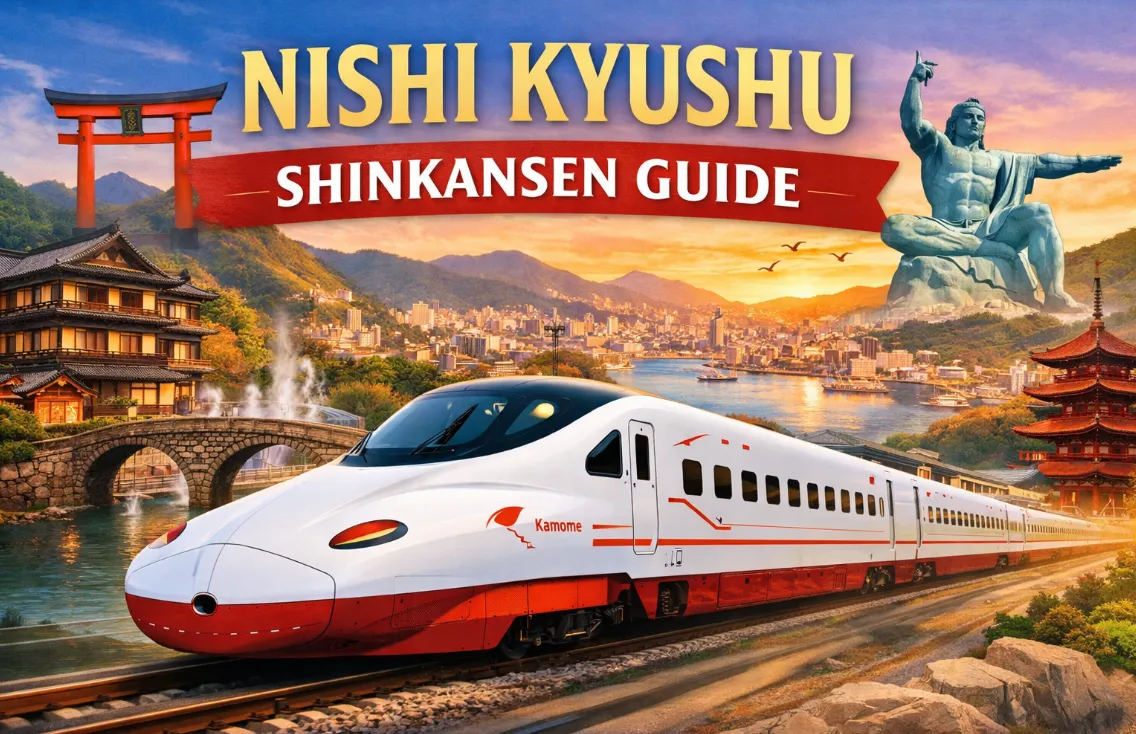
Traveling between Fukuoka and Nagasaki has never been easier thanks to the launch of the Nishi Kyushu Shinkansen. This modern high-speed rail line has transformed transportation in western Kyushu, cutting travel times and offering a smoother, more comfortable journey.If the Nishi Kyushu Shinkansen is on your 2026 itinerary, you’ll want to know the ins and outs of the system before you board. This comprehensive guide breaks down everything from purchasing passes versus point-to-point tickets, to the nuances of reserved and non-reserved cars. We’ll also walk you through the latest carriage layouts and the specific size limits for luggage storage, ensuring your journey from Hakata to the southern islands is as smooth as the ride itself.
What Is the Nishi Kyushu Shinkansen?
➤ Operator: JR Kyushu.
➤ Train Type: 6-car N700S series trains named "Kamome".
➤ Route: Connects Takeo-Onsen Station (Saga Prefecture) to Nagasaki Station.
➤ Speed: Maximum operating speed of 260 km/h.
The Nishi Kyushu Shinkansen (also known as the "Kamome") is a short Shinkansen route operated by JR Kyushu, which opened in September 2022. It is currently the shortest Shinkansen line in Japan (66km), famous for its striking red-and-white N700S "Kamome" (Seagull) trains.It currently connects Takeo-Onsen to Nagasaki in approximately 23–30 minutes.
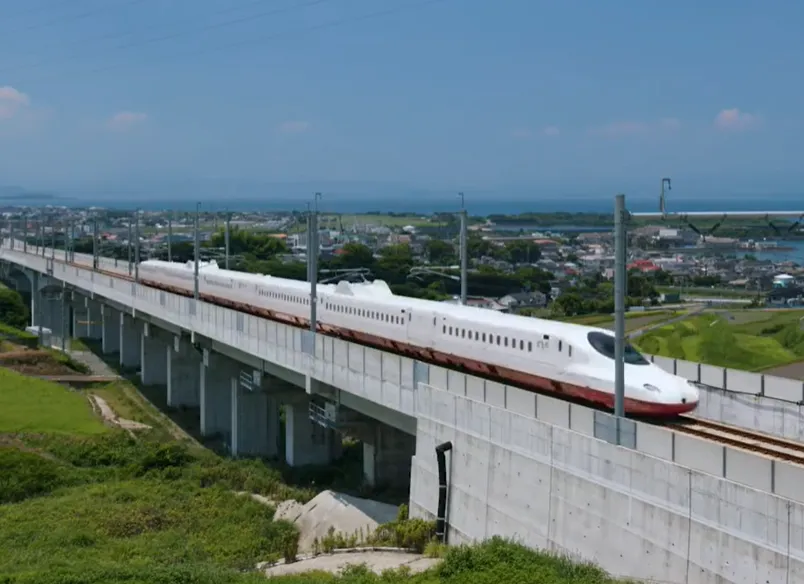
Here is what makes this line unique and how it currently functions:
1. The "Isolated" Shinkansen
Unlike other Shinkansen lines that are thousands of kilometers long, the Nishi Kyushu Shinkansen is currently the shortest in Japan, spanning only 66 km (41 miles).
Because of a long-standing disagreement regarding construction through Saga Prefecture, the line does not yet connect directly to the rest of the Shinkansen network at Hakata (Fukuoka). It currently exists as a "high-speed island" in western Kyushu.
2. The "Relay Kamome" System
Since the line is disconnected from Fukuoka, JR Kyushu uses a seamless cross-platform transfer system at Takeo-Onsen Station:
-
From Fukuoka: You board the Relay Kamome (a limited express train) at Hakata Station.
-
The Transfer: When you arrive at Takeo-Onsen, the Shinkansen is waiting on the opposite side of the same platform. You simply walk across—usually in under 3 minutes—to board the bullet train.
-
The Result: Even with the transfer, the total travel time from Hakata to Nagasaki has been reduced to about 80–90 minutes (roughly 30 minutes faster than the old express trains).
3. The "Kamome" (Seagull)
The train service is named Kamome, which means "Seagull" in Japanese. This name has a 60-year history in the region, formerly used for the limited express trains that ran the same route.
-
The Train: It uses a customized 6-car N700S series, the same model used on the famous Tokaido (Tokyo-Osaka) line, but with a unique white and red "JR Kyushu" livery.
-
Designer Touch: The interiors were designed by Eiji Mitooka (famous for the Seven Stars luxury train), featuring high-end materials like wood, traditional Japanese patterns, and high-quality textiles.
The Route and Stations
A. The Full Route (Hakata to Nagasaki)
Even though the bullet train itself only covers the second half, the route is marketed as a single journey.
-
Part 1: Hakata (Fukuoka) to Takeo-Onsen via the Relay Kamome (Limited Express).
-
Part 2: Takeo-Onsen to Nagasaki via the Kamome (Shinkansen).
B. The Shinkansen Stations
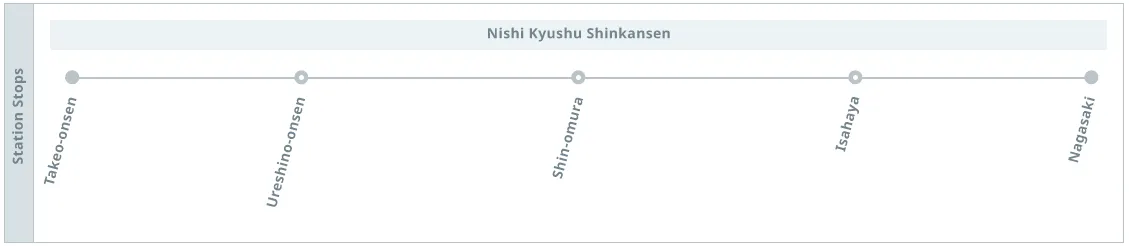
There are 5 stations on the high-speed section. Some trains stop at all of them, while others skip the smaller ones to speed up the trip.
|
Station Name |
Prefecture |
Key Transfers & Local Access |
|
Takeo-Onsen |
Saga |
The Transfer Hub: Connects to the Relay Kamome for Fukuoka. Home to 1,300-year-old hot springs. |
|
Ureshino-Onsen |
Saga |
New Station: Dedicated to the famous tea and "hot spring for beautiful skin" district. (Requires a short bus/taxi to the town center). |
|
Shin-Omura |
Nagasaki |
Airport Access: Transfers to the local JR Omura Line. Nearest station to Nagasaki Airport (NAG). |
|
Isahaya |
Nagasaki |
Transit Hub: Connects to the Shimabara Railway and the Nagasaki Main Line. |
|
Nagasaki |
Nagasaki |
The Terminus: Located in the city center. Connects to the Nagasaki Electric Tramway for sightseeing. |
C. The Takeo-Onsen Transfer
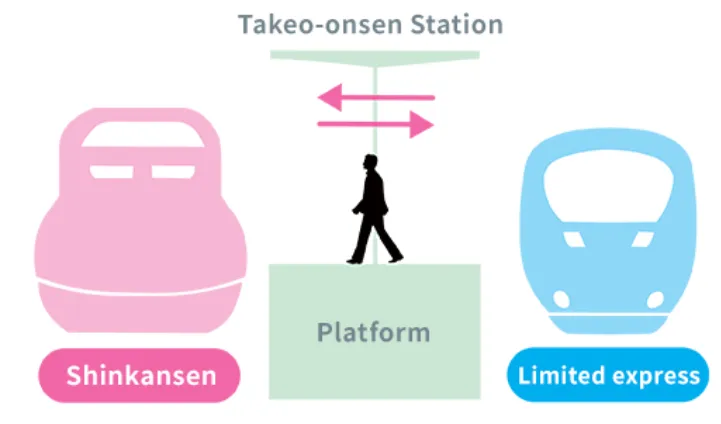
The most critical part of the route is the "Shinkansen Relay" at Takeo-Onsen.
-
The Design: Platforms 10 and 11 are designed so the Relay Kamome and the Shinkansen Kamome pull up on opposite sides of the same platform.
-
The Time: The transfer usually takes only 3 minutes. You literally walk about 10–15 steps across the platform. There is no need to change levels or go through ticket gates again.
If you aren't in a rush, there is a luxury sightseeing train called the "Futatsuboshi 4047" that follows a scenic coastal route between Takeo-Onsen and Nagasaki. It travels along the Ariake Sea or Omura Bay, offering a much slower but more beautiful alternative to the Shinkansen's mountain tunnels.
Seat Type and Train Classes
The Nishi Kyushu Shinkansen (Kamome) uses a unique 6-car configuration that differs from the standard long-distance Shinkansen you might find in Tokyo or Osaka.
1. No "Green Car" (First Class)
The most important thing to note is that the Nishi Kyushu Shinkansen does not have a Green Car.
-
The Logic: Because the ride is so short (23–30 minutes), JR Kyushu opted for a high-quality "Ordinary" class rather than a separate first-class cabin.
-
The Exception: If you are taking the Relay Kamome from Hakata to Takeo-Onsen, that specific train does have a Green Car. If you book a Green Car ticket for the whole trip, you will sit in the Green Car for the first 60 minutes and then move to a Reserved Seat for the final Shinkansen leg.
2. Reserved Seats (Cars 1–3)
The reserved cars are widely considered the "sweet spot" of this line. They feel like a luxury experience for the price of a standard ticket.
-
Layout: 2+2 configuration (two seats on each side of the aisle).
-
Design: Every car has a different theme. You’ll see high-quality wood, traditional Japanese patterns (like Karakusa or floral motifs), and soft, textured fabrics.
-
Comfort: These seats are wider and more private than standard Shinkansen seats. They include wooden armrests and individual power outlets.
3. Non-Reserved Seats (Cars 4–6)
The non-reserved cars are more functional but still very modern and clean.
-
Layout: 3+2 configuration (three seats on one side, two on the other).
-
Design: These cars feature a bright, cheerful mustard yellow upholstery.
-
Comfort: While the seats are slightly narrower than the reserved section, they are perfectly comfortable for a 30-minute hop. They also feature power outlets at every seat.
|
Feature |
Reserved (Cars 1–3) |
Non-Reserved (Cars 4–6) |
|
Seating Layout |
2 + 2 (Spacious) |
3 + 2 (Standard) |
|
Seat Map |
Designated row/letter |
First-come, first-served |
|
Interior Style |
Designer wood & textiles |
Mustard yellow fabric |
|
Power Outlets |
Every seat |
Every seat |
|
Best For |
Couples and those with luggage |
Solo travelers or budget trips |
The Travel Time & Timetable
Traveling on the Nishi Kyushu Shinkansen is highly efficient due to its integrated "Relay" system. Because the high-speed tracks only cover the final leg of the journey to Nagasaki, your travel time is split between a standard express train and the bullet train.
A. Travel Time Estimates
The total journey from Hakata (Fukuoka) to Nagasaki now takes approximately 80 to 90 minutes, saving about 30 minutes compared to the pre-2022 express-only route.
|
Route Segment |
Train Type |
Approx. Time |
|
Hakata → Takeo-Onsen |
Relay Kamome (Express) |
60 mins |
|
Transfer |
Cross-platform walk |
3 mins |
|
Takeo-Onsen → Nagasaki |
Kamome (Shinkansen) |
23–30 mins |
|
Total Journey |
~1h 25m |
|
B. Timetable Overview (2026)
Trains typically run 1–2 times per hour from early morning until late night.
-
First Train: Usually departs Nagasaki around 6:17 AM and Takeo-Onsen around 7:03 AM.
-
Last Train: Usually departs Nagasaki around 10:10 PM and Takeo-Onsen around 11:17 PM.
Typical Hourly Patterns:
-
Fastest Services: Stop only at Isahaya and Nagasaki, completing the Shinkansen leg in just 23 minutes.
-
Local Services: Stop at all stations (Ureshino-Onsen, Shin-Omura, Isahaya), taking roughly 31 minutes.
Timetables (major trains, 2026.3.14-2027.2.28)
🔔Connection Tips:
-
① Don't Panic at Takeo-Onsen: The transfer is designed to be "stress-free." The trains are literally parked side-by-side. You do not need to go through another ticket gate or change floors.
-
② Single Ticket: Even though you change trains, you can buy one single "Hakata to Nagasaki" ticket that covers both segments.
-
③ Digital Timetables: Using the NAVITIME Japan Travel app or Google Maps is highly accurate for this line, as they factor in the specific relay transfer times automatically.
Tickets & Reservations
To ride the Nishi Kyushu Shinkansen, you need to understand the Japanese "dual-ticket" system. Because this line is currently a relay service, your ticket typically covers both the Relay Kamome (Express) and the Kamome (Shinkansen).
1. Understanding the Fare
-
Base Fare (Joshaken): The cost of the distance traveled.
-
Limited Express Surcharge (Tokkyuken): The "speed" fee for using the Shinkansen and Express trains.
-
The Difference: A Reserved Seat usually costs about ¥530 more than a Non-Reserved Seat. During peak seasons (Golden Week, Obon, New Year), this surcharge may increase by ¥200.
2. Where to Buy Tickets
-
Online (Recommended): Use the official JR Kyushu Train Reservation website. You can book up to one month in advance (from 10:00 AM JST).
-
Smart EX: This app allows you to link your ticket to an IC Card (like Suica or Pasmo), so you can simply tap through the gates with your phone or card.
-
Ticket Machines: Available at all major stations. Look for the "Reserved Seat" machines (usually purple or green) which have a full English interface.
-
Ticket Offices (Midori-no-Madoguchi): Best if you need to reserve specific seats (like the oversized luggage area) or if you are using a complicated rail pass.
3. Using Rail Passes
The Nishi Kyushu Shinkansen is fully covered by several passes. If you have a pass, you don't need to pay extra for the base fare or the surcharge.
|
Pass Type |
Coverage |
Seat Reservation Rule |
|
All Kyushu / Northern Kyushu |
Free. (Northern Kyushu version has a limit of 6 free reservations; All Kyushu is unlimited). |
|
|
Nationwide |
Free. Unlimited reservations at any JR ticket office or machine. |
|
|
Fukuoka & Saga |
Non-Reserved only. Does not include seat reservations. |
🔔Reservation Tips:
① Is it necessary? For the 30-minute Shinkansen leg, you can usually find a seat in the non-reserved cars (4–6). However, the Relay Kamome from Hakata to Takeo-Onsen (60 mins) can get very crowded. I recommend reserving for the whole journey to ensure you have a seat for the longer leg.
② The "Last Row" Rule: If you have large suitcases (total dimensions >160 cm), you must reserve the "Seat with Oversized Baggage Area" in the reserved cars.
③ Changing your mind: If you miss your reserved train, your ticket is still valid for a non-reserved seat on any later train that same day.
4. Ticket Prices
The ticket prices for the Nishi Kyushu Shinkansen (Kamome) are calculated based on whether you are doing a "local" trip on the Shinkansen tracks or the full "relay" trip from Fukuoka (Hakata).Below are the standard adult one-way fares for 2026.
1)Standard One-Way Fares
The following prices include the Base Fare + Limited Express Surcharge.
|
Route |
Non-Reserved Seat |
Reserved Seat |
|
Hakata ↔ Nagasaki (Full Relay) |
¥5,520 |
¥6,050 |
|
Takeo-Onsen ↔ Nagasaki |
¥3,070 |
¥3,600 |
|
Shin-Omura ↔ Nagasaki |
¥1,760 |
¥2,290 |
-
Children (6–11): Tickets are exactly 50% off the adult fare.
-
Toddlers (1–5): Free if they sit on your lap (up to two per adult). If they need their own seat, a child's ticket must be purchased.
2) Discounted Online Fares
If you book through the JR Kyushu Train Reservation website, you can access "Kamome Netto" tickets, which are significantly cheaper than buying at the station.
-
Kamome Netto Kippu: A standard online discount for reserved seats.
-
Hakata to Nagasaki: ~¥4,200
-
-
Kamome Netto Hayatoku 3: Requires booking at least 3 days in advance.
-
Hakata to Nagasaki: ~¥3,600
-
-
Kamome Netto Hayatoku 7: Requires booking at least 7 days in advance.
-
Hakata to Nagasaki: ~¥3,200 (Limited availability)
-
The Luggage Rules
When riding the Nishi Kyushu Shinkansen (the Kamome), the luggage rules are strictly enforced to ensure the compact 6-car trains don't become overcrowded.
1. The 160 cm Rule
-
Standard Bags (Under 160 cm): No reservation needed. You can store these on the overhead racks or in the space at your feet. Most standard "check-in" suitcases actually fall under this limit.
-
Oversized Bags (161 cm – 250 cm): Reservation Mandatory. You must book a specific "Seat with Oversized Baggage Area."
-
Prohibited (Over 250 cm): You cannot bring these on the train at all. You must use a delivery service like Yamato (Takkyubin).
|
Bag Size (L+W+H) |
Status |
Where to Store |
|
Up to 160 cm |
No reservation needed |
Overhead rack or at your feet |
|
161 cm to 250 cm |
Reservation Required |
Dedicated "Oversized Baggage" area |
|
Over 250 cm |
Not allowed |
Must use a delivery service (e.g., Yamato/Sagawa) |
2. How to Book the Correct Seat
When booking your ticket (at a machine, ticket office, or online), you must specifically select "Seat with Oversized Baggage Area."
-
The Cost: There is no extra fee for this reservation; it costs the same as a regular reserved seat.
-
The Location: These seats are the last row of the reserved cars (Cars 1, 2, or 3). The space behind your seat is your designated storage area.
-
Non-Reserved Cars: You cannot bring oversized baggage into non-reserved cars (Cars 4–6), as they do not have designated storage areas.
3. How to Handle Oversized Baggage (160cm - 250cm)
1) Reserve a Designated Seat in Advance
When booking your ticket (online, at a machine, or at a counter), you must reserve a seat that comes with space for oversized luggage. This reservation is free of charge—you only pay the standard reserved seat fare.
-
Seats with an Oversized Baggage Area: These are the last-row seats in some reserved cars. You store your luggage in the space directly behind your seat. This space can accommodate bags with total dimensions up to 250cm.
2) Boarding and Fees
-
If you bring oversized baggage without a reservation, you will be charged a 1,000 yen fee onboard, and staff will direct you where to store it.
-
It is best to reserve early, as there are a limited number of these seats per train.
Frequently Asked Questions (Q&A)
Can I eat and drink on board?
Yes. Unlike local commuter trains, eating and drinking (including alcohol) is perfectly acceptable on the Shinkansen.
Does it have Wi-Fi and power outlets?
-
Power: Yes, every single seat on the N700S "Kamome" train has a power outlet located in the armrest.
-
Wi-Fi: Free "JR-KYUSHU FREE Wi-Fi" is available on board.
Can I bring my pet?
Yes, but with strict rules:
-
Size: The pet must be in a carrier with total dimensions (L+W+H) under 120 cm.
-
Weight: The combined weight of the pet and carrier must be under 10 kg.
-
Fee: You must buy a "Personal Belongings Ticket" (temochihinitu) at the ticket gate for ¥290.
Is it worth taking compared to a highway bus?
Compared to highway buses:
-
Much faster
-
More spacious
-
More reliable
However, buses may be cheaper for budget travelers.
Are seat reservations required?
No, reservations are not mandatory for ordinary cars.
Is there a "Green Car" (First Class)?
Actually, the Nishi Kyushu Shinkansen does not have a Green Car. However, the reserved seats in Cars 1–3 are designed to feel significantly more "premium" than standard Shinkansen cars on other lines.