Traveling through Kyushu by bullet train is an experience in itself.In just a few hours, you can glide from vibrant urban centers to coastal landscapes and volcanic scenery, all while enjoying quiet cabins and punctual service.To make the most of your journey, it’s important to understand how fares work, where to sit, what you can bring onboard, and how reservations are handled. Inside, you’ll find step-by-step instructions for purchasing passes, a detailed look at interior configurations for every train type, and professional advice on managing your reservations to avoid extra fees.
What is the Kyushu Shinkansen?
➤ Opened: In 2004.
➤ Operator: JR Kyushu.
➤ Route: Connects Hakata (Fukuoka) to Kagoshima-Chuo, connecting to the San'yo Shinkansen for direct service to Osaka.
➤ Max speed: Up to 260 km/h.
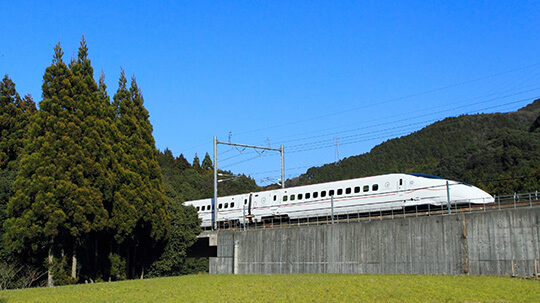
The Kyushu Shinkansen (九州新幹線) is a high-speed "bullet train" line that runs through the island of Kyushu in southern Japan. Operated by JR Kyushu, it serves as the backbone of the island's transportation, connecting the major northern hub of Fukuoka (Hakata Station) to the southern city of Kagoshima.The southern half was opened in 2004 and the northern half in 2011. A branch line to Nagasaki, the Nishikyushu Shinkansen, partially opened in September 2022.This high-speed railway will bring you across Kyushu Island in under 90 minutes. It also connects to the Sanyo Shinkansen at Hakata station and shares many of the trains that come or go from Shin-Osaka.Whether you’re heading to hot springs, volcano views, or historic cities, the line offers a smooth travel experience.
🔺Key Features:
-
Through-Service: The Kyushu Shinkansen connects directly with the Sanyo Shinkansen at Hakata, allowing passengers to travel from Kagoshima to Shin-Osaka without changing trains.
-
West (Nishi) Kyushu Shinkansen: A separate branch line opened in 2022 connecting Takeo-Onsen to Nagasaki. It is currently a "relay" service, meaning you take a regular express train from Hakata and transfer to the Shinkansen at Takeo-Onsen.
-
Scenic Route: Unlike urban-heavy lines, the Kyushu Shinkansen passes mountains, countryside, coastlines, and volcanic landscapes. The ride between Kumamoto and Kagoshima is especially popular for its natural scenery.
-
Comfortable & Spacious Seating: Kyushu Shinkansen trains feature wide, reclining seats with generous legroom. Most cars use a 2+2 seating layout, offering more space than standard trains. Green Car (first class) options provide even more comfort for longer rides.
-
Convenient Luggage Facilities: Overhead racks fit standard suitcases, and select seats include oversized luggage storage areas for larger bags. Travelers can reserve special baggage seats in advance, making the Shinkansen friendly for tourists with suitcases.
1. Major Stations & Routes
The Kyushu Shinkansen network is essentially split into two distinct lines: the primary Kagoshima Route (running north-south) and the newer Nishi-Kyushu Route (branching west).
-
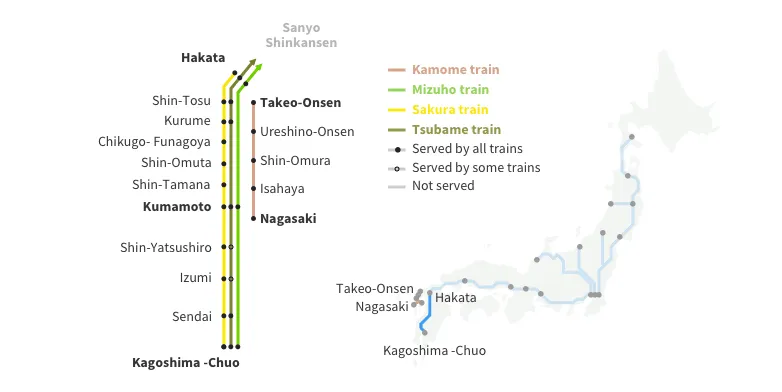
Kagoshima Route: Connects Fukuoka (Hakata Station) to Kagoshima (Kagoshima-Chuo Station). This is fully integrated with the national network via the Sanyo Shinkansen.
-
Nagasaki Route (Nishi Kyushu Line): Connects Takeo-Onsen to Nagasaki. ⚠️Note: This line is not directly connected to Hakata. You must transfer to a special relay train from Hakata.
A. Kagoshima Route (The Main Line)
This 257 km route connects the northern gateway of Fukuoka to the southernmost tip of Kyushu.
-
Route: Connects Fukuoka (Hakata Station) in the north to Kagoshima (Kagoshima-Chuo Station) in the south.
-
Length: Approximately 257 km.
-
Major Stops: Hakata (Fukuoka), Kumamoto, and Kagoshima-Chuo.
-
Opening: The full line opened in 2011. A notable feature is the 12.7 km underwater tunnel under the Kammon Strait, linking Kyushu to Honshu, which allows through services to/from the Sanyo Shinkansen (e.g., to Osaka, Hiroshima).
|
Station |
Major Connections & Highlights |
|
Hakata (Fukuoka) |
Northern Terminus; connects to Sanyo Shinkansen (to Osaka/Tokyo). |
|
Shin-Tosu |
Transfer here for the Nagasaki Main Line (conventional trains). |
|
Kurume |
Famous for Tonkotsu ramen and the giant Kurume Naritasan statue. |
|
Chikugo-Funagoya |
Scenic stop near the Yabe River; home to the SoftBank Hawks stadium. |
|
Shin-Omuta |
Gateway to the UNESCO-listed Miike Coal Mine. |
|
Shin-Tamana |
Near the historic Tamana Onsen area. |
|
Kumamoto |
Major Hub. Famous for Kumamoto Castle and Mt. Aso access. |
|
Shin-Yatsushiro |
Gateway to southern Kumamoto and the scenic Hisatsu line. |
|
Shin-Minamata |
Known for eco-tourism and the beautiful Rose Garden. |
|
Izumi |
Famous for the winter migration of thousands of cranes. |
|
Sendai |
Strategic stop in northern Kagoshima Prefecture. |
|
Kagoshima-Chuo |
Southern Terminus; views of the Sakurajima volcano. |
B. Nishi-Kyushu Route (The West Line)
This is Japan's first high-speed line to use DC electrification and Variable Voltage Variable Frequency (VVVF) inverter control, designed for the line's many curves and gradients. It is not directly connected to the rest of the national Shinkansen network. To travel from Hakata (Fukuoka), passengers transfer to a relay Kamome limited express train at Takeo-Onsen.
-
Route: Connects Takeo-Onsen to Nagasaki.
-
Length: Approximately 66 km.
-
Opening: The full line opened in September 2022.
|
Station |
Major Connections & Highlights |
|
Takeo-Onsen |
The current starting point. You must arrive here via the "Relay Kamome" express train from Hakata. |
|
Ureshino-Onsen |
Famous for tea and "skin-beautifying" hot springs. |
|
Shin-Omura |
Near Nagasaki Airport. |
|
Nagasaki |
The terminal station; a major tourist destination for history and food. |
2. Service Types & Speed
There are three main service types, ranked from fastest to slowest:
-
Mizuho – Fastest, limited stops (may have limitations for some passes).
-
Sakura – Balance of speed and coverage.
-
Tsubame – All-stop service, ideal for local access.
|
Service |
Stops |
Speed (In Kyushu) |
Typical Route |
|
Mizuho |
Stops only at major stations (Hakata, Kumamoto, Kagoshima-Chuo). |
260 km/h |
Kagoshima ↔ Shin-Osaka |
|
Sakura |
Stops at major stations and a few intermediate ones. |
260 km/h |
Kagoshima ↔ Shin-Osaka/Hakata |
|
Tsubame |
Stops at every station along the line. |
260 km/h |
Hakata ↔ Kumamoto/Kagoshima |
## The "Two-Speed" Experience
If you take a Mizuho or Sakura train from Kyushu toward Osaka, the train actually "speeds up" once it hits the main island (Honshu):
-
On Kyushu Tracks: Max 260 km/h.
-
On Sanyo Tracks (Hakata to Osaka): Max 300 km/h.
Because the trains use the N700 series (the same model used on the Tokyo line), they are physically capable of much higher speeds but are restrained while in Kyushu.
## West (Nishi) Kyushu Shinkansen: The "Kamome"
As of 2026, the branch line to Nagasaki is its own unique operation:
-
Service Name: Kamome (Seagull).
-
Speed: Max 260 km/h.
The Catch: It only runs for 66 km (about 23–30 minutes) between Takeo-Onsen and Nagasaki. To get there from Fukuoka, you must take the Relay Kamome (a standard express train) which only goes 130 km/h, then switch to the Shinkansen.
3. Seat Types
The Kyushu Shinkansen is designed for comfort, whether you’re traveling for a short hop or a long journey across the island. From flexible non-reserved seats to premium Green Car seating, passengers can choose the level of space and convenience that best fits their trip. Below are the main seat types available on Kyushu Shinkansen trains.
|
Feature |
Non-Reserved (Ordinary) |
Reserved (Ordinary) |
Green Car (Reserved Only) |
|
Cost |
Cheapest |
Slightly more expensive |
Significantly more expensive |
|
Booking |
Not possible |
Required |
Required |
|
Layout |
3x2 |
2x2 |
2x2 |
|
Seat Guarantee |
❌ No |
✅ Yes |
✅ Yes |
|
Comfort |
Very Good |
Very Good |
Excellent (wider, plusher) |
|
Power Outlets |
Windows/Ends |
Windows/Ends |
Every Seat |
|
Best For |
Flexibility, off-peak |
Peace of mind, peak travel |
Luxury, quiet, long journeys |
|
Perks |
None |
None |
Complimentary towel/drink |
A. Non-Reserved Seats (Standard)
These are the most affordable seats and are found in cars 1–3 of most trains.
-
Experience: Similar to the Tokaido (Tokyo-Osaka) Shinkansen. It's perfectly comfortable but can feel a bit snug when the train is full.
-
Availability: First-come, first-served. If you have a JR Pass or a basic ticket, you can hop on any Sakura or Tsubame and sit here.
B. Reserved Seats (The "Secret" Upgrade)
This is where the Kyushu Shinkansen really shines. On the N700 series (the Mizuho and Sakura), the reserved cars are a massive step up.
-
Experience: Because there are only four seats across instead of five, the seats are significantly wider and have much larger armrests. They are often described as "Green Car quality for a Standard price."
-
Design: Expect wood-grain tables and high-quality upholstery.
-
800 Series Exception: On the Tsubame (800 Series), every car is 2x2, so even the non-reserved seats feel premium and artistic.
C. Green Car (First Class)
The Green Car is the highest class of service, usually located in a section of Car 6 on the N700 series.
-
Experience: These seats are essentially "power recliners." They feature:
-
Deeper recline and integrated footrests.
-
Personal reading lights and larger tray tables.
-
A quieter, more exclusive atmosphere.
-
Honestly, because the Reserved Seats in Kyushu are already so spacious (2x2), many travelers find the extra cost for a Green Car unnecessary unless the train is very crowded.
🔔Quick Seat Selection Tips:
✔️Reserve seats during holidays (Golden Week, summer, New Year).
✔️Choose luggage seats if carrying large suitcases.
✔️Green Car for comfort on rides over 1 hour.
✔️Non-reserved for budget and flexibility.
4. Seat Maps & Configurations
Kyushu Shinkansen trains have a more spacious layout than the Tokyo-bound trains.The main trains on the Kagoshima Route are the N700 Series and the 800 Series Tsubame.
N700 Series (Mizuho & Sakura):
-
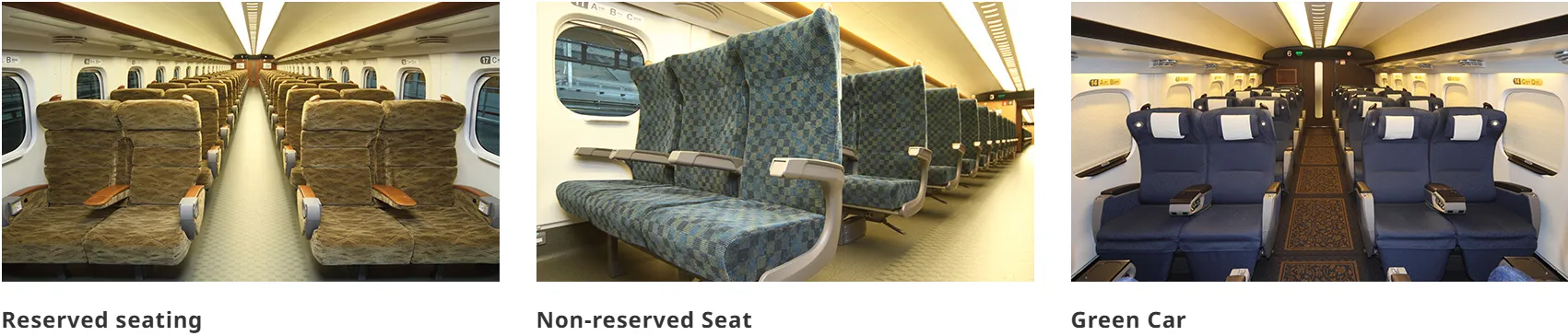
Reserved Cars (2x2): These feature high-quality wood and leather/fabric seats. There are only 4 seats across (A-B and D-E), making them as comfortable as "Green Cars" on other lines.
-
Non-Reserved Cars (2x3): Standard 5-seat-across layout (A-B-C and D-E).
Typical Standard Car Layout (8 Cars):
-
Cars 1-3: Usually Non-Reserved Seats.
-
Cars 4-8: Reserved Seats.
-
Car 8: Often has "Green Car" (First Class) at the Nagasaki/Kagoshima end.
-
Car 7 or 5: Usually contains the multipurpose room (for passengers with babies or needing medical care) and wheelchair-accessible seats.
800 Series (Tsubame & some Sakura):
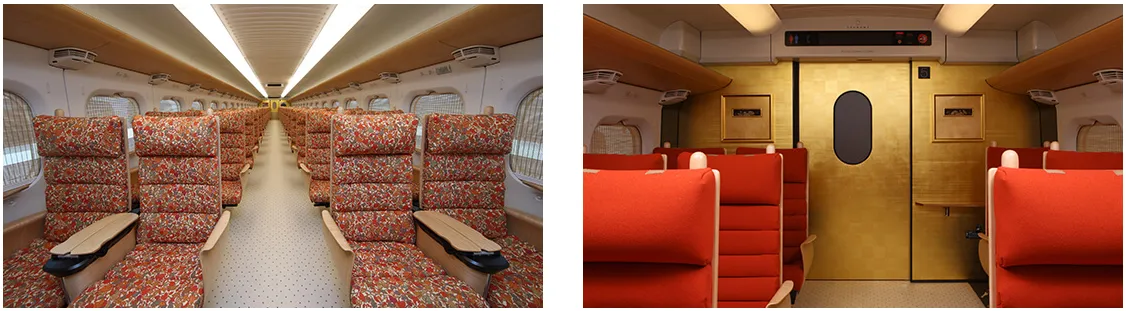
- All Cars (2x2): These are exclusive to Kyushu and famous for their "swallow" (Tsubame) motif, gold leaf walls, and camphor wood seats.There is no Green Car on the 800 Series, but the standard seats are very luxurious.
🔔Pro Tip: If you appreciate design, try to catch the 800 Series trains. They are exclusive to the Kyushu line and feature beautiful wood-rimmed seats and calligraphy-style signage.
‼️Choosing Your Seat:
-
A or E Column (Window): Best for views of Mount Aso, the Kammon Strait, and Kyushu's countryside.
-
C or D Column (Aisle): Easier for getting in/out.
-
Forward/Backward Facing: Seats automatically rotate; you cannot choose direction. Rows are usually arranged in groups of 2x2.
-
Power Outlets: Available under the armrest or window for most seats.
When booking online or at a machine, you can see the seat map and select your exact preference.
5. Travel Times & Timetable
The Kyushu Shinkansen offers one of the fastest and most reliable ways to travel across Kyushu, connecting Hakata (Fukuoka) with Kagoshima-Chuo in just over an hour on the fastest services. With frequent departures throughout the day, it’s easy to plan both short hops and long-distance journeys.
A. Typical Travel Times
The speed of your journey depends heavily on the service type (Mizuho, Sakura, or Tsubame).
|
Route |
Fastest (Mizuho) |
Mid-Tier (Sakura) |
Local (Tsubame) |
|
Hakata ↔ Kumamoto |
~32 mins |
~38 mins |
~49 mins |
|
Hakata ↔ Kagoshima-Chuo |
~1 hr 17 mins |
~1 hr 36 mins |
~1 hr 48 mins |
|
Kumamoto ↔ Kagoshima-Chuo |
~44 mins |
~50 mins |
~1 hr 05 mins |
|
Hakata ↔ Nagasaki * |
~1 hr 20 mins |
N/A |
N/A |
Times are approximate and vary slightly by service and stops.
B. Service Frequency
-
Mizuho: This is the "executive" service. It runs primarily during morning and evening peak hours (about 6-8 times per day).
-
Sakura: The workhorse of the line. You can expect 1–2 trains per hour. Most of these are "through-service" trains coming from or going to Osaka.
-
Tsubame: Operates roughly 1–2 times per hour, mostly between Hakata and Kumamoto.
C. Operating Hours (Timetable Overview)
The Shinkansen does not run 24 hours a day to allow for nightly track maintenance.
-
First Trains: Usually depart around 6:00 AM – 6:10 AM from major terminals like Hakata and Kagoshima-Chuo.
-
Last Trains:
- The last through-service from Hakata to Kagoshima-Chuo typically leaves around 10:20 PM (Mizuho) or 11:00 PM (Tsubame/Sakura variants).
-
If you are only going as far as Kumamoto, the last train from Hakata is usually around 11:30 PM.
⁉️How to Check Real-Time Schedules:
-
Google Maps or Apple Maps App: For 99% of travelers, this is the gold standard.It pulls data directly from Japanese transit APIs and tells you the platform number, which car is closest to the exit, and live delay info.
-
Smart-EX App/Website: If you want the absolute "source of truth" directly from the rail companies.
-
Japan Travel by NAVITIME App / Website: This is the most powerful app for foreign tourists.It has a specific toggle to "Prioritize JR Pass," which will automatically exclude trains you can't ride (like the Mizuho without a supplement) and provides push notifications for delays, suspended lines, or weather-related issues.
Ticketing for Kyushu Shinkansen
1. The Fare Structure
Buying a ticket for the Kyushu Shinkansen is slightly more complex than a standard train because every "ticket" is actually a combination of two different fees.
-
Base Fare (Joshaken): The cost for the distance traveled.
-
Limited Express Surcharge (Tokkyuken): The "speed" fee for using the Shinkansen tracks.
These are often printed on two separate slips of paper, or combined into one if bought at a machine. You must have both to pass through the gates.
2. How to Buy the Tickets
Buying tickets for the Kyushu Shinkansen is straightforward, with options ranging from high-tech apps to traditional counter service.
A. Online: Smart-EX (The Standard App)
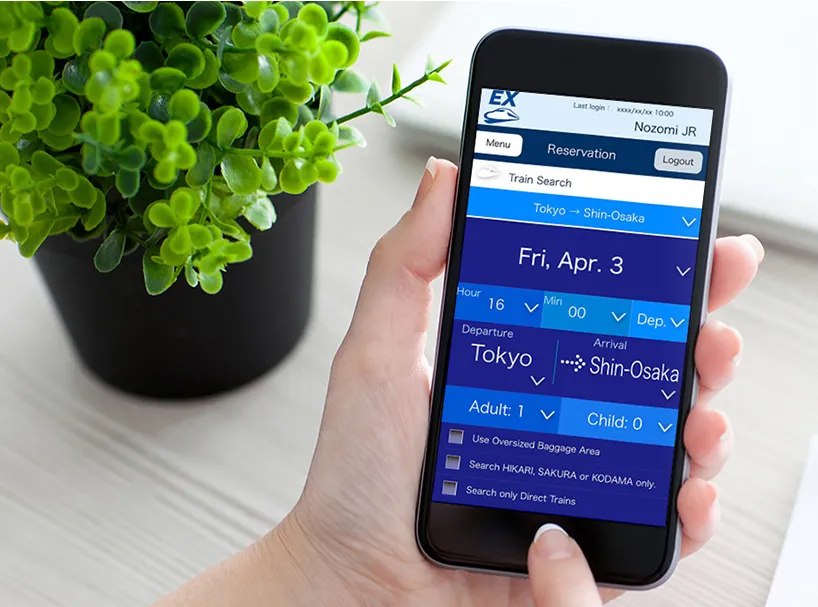
The Smart-EX app (and website) is the official tool for the Tokaido-Sanyo-Kyushu Shinkansen lines.
-
Best for: Travelers without a rail pass who want the best discounts.
-
Benefits: You can book seats on a map, get "Hayatoku" early-bird rates, and change your reservation for free up until departure.
-
Ticketless Entry: If you register a physical or digital IC card (like Suica or Pasmo) in the app, you can simply tap your phone/card at the Shinkansen gates to enter.
-
QR Codes: If you don't have an IC card, the app provides a QR code you can scan at the ticket machines to print a physical ticket.
Certain third party (such as Klook etc.) also issue Shinkansen tickets with or without seat reservations.They provide a QR code which you scan at a station kiosk to print your physical tickets.
B. At the Station: Ticket Machines
Every Shinkansen station has "Reserved Seat" vending machines (usually purple, blue, or green).
-
How to Use: Select "English" in the top right. You can choose "Reserved" or "Non-Reserved" and pay by cash or credit card.
-
Advanced Features: These machines also handle picking up tickets you bought online (via the JR Kyushu website or Smart-EX). Just bring the credit card you used for the purchase or your QR code.
C. The Ticket Office (Midori-no-Madoguchi)
If you prefer talking to a human or have a complex request (like booking a "Seat with Oversized Baggage Area"), look for the green sign with a person reclining in a seat.
-
Hakata Station: The JR Kyushu ticket office is open 7:00 AM – 9:00 PM.
-
Kumamoto/Kagoshima-Chuo: Generally open 7:00 AM – 9:00 PM.
-
⚠️Note: During peak travel times, lines can be 20–30 minutes long.
‼️Summary: Which method should you use?
|
If you want... |
Use... |
|
The cheapest price |
Smart-EX app (Book 21+ days early). |
|
To use a JR Pass |
Ticket Machines or the Official Rail Pass site. |
|
Last-minute flexibility |
Ticket Machines at the station. |
|
Special seating (Luggage/Wheelchair) |
Ticket Office or Smart-EX app. |
3. Ticket Prices
Prices vary depending on distance, seat type, and train service. Below is a comprehensive overview for typical routes.
|
Route (from Hakata) |
Non-Reserved |
Reserved Seat |
Green Car |
|
to Kumamoto |
~¥4,700 |
~¥5,200 |
~¥7,200 |
|
to Kagoshima-Chuo |
~¥10,100 |
~¥10,600 |
~¥14,500 |
|
to Nagasaki |
~¥5,600 |
~¥6,100 |
~¥8,500 |
Children's Fares:
-
Ages 6–11: 50% of the adult fare.
-
Under 6: Free (if they sit on your lap). If they need their own reserved seat, you must pay the child's fare.
4. Discount & Special Passes
1) Discounted Online Tickets (Early Bird)
If you book through the JR Kyushu Train Reservation website or the Smart-EX app, you can access "Hayatoku" fares - discounts can save you 10% to 30%:
|
Ticket Name |
Requirement |
Best For |
|
EX Hayatoku 21 |
Book 21 days in advance. |
Long-distance (e.g., Kagoshima to Osaka). |
|
EX Hayatoku 7 |
Book 7 days in advance. |
Mid-distance weekend travel. |
|
EX Hayatoku 1 |
Book by 11:30 PM the day before. |
Last-minute savings on reserved seats. |
⚠️Note: The "Smart EX Round-Trip" discount is scheduled to be phased out in March 2026. If you are traveling after March 31, 2026, plan for one-way "Hayatoku" fares instead.
2) JR Passes
Using rail passes can save money, especially for multiple rides:
|
Pass |
Coverage |
Typical Price |
|
JR Kyushu Rail Pass |
Unlimited Kyushu rides (any Shinkansen except Mizuho without restriction) |
¥16,000 (3 days) |
|
Japan Rail Pass |
Nationwide coverage including most Shinkansen |
¥33,610 (7 days, Ordinary) |
You must book your seat reservation separately at no extra cost at a ticket counter or machine before boarding. Do not board a reserved car without a seat ticket.
-
Booking at Machines: You can insert your physical rail pass into the "Reserved Seat" machines to book seats for free (up to the limit of your pass).
-
Wait in Line: You can always go to a ticket office and show your pass to an agent to get a seat reservation.
🔔Quick Tips for Buying:
-
Reserve early for holidays like Golden Week or New Year.
-
Use reserved seats if traveling with luggage or children.
-
Green Car tickets give extra comfort on long journeys.
-
Keep your ticket or QR code handy for boarding.
The Luggage Rules
The Kyushu Shinkansen is convenient for travelers with luggage, but there are specific rules to follow to ensure a smooth ride. Knowing the size limits, storage options, and reservation requirements can help you avoid fines or inconvenience.
1. The 160cm Rule (Oversized Baggage)
To determine if you need a special reservation, add the total dimensions (Length + Width + Height) of your suitcase.
|
Size (Length + Width + Height) |
Rule |
|---|---|
|
Under 160 cm |
No reservation needed. Can be placed on overhead racks. |
|
161 cm – 250 cm |
Reservation Required. This is considered "Oversized Baggage" (typical for very large check-in suitcases). |
|
Over 250 cm |
Not allowed on the train. |
2. How to Reserve Space
There is no extra fee for an oversized baggage reservation, but you must select a specific seat type when booking:
-
Seat with Oversized Baggage Area: These are the seats in the very last row of the car. You store your bag in the space directly behind your seat.
-
Seat with Oversized Baggage Compartment: These are seats that give you access to a locking cabinet located in the deck area (near the doors).
-
Self-Locking: You will need a contactless IC card (like Suica, Pasmo, or Sugoca) to lock and unlock these compartments.
-
-
Booking Methods: You can select these via the Smart-EX app, JR Kyushu website, or at Ticket Machines by choosing the "Seat with Oversized Baggage" option.
3. Important Rules & Penalties
-
The ¥1,000 Penalty: If you bring an oversized bag into the train without a reservation, the conductor will charge you a ¥1,000 fee. They will then move your bag to a designated storage area (which may be in a different car).
-
Non-Reserved Cars: You cannot bring oversized baggage into non-reserved cars (Cars 1–3). If you have large bags, you must book a reserved seat.
-
Strollers & Sports Equipment: Bicycles (in bags), strollers, and musical instruments are exempt from the reservation rule. You can bring them for free, though booking the back row is still recommended for the extra space.
4. Luggage Storage Summary
|
Bag Size |
Storage Location |
Reservation Needed? |
|
Small (Carry-on) |
Overhead Rack |
No |
|
Medium (Standard Check-in) |
Overhead Rack |
No (if under 160cm total) |
|
Large (Over 160cm total) |
Behind last row / Cabinet |
Yes (Reserved Seat only) |
|
Exempt (Strollers/Bikes) |
Behind last row / At feet |
No (but recommended) |
🔔Pro Tip: If the oversized baggage seats are fully booked on your preferred train, you may have to take a later train or use a Takkyubin (luggage delivery service) to send your bags ahead to your hotel for about ¥2,000–¥3,000.
Boarding & Etiquette Tips
-
Arrive Early: Stations are large. Arrive at least 20-30 minutes before departure if you need to pick up tickets or find your platform.
-
Find Your Car Number: Platform signs show where each car number will stop. Line up on the marked spots.
-
Queue Orderly: Wait in line and board quickly.
-
Quiet Cars: Not officially designated on Kyushu Shinkansen, but always keep noise to a minimum. Set phones to silent, talk quietly, and use headphones.
-
No Phone Calls: Move to the vestibule area between cars if you must make a call.
-
Seat Reclining: It's acceptable to recline your seat, but do it gently and consider the person behind you, especially during meal times.
-
Trash: Take your trash with you. There are no large trash bins on board or on platforms.
- Smoking: All Kyushu Shinkansen trains are strictly non-smoking. Some trains have small smoking rooms, but many newer services (and N700S models) have removed them entirely.
Common Questions
Q: Can I use the Japan Rail Pass (National) on all trains?
A: Mostly. You can ride the Sakura and Tsubame for free. However, for the Mizuho (the fastest service), you must purchase a special "Mizuho/Nozomi Supplement Ticket" at the station.If you are using a JR Kyushu Regional Pass (All Kyushu, Northern, or Southern), the Mizuho is usually included at no extra cost.
Q: Is there food and drink service on board?
A: No. As of 2024, onboard trolley sales were discontinued on most Shinkansen lines, including Kyushu. There are vending machines on some trains, but it is highly recommended to buy your "Ekiben" (station bento) and drinks at the station before you board.
Q: Is there free Wi-Fi?
A: Yes. Most trains offer "Shinkansen Free Wi-Fi." You’ll need to register with an email or social media account. While generally reliable, the signal can drop briefly when the train passes through the many tunnels in the mountainous Kyushu interior.
Q: Can I sit anywhere if I have oversized luggage with reservation?
A: No, you must sit in the specific seat you reserved (the last row with storage behind it).
Q: Can I put my oversized bag in the overhead rack?
A: No, it's unsafe and prohibited. Oversized bags must go in the designated storage area.
Q: What happens if the train is crowded and my reserved storage space is full?
A: In rare cases, staff may relocate your luggage to another secure area on the train.
Q: My suitcase is about the size I'd check on a plane. Do I need a reservation?
A: Most likely, YES. A standard checked suitcase (approx. 70-90 cm in height) will almost always exceed the 160 cm total dimension limit. You must reserve an "Oversized Luggage Seat." When in doubt, measure (L+W+H) or assume you need the reservation.
Q: What happens if I miss my reserved train?
A: Don't panic. If you have a standard "Reserved Seat" ticket and miss your train, you can board any later train on the same day and sit in the Non-Reserved section (Cars 1–3) for free. You do not need to buy a new ticket.
Q: Do the trains run during typhoons?
A: Kyushu is prone to typhoons (usually Aug–Oct). JR Kyushu is very proactive about safety; they may implement "planned suspensions" if a storm is approaching. Always check the JR Kyushu Real-Time Map if there is a weather warning.
Q: Can I choose a forward-facing seat?
A: Not manually. Seats are automatically rotated at terminal stations. When booking, some online systems and ticket machines show the direction with arrows on the seat map, but you cannot guarantee it. The seats are comfortable in either direction.
Q: Can I buy a ticket right before the train leaves?
A: Yes, but with risks. You can purchase a Non-Reserved Seat ticket and board the next train. However, during peak times, you may have to stand. For a Reserved Seat, you can try, but popular trains (especially morning/evening commutes and weekends) often sell out.