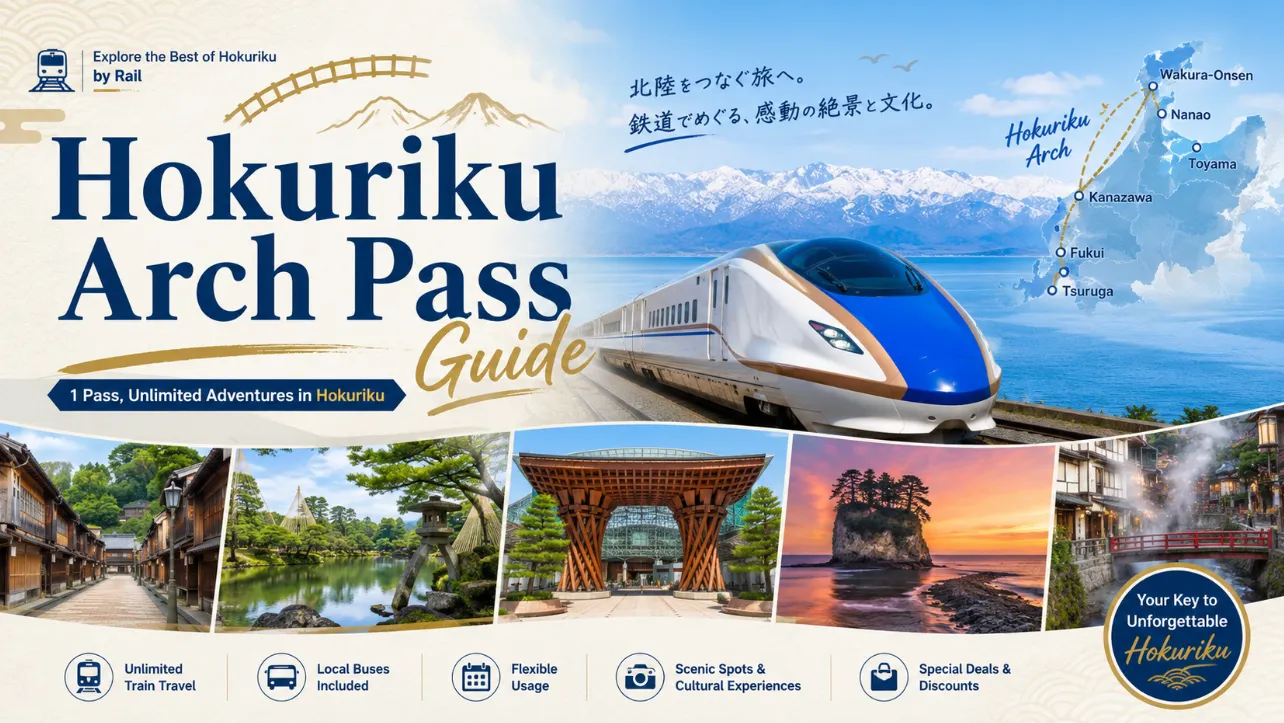
Japan’s rail network is famous for speed and efficiency, but choosing the right regional pass can make a huge difference to both your budget and your itinerary. For travelers heading beyond Tokyo and Kyoto, the Hokuriku area opens the door to samurai-era cities, alpine scenery, fresh seafood markets, and some of the country’s best onsen towns — all easily accessible by train.This guide breaks down everything international travelers need to know before using the Hokuriku rail pass — including where to buy it, how seat reservations work, which trains are covered, and whether the pass is still worth it after recent fare changes. You’ll also find practical itinerary ideas ranging from quick 5-day trips to longer 10-day journeys covering the Japanese Alps, traditional ryokan towns, and coastal destinations. Whether you’re visiting Japan for the first time or planning a return trip beyond the Golden Route, this pass can unlock a more relaxed and rewarding travel experience.
What is the Hokuriku Arch Pass?
The Hokuriku Arch Pass is a joint rail pass created by JR East and JR West, designed for foreign tourists holding a Temporary Visitor visa. It offers unlimited travel for 7 consecutive calendar days on a specific network of trains connecting Tokyo, the Hokuriku region (Nagano, Toyama, Kanazawa, Fukui), and the Kansai region (Kyoto, Osaka, Nara, Kobe).
Think of it as a scenic alternative to the Tokaido Shinkansen. Instead of rushing directly between Tokyo and Osaka, this pass takes you on the “arch” route via the Japan Sea coast—through the Japanese Alps, historic castle towns, and coastal cities.The pass is ideal for travellers looking to explore lesser-known, culturally rich destinations in central Japan without the premium cost of a nationwide Japan Rail Pass.
Core Specifications:
-
Validity: 7 consecutive calendar days (midnight to midnight).
-
Price (Effective March 14, 2026):
-
Adult (12+): ¥35,000
-
Child (6–11): ¥17,500 (Children under 6 travel free if they do not occupy a reserved seat)
-
-
Eligibility: Non-Japanese passport holders entering Japan under the "Temporary Visitor" visa status (90 days or less).
It is especially popular for:
-
Tokyo → Kanazawa → Kyoto/Osaka trips.
-
Winter snow & onsen itineraries.
-
Cherry blossom routes through central Japan.
-
Travelers wanting an alternative to the expensive nationwide JR Pass.
What's the Pass Included?
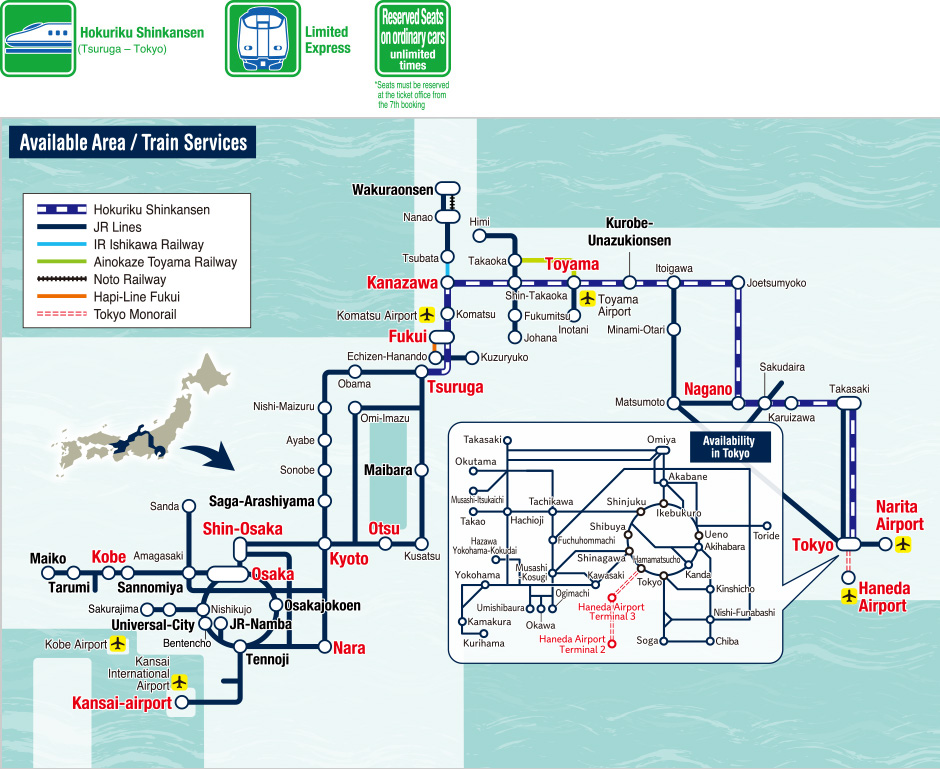
The pass allows unlimited rides on ordinary car reserved and non-reserved seats on Shinkansen, Limited Express, Rapid, and Local trains within the designated "Arch" zone.
Covered Shinkansen & Limited Express Trains
|
Train Type |
Route Covered |
Notes |
|
Hokuriku Shinkansen |
Tsuruga ↔ Tokyo |
KAGAYAKI, HAKUTAKA, ASAMA, TSURUGI services |
|
Limited Express Thunderbird |
Osaka/Kyoto ↔ Kanazawa |
Connects Kansai with Hokuriku |
|
Limited Express Haruka |
Kansai Airport ↔ Osaka/Kyoto |
Airport transfer |
|
Narita Express (N’EX) |
Narita Airport ↔ Tokyo |
Airport transfer |
|
Tokyo Monorail |
Haneda Airport ↔ Tokyo |
Airport transfer |
Reserved seats are included at no additional charge on all of the above trains. However, on trains with all-reserved seating (no non‑reserved cars), you must obtain a reserved seat ticket before boarding.
Covered Local & Rapid JR Lines
The pass also covers unlimited travel on Special Rapid, Rapid, and Local trains on JR East and JR West lines within the valid area map—including all JR local lines within Tokyo, Osaka, Kyoto, and Nara city areas.
Third-Party & Non-JR Lines (with restrictions)
The pass allows travel on the following non-JR lines, but only for transit (passing through):
|
Line |
Segment |
Restriction |
|
IR Ishikawa Railway |
Kanazawa ↔ Tsubata |
Transit only. Cannot get on/off at intermediate stations. |
|
Ainokaze Toyama Railway |
Takaoka ↔ Toyama |
Transit only. Cannot get on/off at intermediate stations. |
|
Hapi-Line Fukui |
Echizen-Hanandō ↔ Fukui |
Transit only. Cannot get on/off at intermediate stations. |
|
Noto Railway |
Nanao ↔ Wakura Onsen |
Use is permitted (full coverage). |
⚠️ Important: On the “transit only” lines, you may board at the first station, ride through the segment, and disembark at the final station—but you cannot get off at any station in between. If you do, you will need to pay the fare for that segment.
‼️ What’s New in 2026?
-
Expanded Coverage Area: The pass now covers the Chuo Line and Oito Line, providing seamless access to Matsumoto (and its famous black castle) from Tokyo and Nagano. On the western end, coverage has expanded to include the Maizuru Line and the Obama Line for travelers looking to explore "Kyoto by the Sea" or the rugged Fukui coastline.
-
Hokuriku Shinkansen Extension Integration: Full coverage is included on the Hokuriku Shinkansen all the way from Tokyo to its new southern terminus at Tsuruga, where you easily transfer to the Thunderbird Limited Express for Kyoto/Osaka.
❌ What is NOT Covered:
-
Tokaido Shinkansen (Shin-Osaka ↔ Tokyo) — the high‑speed line most tourists use between Osaka and Tokyo
-
Sanyo Shinkansen (Shin-Osaka ↔ Hakata)
-
Tohoku Hokkaido Shinkansen (Hayabusa), Akita Shinkansen (Komachi) — these require separate tickets
-
Gran Class on any shinkansen — requires an additional Gran Class ticket plus a limited express ticket. Green Car (First Class) also requires an extra ticket
How to Buy & Pick Up Your Pass?
There are two main ways to purchase the pass: online from official JR websites before arriving in Japan, or through authorized overseas travel agencies.
Option A: Official JR Websites
Buy online via the official JR-EAST Train Reservation or JR-WEST Online Train Reservation portals.
-
Pros:
-
You can book seat reservations online before arriving in Japan.
-
Fast track collection at automated Reserved Seat Vending Machines with Passport Readers (no queueing at the counters).
-
-
How to Redeem: Purchases made via official JR East/West sites can be redeemed instantly using automated ticket machines equipped with passport readers, cutting out long lines at manned ticket windows.
-
Find a ticket machine with a passport reader logo.
-
Scan the QR code from your reservation email.
-
Scan the photo page of your physical passport (must have the "Temporary Visitor" immigration stamp).
-
The machine will print your physical rail pass immediately.
-
Option B: Authorized Travel Agencies
Buy an Exchange Order (MCO) via platforms like Klook, KKday, or local travel agencies.
-
Pros: Often available with platform discounts, bundle deals, or localized payment options.
-
How to Redeem:
-
Bring your voucher and physical passport to a JR East Travel Service Center, JR West Ticket Office (Midori-no-madoguchi), or designated international travel service desks in major stations (Tokyo, Shinjuku, Kyoto, Osaka, Kansai Airport).
-
⚠️ Note: Vouchers purchased from third-party agencies cannot be redeemed at automated vending machines and require queueing at a manned service counter.
How to Use the Pass at Stations?
At Automatic Gates
On most JR lines, you can insert your Hokuriku Arch Pass into the automatic ticket gate (like a regular ticket). The gate will open and return the pass to you.
At Manned Gates
If the automatic gate does not accept the pass (e.g., at some smaller stations or on non‑JR lines), simply show the pass to station staff at the manned gate.
On Shinkansen & Limited Express Trains
-
You must have a reserved seat ticket to board trains with all‑reserved seating (e.g., Kagayaki shinkansen, most Thunderbird services).
-
For trains that have non‑reserved cars (e.g., Hakutaka, Asama, Tsurugi shinkansen), you may board non‑reserved cars without a seat reservation. However, during busy seasons, reserved seats are strongly recommended.
-
When boarding with a reserved seat ticket, insert both your pass and the reserved seat ticket into the gate (if required), or simply show both to staff.
On Local Trains
Simply insert your pass into the automatic gate (if available) or show it to the driver/conductor when exiting.
How to Reserve Seats?
Seat reservations are free and unlimited with the Hokuriku Arch Pass. Given that some trains on this route (like the ultra-fast "Kagayaki" Shinkansen,Limited Express "Thunderbird", and the "Narita Express") are fully reserved (no non-reserved cars available), reserving in advance is highly recommended.
Method 1: At Reserved Seat Ticket Vending Machines (Fastest)
-
Go to any blue/green JR Reserved Seat Ticket Vending Machine.
-
Select your preferred language and press the "Select Ticket with Rail Pass" button.
-
Insert your physical Hokuriku Arch Pass (you can insert up to 6 passes at once for group bookings).
-
Select your departure station, destination, and preferred train time.
-
Pick your seats from the digital seat map. The machine will print a separate seat ticket.
⚠️ Note: You can issue up to 6 seat reservations per pass directly at the ticket machines. For any additional seat reservations beyond the first six, you must go to a manned ticket window.
Method 2: At Manned Ticket Counters (Midori-no-madoguchi)
Show your physical pass to the station staff at any JR Ticket Office and tell them your desired train, date, and time. They will issue your reserved seat tickets on the spot.
Method 3: Online (If Purchased Directly from JR Websites)
Log in to the portal where you bought your pass, book your train times, and pick up your seat tickets at a vending machine or ticket counter alongside your main pass.
Best 5, 7, and 10-Day Hokuriku Arch Pass Itinerary
Because the pass lasts for 7 days, a 5-to-7-day itinerary maps perfectly to its validity. For a 10-day trip, you can activate the pass on Day 3 or Day 4 to cover the major long-distance travel legs.
To help you get the absolute most out of your travel, here are three custom itineraries designed to highlight the stunning scenery, cultural hubs, and historic castles made accessible by the 2026 pass expansions.
Option 1: The 5-Day "Highlights of the Arch" (Fast-Paced)
Best for travelers trying to hit the core cultural spots efficiently.
-
Day 1: Tokyo to Karuizawa & Nagano. Catch an early morning Shinkansen. Stop at Karuizawa for shopping or biking, then head to Nagano city to visit the historic Zenko-ji Temple. (Stay in Nagano).
-
Day 2: Nagano to Toyama & Kanazawa. Take the Shinkansen to Toyama for a seafood lunch by the bay, then push on to Kanazawa. Explore the Kenroku-en Garden in the evening. (Stay in Kanazawa).
-
Day 3: Exploring Kanazawa. Spend the day wandering through the Higashi Chaya geisha district and the Nomura Samurai House.
-
Day 4: Kanazawa to Fukui & Kyoto. Take the Shinkansen to Tsuruga, then catch the Thunderbird Limited Express to Kyoto. Spend the afternoon at Fushimi Inari Shrine. (Stay in Kyoto).
-
Day 5: Kyoto to Osaka. Explore Arashiyama Bamboo Grove in the morning, then take a quick local JR train down to Osaka for a night of street food in Dotonbori.
Option 2: The 7-Day "Alpine & Cultural Deep-Dive" (Standard)
The perfect match for the pass duration, leveraging the 2026 Oito/Chuo line expansions.
-
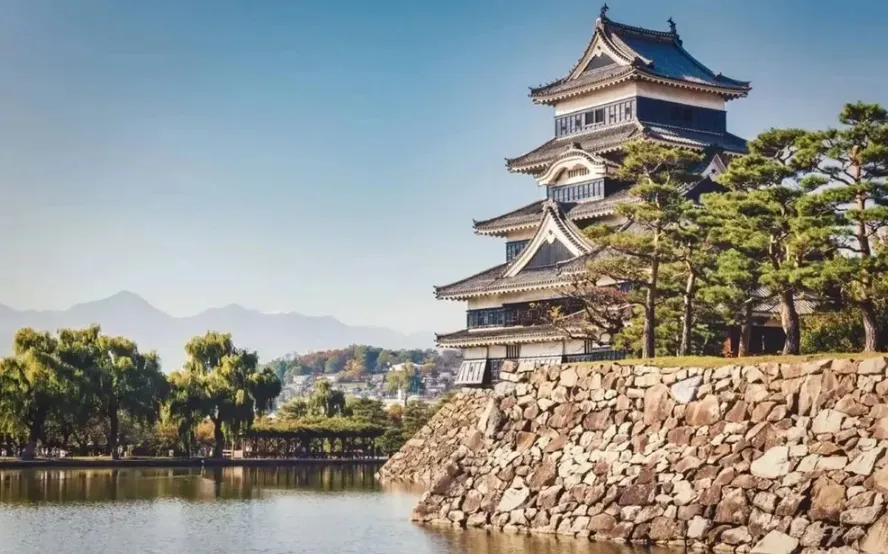
Day 1: Tokyo to Matsumoto. Use the expanded Chuo Line coverage to ride the Azusa Limited Express straight to Matsumoto. Tour the stunning black Matsumoto Castle.
-
Day 2: Matsumoto to Itoigawa & Kanazawa. Head north via the Oito line toward the coast, then catch the Hokuriku Shinkansen to Kanazawa.
-
Day 3: Kanazawa Cultural Day. Experience gold leaf crafting, the Omicho Market, and contemporary art at the 21st Century Museum.
-
Day 4: Day Trip to Fukui. Take a short train ride down to Fukui. Visit the world-class Fukui Prefectural Dinosaur Museum or the serene Eihei-ji Temple. Return to Kanazawa.
-
Day 5: Kanazawa to Kyoto. Ride the Shinkansen to Tsuruga and transfer seamlessly to the Thunderbird down to Kyoto. Spend the evening in Gion.
-
Day 6: Kyoto Imperial Sites. Visit Kinkaku-ji (Golden Pavilion), Kiyomizu-dera, and the historic streets of Higashiyama.
-
Day 7: Kyoto to Osaka & Nara. Take a day trip to Nara via the JR Nara line to see the bowing deer and the Giant Buddha at Todai-ji, ending your journey in central Osaka.
Option 3: The 10-Day "Complete Journey" (Relaxed)
Maximize a longer vacation by activating your 7-day pass on Day 3 or 4.
-
Days 1–3: Tokyo Capital Exploration. Use an IC Card (like Suica/Pasmo) to explore Tokyo (Shibuya, Shinjuku, Akihabara). Do not activate your pass yet.
-
Day 4: Pass Activation & Journey to Karuizawa. Activate your Hokuriku Arch Pass. Head to the mountain resort town of Karuizawa to enjoy nature, waterfalls, and outdoor shopping.
-
Day 5: Karuizawa to Nagano & Toyama. Travel to Nagano to see the snow monkeys at Jigokudani (via local bus from Nagano station), then head to Toyama for the night.
-
Day 6: Toyama to Kanazawa. Discover Toyama's Glass Art Museum, then take a 20-minute Shinkansen hop to Kanazawa.
-
Day 7: Kanazawa to Kyoto. Move south via the Tsuruga transfer hub into Kyoto. Enjoy a traditional Kaiseki dinner.
-
Day 8: Deep Kyoto Exploration. Dedicate a full day to the quieter, northern temple districts of Kyoto or take a side trip to Uji for matcha tasting.
-
Day 9: Kyoto to Osaka. Relocate to Osaka. Spend the day at Osaka Castle and the evening exploring the retro-futuristic Shinsekai district.
-
Day 10: Osaka to Kansai Airport. Use your pass for a final ride on the Haruka Express straight to Kansai International Airport (KIX) for your flight home.
Financial Breakdown: Is the Pass Worth It?
Let's look at the financial math of a standard 2026 route. If you were to buy separate tickets for a classic Tokyo–Nagano–Kanazawa–Kyoto–Osaka one-way itinerary, the costs would look like this:
|
Route / Ticket Type |
Train Type |
Approximate Price (Individual Ticket) |
|
Narita Airport to Tokyo |
Narita Express (N'EX) |
~¥3,070 |
|
Tokyo to Nagano |
Hokuriku Shinkansen (Kagayaki/Asama) |
~¥8,340 |
|
Nagano to Kanazawa |
Hokuriku Shinkansen (Hakutaka) |
~¥9,120 |
|
Kanazawa to Kyoto |
Shinkansen + Thunderbird Limited Express |
~¥9,000 |
|
Kyoto to Osaka |
JR Special Rapid Service |
~¥580 |
|
Osaka to Kansai Airport |
Limited Express Haruka |
~¥2,900 |
|
TOTAL INDIVIDUAL TICKETS |
~¥33,010 |
|
Pro Tips & Warnings
-
Pass works on calendar days: A 7‑day pass activated at 6:00 PM on Day 1 expires at midnight on Day 7, not 6:00 PM. Keep this in mind for long travel days.
-
Children policy: Each adult or child pass holder can accompany up to two children (ages 1–5) for free. For three or more children, additional child passes are required.
-
Seat reservations are essential on Kagayaki: The Kagayaki shinkansen between Tokyo and Kanazawa is all reserved seats only. You will not be permitted to board without a seat reservation ticket.
-
No Tokaido Shinkansen: Remember—you cannot use the Tokaido Shinkansen between Tokyo and Osaka with this pass. You must follow the Hokuriku “arch” route through Nagano/Kanazawa.
-
Value check: A round‑trip on the Tokaido Shinkansen between Tokyo and Osaka costs around 27,000 yen (non‑reserved seat). The Hokuriku Arch Pass costs 35,000 yen but includes 7 days of unlimited travel across Tokyo, Hokuriku, and Kansai — a bargain if you plan to explore multiple cities.
-
One pass only: Each traveler can only use one Hokuriku Arch Pass during a single trip to Japan. You cannot buy a second pass with overlapping validity dates.
-
Check official websites before travel: Timetables and train schedules may change seasonally. Always verify your train times using JR East’s website or JR West’s website before departure.
-
Buses are not covered: The pass covers JR trains only. Buses to Shirakawa‑go, Tateyama Alpine Route, Togakushi, or Snow Monkey Park require separate payment.
-
Keep your passport on you: JR staff may request to see your passport together with the pass to verify your Temporary Visitor status.
-
Download a train app: Use Japan Travel by Navitime or Hyperdia to plan your shinkansen and limited express connections.